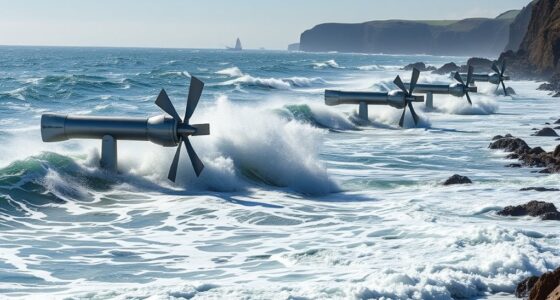
Offshore wind is getting bigger with floating turbines and giant projects that harness stronger, more consistent winds further offshore. These developments allow for deeper waters where fixed structures can’t go, creating new opportunities for clean energy. However, scaling up involves complex logistics, environmental assessments, and infrastructure investments. While larger projects boost power capacity, they also pose ecological challenges and supply chain hurdles. Keep exploring to discover how these innovations are shaping a sustainable energy future.
Key Takeaways
- Offshore wind projects are shifting from small installations to large-scale, floating turbine farms in deeper waters.
- Floating turbines enable access to stronger, more consistent offshore winds, expanding renewable energy potential.
- Mega-project developments require advanced supply chain logistics, specialized vessels, and port infrastructure.
- Environmental assessments are essential to balance habitat creation and ecological disruption from large wind farms.
- Infrastructure investments and technological innovations are critical for supporting the scale and efficiency of mega offshore wind projects.
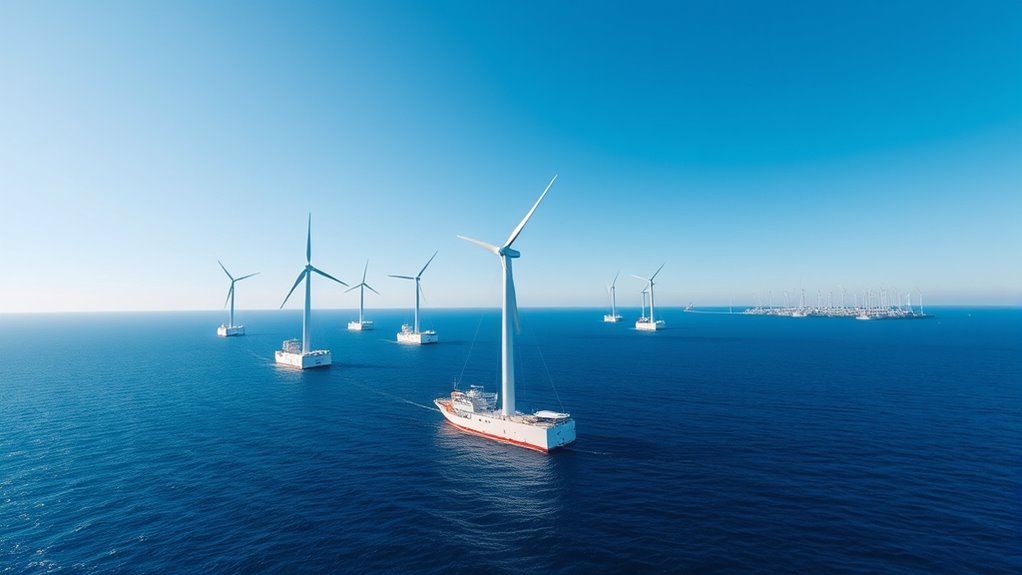
Have you noticed how offshore wind energy is rapidly expanding beyond small-scale projects? It’s no longer just about a handful of turbines off the coast; now, massive floating wind farms are taking shape, transforming the energy landscape. These large-scale developments are designed to harness stronger, more consistent winds found further offshore, opening up new possibilities for clean power generation. As these projects grow in size and scope, you’ll see a significant impact on marine habitats and the entire supply chain logistics involved in bringing these turbines from factory to deployment site.
Offshore wind is expanding with massive floating farms, impacting marine habitats and transforming supply chain logistics.
The shift toward floating turbines allows projects to be situated in deeper waters, where traditional fixed-bottom structures are impractical or too costly. But this innovation isn’t without its challenges. One critical aspect is understanding how these large installations will affect marine habitats. While offshore wind farms can provide new habitats for some marine species, they can also disrupt migration patterns, breeding grounds, and local ecosystems if not carefully planned. You need to take into account environmental assessments and ongoing monitoring to ensure that the benefits outweigh potential harm, especially as the size of these projects increases. Proper planning and adaptive management can help minimize ecological disruption while maximizing energy output.
On the logistical side, the move toward mega-projects demands a rethinking of supply chain logistics. Transporting enormous turbine components, such as blades and towers, requires specialized vessels and port facilities. The supply chain must be robust and flexible enough to handle the sheer volume and size of equipment needed for these large installations. This involves coordinating multiple stakeholders—from manufacturers and shipping companies to port authorities—ensuring that components arrive on time and meet quality standards. The complexity of logistics grows exponentially with project size, making efficient planning critical to avoid delays and cost overruns.
You’ll also need to account for the infrastructure required to support these projects once they’re operational. This includes not only the turbines themselves but also grid connection points, maintenance facilities, and logistical hubs. Building this infrastructure demands significant investment and careful coordination. As the projects expand, the supply chain needs to adapt, incorporating new technologies and streamlined processes to keep up with the scale and pace of development. Additionally, remote collaboration tools and platforms are becoming essential to facilitate coordination among geographically dispersed teams involved in these large-scale projects.
Frequently Asked Questions
How Do Floating Turbines Differ From Fixed-Bottom Offshore Turbines?
Floating turbines sit on a floating platform, allowing them to be installed in deeper waters where fixed-bottom turbines can’t go. They use dynamic anchoring systems to stay stable against waves and currents, unlike fixed-bottom turbines that are anchored directly to the seabed. This flexibility means floating turbines can access stronger, more consistent winds, making renewable energy generation more efficient and expanding offshore wind’s reach into new, deeper areas.
What Are the Main Environmental Impacts of Large-Scale Offshore Wind Projects?
Imagine you’re a gentle giant, but your steps cause ripples in the water. Large-scale offshore wind projects can disturb marine life through increased marine noise, affecting communication and navigation. Birds, like delicate dancers, might collide with turbines, risking injury or death. While these projects provide clean energy, you must weigh their environmental impacts carefully, balancing renewable benefits with protecting marine ecosystems and bird populations.
How Is the Cost of Floating Turbines Compared to Traditional Fixed Turbines?
You’ll find that floating turbines generally have a higher cost comparison than traditional fixed turbines, mainly due to advanced technology and complex installation processes. However, their economic viability improves in deep or remote waters where fixed turbines aren’t feasible. While initial investments are steeper, floating turbines open new offshore areas, potentially leading to greater long-term benefits and a broader renewable energy supply, making them an attractive option for future projects.
What Are the Logistical Challenges of Constructing Mega Offshore Wind Farms?
You face significant logistical challenges when constructing mega offshore wind farms, including logistical coordination across multiple teams and managing a complex supply chain. You must guarantee timely delivery of large turbine components, coordinate vessel schedules, and navigate harsh sea conditions. Additionally, you need to synchronize installation efforts to minimize delays, all while maintaining safety standards and mitigating environmental impacts, making the entire process highly intricate and demanding.
How Do Offshore Wind Projects Affect Local Marine Ecosystems?
While offshore wind projects gently influence marine ecosystems, you might notice some effects on marine biodiversity and noise pollution. The construction and operation can disturb habitats and temporarily increase underwater noise, which may impact marine life. However, with careful planning and technology, these projects aim to minimize ecological disruptions, preserving the health of marine ecosystems while harnessing clean energy. You can play a role by supporting environmentally responsible development.
Conclusion
You see the future of offshore wind unfolding with massive turbines, floating platforms, and mega-projects. You witness the shift from small beginnings to bold ambitions, from local efforts to global impacts. You embrace the change, the innovation, the growth. You become part of a movement that harnesses the wind, pushes boundaries, and powers a sustainable tomorrow. You realize that big ideas and bold actions are transforming energy, shaping a cleaner world, and inspiring everyone to reach higher.