
Skeleton anatomy models for students range from compact tabletop replicas to full-size teaching models with nerves, ligaments, and muscle landmarks. My best overall pick is the Ultrassist life-size model for its combination of spinal nerves, muscle points, joint ligaments, and a rolling stand. For students short on space, the Axis Scientific Mini offers a smaller study option, while the EVOTECH SCIENTIFIC model set adds torso and organ models for broader anatomy lessons. The main tradeoffs are anatomical detail versus portability, and a standalone skeleton versus a wider teaching set. Read on for the full breakdown and help matching a model to your study space and coursework.

Prime made for students and young adults
- Fast, free delivery for dorm and study essentials
- Prime Video and Amazon Music included
- Member-only deals
Key Takeaways
- Full-size models lead when whole-body proportions matter: Several 67- to 70.8-inch options provide a scale suited to demonstrations, but they need more floor space than the 17.7-inch and mini models.
- The Ultrassist model has the broadest named anatomy detail: Its listed spinal nerves, muscle insertion and origin points, and joint ligaments make it a strong study-focused pick compared with basic skeletons.
- Compact models trade scale for easier storage: The NLShan 17.7-inch and Axis Scientific Mini are better fits for desks and shared rooms, though they cannot match life-size teaching presence.
- Removable limbs serve a different purpose than fixed display models: The TYRRDE and breesky 33.4-inch models make limb-focused handling easier, while rolling-stand models are more suited to moving a full-size teaching aid.
- A wider set can be more useful than extra skeleton detail: EVOTECH SCIENTIFIC’s skeleton, torso, heart, and half-size skull set supports broader anatomy study, while the nervous-system models focus attention on structures associated with the skeleton.


| skeleton anatomy models for student | Height | Material | Weight | Stand |
|---|---|---|---|---|
| NLShan 17.7-Inch Human Skeleto | 17.7 inches | PVC | 1.08 pounds | — |
| 70.8-Inch Human Anatomy Skelet | 70.8 inches | PVC | 20 pounds | Metal stand with five wheels |
| TYRRDE 33.4-Inch Human Skeleto | 33.4 inches | Polyvinyl chloride (PVC) | 4.3 pounds | Display base with reinforced metal hardware |
| NLShan Life-Size Human Skeleto | 70.8 inches | — | — | Five-wheel rolling stand |
| Ultrassist Human Skeleton Mode | 71 inches | Washable PVC | — | Detachable rolling stand with four casters |
| EVOTECH SCIENTIFIC Human Anato | — | Plastic | — | — |
| breesky Scientific Human Skele | 33.4 inches | Metal | — | Metal stand included |
| 70.8" Life Size Human Skeleton | 70.8 inches | PVC | 8 kg | Rolling metal stand |
| 17.72-Inch Human Skeleton Anat | 17.72 inches | Hard PVC | 1.08 pounds | — |
| EVOTECH SCIENTIFIC Full-Size D | 67 inches | PVC plastic | 8.07 kg | — |
| Axis Scientific Mini Human Ske | 31 inches | Metal | 5 pounds | — |
| GIANTEX 70.8-Inch Life-Size An | 70.8 inches | Plastic | — | Mobile stand with casters and stainless steel holder |
| Axis Scientific Life Size Skel | — | — | 24.6 pounds | Pelvic-mounted rolling stand |
| Breesky Life-Size Human Skelet | 70.8 inches | Non-toxic PVC | — | — |
| Breesky Life-Size Human Skelet | 70.8 inches | Polyvinyl chloride (PVC) | 22 pounds | Five-wheel rolling stand |
More Details on Our Top Picks
NLShan 17.7-Inch Human Skeleton Anatomy Model with Movable Joints and Display Stand
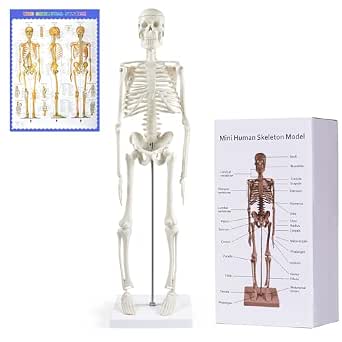
For students who need a small model they can keep on a desk, the NLShan 17.7-inch skeleton offers more hands-on movement than a static reference. Its movable shoulders, elbows, wrists, knees, and ankles let students explore basic joint motion, while the removable skull and opening jaw help with simple demonstrations. A stand and study poster add useful support without requiring the space or setup of the life-size NLShan model. The tradeoff is scale: this is better for individual review than for showing fine detail to a group. The listed dimensions also appear inconsistent with the stated height, so I would verify the actual size before ordering. Choose it for portability, not classroom-wide visibility.
Pros:- Movable joints support basic study of limb movement and posture.
- Removable skull and opening jaw provide simple head-anatomy demonstrations.
- Detachable stand and included study poster add display and reference options.
- PVC construction is described as non-toxic and easy to clean.
Cons:- The 17.7-inch scale limits visibility and fine-detail study compared with life-size models.
- Listed product dimensions appear inconsistent with the stated height, making sizing uncertain.
Best for: Students with limited desk or storage space who want an articulated model for individual study and basic posing.
Not ideal for: Instructors needing a life-size model or clearly visible bone detail for demonstrations to a group.
- Height:17.7 inches
- Material:PVC
- Joint movement:Movable shoulders, elbows, wrists, knees, and ankles
- Skull:Removable, with spring-connected opening jaw
- Base dimensions:4.75 x 4.75 inches
- Weight:1.08 pounds
- Model number:X-4
Our verdict“Choose this compact NLShan model for personal, space-conscious study, but pick a life-size option for group teaching.”
70.8-Inch Human Anatomy Skeleton Model with Muscle Insertion Points and Ligaments
This 70.8-inch model is the most instruction-focused pick here for students ready to connect bones with surrounding anatomy. Numbered bones, muscle origin and insertion points, flexible ligaments, and details of the nervous system and carotid artery give lessons more depth than the compact NLShan model or the half-size TYRRDE. Its wheeled metal stand helps reposition the full-scale figure, while the poster and color illustrations support reference during study. That detail comes with practical costs: it weighs 20 pounds, needs assembly, and takes substantial room to store. Students seeking a simple bone-only aid may find the added markings more than they need. I rank it for anatomy classes where the extra structures can be put to use.
Pros:- Life-size scale makes bones and anatomical relationships easier to demonstrate to a group.
- Numbered bones and muscle attachment points support structured identification study.
- Flexible ligaments and nervous-system details extend study beyond basic bone anatomy.
- Five-wheel stand, dust cover, illustrations, and poster support classroom use and storage.
Cons:- Its 70.8-inch height and 20-pound weight require substantial storage and floor space.
- Assembly is required before the model is ready for use.
Best for: Anatomy instructors and advanced students who need a full-size model with muscle, ligament, and selected nervous-system details.
Not ideal for: Students in small rooms or those seeking a lightweight, bone-focused model that needs little assembly.
- Height:70.8 inches
- Material:PVC
- Weight:20 pounds
- Features:Numbered bones, muscle origin and insertion points, flexible ligaments, nervous system and carotid artery details
- Stand:Metal stand with five wheels
- Included:Dust cover, color illustrations, assembly instructions, and bone identification poster
- Package dimensions:36 x 16 x 9 inches
Our verdict“Choose this model for advanced classroom demonstrations where full scale and added anatomical markings justify the space and setup.”
TYRRDE 33.4-Inch Human Skeleton Model with Removable Limbs and Display Stand
The 33.4-inch TYRRDE fills the gap between a desk-size model and a life-size classroom skeleton. Its numbered muscle attachment points give students more instructional cues than the 17.7-inch NLShan, while the detachable skull, chin, arms, and legs allow parts to be shown or examined separately. It arrives preassembled and can be disassembled and reassembled quickly, making it easier to move between a shelf and a teaching table than a full-height model on a rolling stand. The compromise is its half-size scale: it will not match life-size models for whole-body proportions or visibility in a large room. Its indoor-use recommendation also makes it a less flexible choice for outdoor displays.
Pros:- Numbered muscle markings provide more study cues than a basic compact skeleton.
- Detachable skull, chin, arms, and legs support focused demonstrations.
- Articulated joints help illustrate movement and posture.
- Preassembled design and reinforced stand hardware make setup and tabletop display straightforward.
Cons:- Half-size proportions are less suitable for full-scale anatomy demonstrations.
- Recommended for indoor use, limiting placement options.
Best for: Students or tutors who want a mid-size tabletop teaching model with detachable limbs and numbered muscle markings.
Not ideal for: Teachers needing life-size proportions for group instruction, or buyers planning to use the model outdoors.
- Height:33.4 inches
- Dimensions:9.8 x 6.6 inches
- Weight:4.3 pounds
- Material:Polyvinyl chloride (PVC)
- Features:Articulated joints and numbered muscle markings
- Detachable parts:Skull, chin, arms, and legs
- Stand:Display base with reinforced metal hardware
- Assembly:Preassembled; disassembles and reassembles in 1–3 minutes
Our verdict“Pick the TYRRDE for portable tabletop teaching with removable parts, but choose a life-size model for class-wide demonstrations.”
NLShan Life-Size Human Skeleton Anatomy Model with Nervous System and Rolling Stand
Students who want a full-scale skeleton without the extensive muscle and ligament labeling of the 70.8-inch anatomy model can turn to this NLShan life-size model. Its 206 articulated bones and naturally moving joints support whole-body study, while the detachable skull and removable skull cap give learners a direct way to examine the head. Three anatomy posters add reference material, and the five-wheel stand helps move the model around a classroom. Compared with the specialized model with muscle insertion points and ligaments, this one puts more emphasis on the articulated skeleton itself rather than a broad set of labeled soft-tissue structures. It still demands room, weighs 21.6 pounds, and requires assembly, so it is a classroom or dedicated study-space choice rather than a casual desktop aid.
Pros:- Full-size model with 206 articulated bones supports whole-body study.
- Detachable skull and removable skull cap allow focused examination of the head.
- Five-wheel rolling stand makes repositioning easier in a classroom.
- Three included posters provide additional anatomy reference.
Cons:- Large dimensions and 21.6-pound weight require substantial storage space.
- Assembly is required before use.
- Its feature set is less focused on labeled muscle and ligament detail than specialized alternatives.
Best for: Students and instructors who need a full-size articulated skeleton with an accessible skull and classroom mobility.
Not ideal for: Buyers with limited storage or students who need explicit muscle, ligament, and nervous-system labeling as their primary study aid.
- Height:70.8 inches
- Bones:206 articulated bones
- Skull:Detachable with removable skull cap
- Stand:Five-wheel rolling stand
- Included:Three anatomy posters
- Package dimensions:33.25 x 15.25 x 10 inches
- Item weight:21.6 pounds
- Manufacturer:NLShan
Our verdict“Choose this NLShan model for full-scale articulated bone study and skull access, but select a more specialized model for muscle and ligament instruction.”
Ultrassist Human Skeleton Model, Life Size Anatomical Skeleton Replica with Spinal Nerves, Muscle Insertion and Origin Points, Joint Ligaments, Includes Rolling Stand
The Ultrassist 71-inch skeleton suits students whose lessons extend beyond identifying bones. Spinal nerves, muscle origin and insertion points, and joint ligaments provide more connected anatomical context than the bone-focused NLShan life-size model. Its removable calvarium adds a useful skull study feature, while realistic joint articulation and a four-caster stand support demonstrations and repositioning. Washable PVC is practical for repeated educational use. This level of detail makes the model a stronger fit for a dedicated classroom or clinic than for a student who only needs a simple skeleton at home. At 25.8 pounds, it is the heaviest option in this group, and assembly is required; it is less convenient to move between locations than the smaller TYRRDE tabletop model.
Pros:- Full-size scale combines bone study with spinal nerve and joint detail.
- Muscle origin and insertion points connect skeletal anatomy to muscle attachment.
- Four-caster rolling stand supports repositioning during instruction.
- Washable PVC is suited to repeated handling and educational use.
Cons:- At 25.8 pounds, it is cumbersome to transport between classrooms or locations.
- Assembly is required before use.
- Its full-size footprint is a poor fit for limited storage space.
Best for: Anatomy educators and students who need life-size bone study alongside spinal nerves, muscle attachment points, and joint ligaments.
Not ideal for: Students seeking a compact, lightweight model for occasional home review or frequent transport between locations.
- Height:71 inches
- Material:Washable PVC
- Item weight:25.8 pounds
- Anatomical details:Spinal nerves, muscle insertion and origin points, and joint ligaments
- Skull:Removable calvarium
- Stand:Detachable rolling stand with four casters
- Package dimensions:38.1 x 18.1 x 11.4 inches
- Manufacturer:Ultrassist
Our verdict“Choose Ultrassist for detailed, full-size instruction that includes nerves and muscle attachments, but skip it if portability or compact storage matters most.”
EVOTECH SCIENTIFIC Human Anatomy Model Set with Skeleton, Torso, Heart, and Half-Size Skull
For students learning how the skeleton fits into broader anatomy, this set offers more range than a standalone model. It pairs a 17.7-inch skeleton with a torso, heart, and half-size skull with brain, so a learner can compare several structures without sourcing separate teaching aids. The illustrated guides and manuals give each model a study purpose, while the carrying case suits students who need to store or transport the set. Compared with the 17.72-inch movable skeleton, this is less focused on posing the limbs but provides three additional anatomy models. The tradeoff is scale: these pieces are compact rather than life-size, which limits visibility in group demonstrations, and some bases may be plastic. I’d choose it for varied individual study, not as a room-filling classroom reference.
Pros:- Four models cover several body systems in one set.
- Illustrated guides and individual manuals support self-directed study.
- Carrying case helps with storage and transport.
- Hand-painted anatomical details add visual cues.
Cons:- Small models offer less detail and visibility than full-size classroom skeletons.
- Some bases may be plastic, which may feel less substantial.
Best for: Students aged 14 and up who want a portable study set spanning the skeleton, torso, heart, and brain.
Not ideal for: Teachers who need a large skeleton visible across a classroom or students seeking full-size bone detail.
- Brand:EVOTECH SCIENTIFIC
- Included models:Human body, skeleton, heart, and half-size skull with brain
- Skeleton height:About 17.7 inches
- Torso height:About 11 inches
- Heart height:About 8 inches including base
- Skull size:About 3.5 inches
- Material:Plastic
- Age range:14 years and up
- Included accessories:Carrying case, anatomy brochure, skeleton chart, heart manual, and skull manual
Our verdict“Choose this set if you want a portable, multi-system introduction to anatomy rather than a single large skeleton model.”
breesky Scientific Human Skeleton Model for Anatomy, 33.4″ Skeleton Model with Metal Stand, Removable Arms & Legs for Student Study, Halloween Decor, Manual Included
The breesky stands between desktop minis and full-size classroom skeletons, making it a practical middle ground for student demonstrations. At 33.4 inches tall, it is easier to store than the 70.8-inch JVVMNJLK model, yet its articulated joints and removable limbs give students more to manipulate than a small fixed display. The removable calvarium also helps when lessons cover the skull’s interior. A metal stand supports upright display, and the listing describes assembly as quick without complex tools. The tradeoff is that this is still a half-life-size model, so small structures are harder to inspect closely and it will not match the presence of a full-size teaching skeleton. Its metal construction is also described as heavy, and it needs more space than a desktop model such as the 17.72-inch skeleton.
Pros:- Articulated joints support posture and movement demonstrations.
- Removable arms, legs, and calvarium allow closer study of separate structures.
- Metal stand provides a stable display base.
- Assembly is described as quick and requiring no complex tools.
Cons:- Half-life-size scale limits close inspection of smaller anatomical details.
- Requires more storage and display room than a desktop skeleton.
- Metal construction is described as heavy.
Best for: Students or educators who want a movable, medium-size skeleton for small-group demonstrations and accessible storage.
Not ideal for: Buyers with very limited display space or anatomy programs that need a life-size reference.
- Brand:breesky
- Height:33.4 inches
- Material:Metal
- Stand:Metal stand included
- Movable features:Fully articulated joints
- Removable parts:Arms, legs, and calvarium
- Model number:85cm-3
- Included accessory:Manual
Our verdict“Pick this model for hands-on demonstrations when a desktop skeleton feels too small but a life-size unit is impractical.”
70.8″ Life Size Human Skeleton Anatomy Model – Muscle Insertion & Ligaments
For students moving beyond bone names, this life-size model adds visible muscle origins and insertions, flexible ligaments, and nervous-system details. Those markings give lessons a wider scope than the EVOTECH SCIENTIFIC 67-inch skeleton, whose listed components emphasize bones and include a poster instead. A removable skull cap, movable jaw, detachable teeth, and hinged limbs create several ways to discuss structure and movement. The rolling metal stand and dust-proof cover also help a school move and store a large display. The tradeoff is its footprint: at 70.8 inches tall and 22 inches wide, it needs a dedicated display area, and its 8 kg weight can complicate lifting during assembly despite the wheels. Students seeking a simple bone-identification model may find its extra anatomical markings more than they need.
Pros:- Muscle attachment markings and flexible ligaments extend study beyond basic bone identification.
- Life-size scale supports classroom demonstrations.
- Movable jaw and detachable skull components provide additional teaching access.
- Rolling stand and dust-proof cover help with movement and storage.
Cons:- Large dimensions require substantial floor and storage space.
- The 8 kg weight may make assembly and lifting difficult.
- Multiple anatomical markings may be unnecessary for introductory bone study.
Best for: Anatomy students and educators who need a life-size model that connects bones with muscle attachments, ligaments, and selected nervous-system structures.
Not ideal for: Beginners with limited storage space or buyers looking for a compact, bone-only study aid.
- Brand:JVVMNJLK
- Height:70.8 inches
- Width:22 inches
- Weight:8 kg
- Material:PVC
- Anatomical markings:Muscle origins and insertions, numbered bones, flexible joint ligaments, nervous system, and carotid artery
- Stand:Rolling metal stand
- Included components:Learning posters, assembly instructions, and dust-proof cover
Our verdict“Choose this model for advanced, life-size demonstrations that link the skeleton to muscle attachments and ligaments.”
17.72-Inch Human Skeleton Anatomy Model with Movable Arms and Legs
This model prioritizes a small footprint and basic movement, making it easier to keep near a study desk than the 33.4-inch breesky skeleton. Its 17.72-inch height and 1.08-pound listed weight suit students who need a portable visual reference rather than a full classroom display. Movable arms and legs let learners adjust poses while reviewing bone placement, and the hard PVC construction is intended for study, teaching, and art reference. Compared with the EVOTECH SCIENTIFIC four-model set, this one focuses entirely on the skeleton instead of spreading attention across the torso, heart, and skull. That focus comes with limits: it has no listed stand, guides, or removable skull components, and its small size restricts visibility for group teaching. Assembly is also required.
Pros:- Compact height fits desk and shelf displays.
- Movable arms and legs allow basic pose adjustment.
- Hard PVC construction is suited to repeated handling and display.
- Light listed weight makes it easier to move than larger models.
Cons:- Small scale limits detail visibility during group demonstrations.
- Assembly is required.
- No stand, manuals, or additional anatomy models are listed.
Best for: Students who want a lightweight, poseable skeleton for an individual desk, small study area, or art reference.
Not ideal for: Educators teaching groups who need a large model, or learners seeking guides and multiple anatomy models in one purchase.
- Height:17.72 inches
- Dimensions:4.72 x 4.72 x 17.72 inches
- Weight:1.08 pounds
- Material:Hard PVC
- Movable parts:Arms and legs
- Model number:gj001
- Suggested uses:Anatomy study, classroom demonstrations, art reference, and display
Our verdict“Choose this compact model for personal study and basic posing when a full-size classroom skeleton would be impractical.”
EVOTECH SCIENTIFIC Full-Size Disarticulated Human Skeleton Anatomy Model, 67-Inch
This full-size EVOTECH SCIENTIFIC model is aimed at students who need to examine individual bones, not just view a posed skeleton. Its 1:1 scale gives anatomical structures a more realistic size than the 33.4-inch breesky, while the disarticulated hand and foot components add a useful close-study element. A laminated bone-identification poster can support self-guided review. Compared with the 70.8-inch JVVMNJLK model, this one is more focused on skeletal anatomy and does not list muscle, ligament, or nervous-system markings. That narrower scope suits bone study but offers less help for lessons that connect bones to surrounding structures. The main caution is assembly: the ribs and thoracic cartilage are not designed to be assembled without specific tools, and disarticulated parts do not demonstrate joint movement.
Pros:- Full-size 1:1 scale provides a realistic anatomical reference.
- Articulated and disarticulated hand and foot components support close study.
- Laminated poster identifies bones for review.
- Includes major skeletal components such as the skull, spine, pelvis, hyoid, and coccyx.
Cons:- Ribs and thoracic cartilage are not designed for assembly without specific tools.
- Disarticulated parts do not demonstrate joint movement.
- At 8.07 kg, the full-size model may be cumbersome to move.
Best for: Students studying bone names and skeletal structure who want full-size scale plus separate hand and foot components.
Not ideal for: Buyers who need an easily posed demonstration skeleton or a model with muscle and ligament markings.
- Brand:EVOTECH SCIENTIFIC
- Height:67 inches
- Scale:1:1, full size
- Material:PVC plastic
- Weight:8.07 kg
- Included components:Skull, spine, pelvis, hyoid bone, coccyx, and articulated and disarticulated hand and foot
- Study aid:Laminated bone-identification poster
- Assembly note:Ribs and thoracic cartilage are not designed for assembly without specific tools
Our verdict“Choose this full-size model for bone identification and close study, but select a more articulated option for movement demonstrations.”
Axis Scientific Mini Human Skeleton Model with Metal Stand
For students who need a model that fits on a desk, the 31-inch height is the main advantage: it gives joints and removable parts room to demonstrate anatomy without taking up the floor space required by the life-size options. The detachable arms, legs, and skull cap support hands-on review, while the included labeled study guide gives learners a reference for anatomical landmarks. Compared with the GIANTEX 70.8-Inch Life-Size Skeleton, this Axis model is easier to store and keep within reach, but it cannot show anatomy at full human scale. Its metal stand and three-year warranty add practical reassurance for regular student use. Choose it for focused desk study; skip it if your lessons depend on full-size demonstrations or group viewing.
Pros:- Removable arms, legs, and skull cap support hands-on study.
- Compact height fits desks and crowded study spaces.
- Includes a metal stand and full-color guide with labeled landmarks.
- Three-year warranty.
Cons:- Smaller scale limits life-size proportion demonstrations.
- A compact model may be harder to view during group instruction.
Best for: Students studying at a desk or in a small room who want removable parts and a study guide without a floor-standing model.
Not ideal for: Teachers demonstrating full-size proportions to a class, since this 31-inch model is much smaller than life-size alternatives.
- Height:31 inches
- Dimensions:12 x 31 x 9 inches
- Weight:5 pounds
- Material:Metal
- Joints:Articulated
- Removable parts:Arms, legs, and skull cap
- Included:Metal stand and full-color study guide
- Warranty:3 years
Our verdict“Choose this Axis model for hands-on anatomy practice in a limited study space, but choose a life-size option for classroom-scale demonstrations.”
GIANTEX 70.8-Inch Life-Size Anatomical Skeleton Model with Mobile Stand
The GIANTEX suits students who need life-size proportions but also expect to move a teaching model between study areas. Its caster-equipped stand makes repositioning simpler than with a desk model such as the Axis Scientific Mini Skeleton, and detachable limbs, a movable jaw, and a removable head cover provide useful points for practical review. The wipe-clean plastic is straightforward to maintain in a shared indoor learning space. The tradeoff is that it takes up considerably more room than compact models, and its feature set is focused on core skeletal study rather than the extra learning materials supplied with the Axis Scientific Life Size Skeleton, which includes guides and numbered stickers. The listed weight of 0.27 g appears implausible, so buyers should not rely on it when planning handling or setup.
Pros:- 70.8-inch life-size format shows human-scale proportions.
- Detachable arms and legs, movable jaw, and removable head cover support study.
- Wheeled stand makes indoor repositioning easier.
- Plastic construction can be wiped clean.
Cons:- Large footprint requires dedicated floor and storage space.
- Product data lists an unusually low weight of 0.27 g, making handling expectations unclear.
- Includes no study guides or posters in the supplied product details.
Best for: Students or instructors who need a full-size skeleton that can be rolled between indoor teaching or study spaces.
Not ideal for: Learners with limited floor or storage space, or buyers who need a dependable listed weight for planning setup and transport.
- Height:70.8 inches
- Dimensions:21 x 14.5 x 70.8 inches
- Material:Plastic
- Features:Detachable arms and legs, movable jaw, removable head cover
- Stand:Mobile stand with casters and stainless steel holder
- Care:Wipe clean
- Recommended use:Indoor
- Listed item weight:0.27 g
Our verdict“Pick the GIANTEX for a mobile, full-size teaching model, but favor the Axis Scientific life-size option if built-in study materials matter more.”
Axis Scientific Life Size Skeleton Model for Anatomy Study
This Axis Scientific model is the strongest fit for students who want a full-size skeleton paired with structured learning aids. Its 206-bone, fully articulated design supports movement demonstrations, while three study guides and 189 numbered stickers give learners a way to label and review anatomy rather than relying on the model alone. The pelvic-mounted rolling stand adds mobility, and the dust cover helps protect a model that may remain set up between sessions. Compared with the Breesky Life-Size Skeleton with Three Posters, this option provides more direct labeling support, though the Breesky is also life-size and includes visual reference posters. The Axis model’s 62-inch listed dimension and 24.6-pound weight mean it needs room and may be awkward to handle off its stand.
Pros:- Fully articulated 206-bone design supports movement demonstrations.
- Three guides and 189 numbered stickers provide structured labeling practice.
- Pelvic-mounted rolling stand aids repositioning.
- Includes a dust cover and a three-year warranty.
Cons:- Full-size dimensions require substantial space.
- At 24.6 pounds, it is heavy to move when not using the stand.
- More extensive study materials may be unnecessary for students who only need a visual reference.
Best for: Anatomy students who want a full-size articulated model with labeling tools and study guides for independent review.
Not ideal for: Students in small rooms or those who need a lightweight model that can be carried frequently without its stand.
- Dimensions:10 x 14 x 62 inches
- Approximate height:About 5 feet 6 inches
- Weight:24.6 pounds
- Bones:206
- Joints:Fully articulated
- Study materials:3 study guides and 189 numbered stickers
- Stand:Pelvic-mounted rolling stand
- Warranty:3 years
Our verdict“Choose this Axis model for full-size, label-focused self-study, especially if you will use the included guides and stickers.”
Breesky Life-Size Human Skeleton Model with Nervous System, Rolling Stand, and 3 Posters
The Breesky combines a 70.8-inch, 206-bone skeleton with three reference posters, making it a useful choice for students who want a standing model and visual material to consult nearby. Movable joints and a detachable skull cap allow more hands-on exploration than a fixed display, while the rolling stand helps reposition the 22.4-pound unit. Compared with the Axis Scientific Life Size Skeleton, this Breesky emphasizes poster-based reference rather than numbered stickers and multiple study guides, so it may suit a classroom or shared study area better than structured self-quizzing. Its washable PVC is practical for regular handling, but the large format needs storage space, and installation and removal add setup work. The product title mentions a nervous system, while the supplied feature details focus on bones and do not specify its extent.
Pros:- Life-size model represents 206 articulated bones.
- Movable joints and detachable skull cap support hands-on study.
- Includes a rolling stand and three reference posters.
- Non-toxic PVC is washable.
Cons:- Large dimensions require considerable storage space.
- Installation and removal add setup effort.
- Supplied feature details do not describe the nervous-system component named in the title.
Best for: Students and instructors who want a full-size articulated skeleton with posters for visual reference in a classroom or dedicated study area.
Not ideal for: Learners with limited storage space or buyers specifically seeking documented nervous-system detail or self-labeling materials.
- Height:70.8 inches
- Bones:206 articulated bones
- Material:Non-toxic PVC
- Features:Movable joints and detachable skull cap
- Included:Rolling stand and 3 posters
- Package dimensions:33 x 15.25 x 9.75 inches
- Item weight:22.4 pounds
- Model number:170-01
Our verdict“Choose this Breesky if posters and a washable, full-size model suit your teaching space, but select the Axis Scientific model for more specified labeling tools.”
Breesky Life-Size Human Skeleton Anatomy Model with Rolling Stand and 3 Posters
This Breesky is a straightforward pick for students who want a 70.8-inch skeleton with 206 articulated bones, a rolling stand, and posters without the extra labeling kit found with the Axis Scientific Life Size Skeleton. Detachable and movable joints support practical anatomy review, while the five-wheel stand gives the full-size model a mobile base for moving around a classroom or study room. Its wipe-clean PVC is suited to frequent handling. Compared with the Breesky model with nervous-system wording, this listing describes the skeletal features more directly, but it does not specify a detachable skull cap. The included posters offer visual reference, though students seeking guided labeling or more detailed study materials may prefer the Axis option. Assembly is required, and the large footprint makes this a poor fit for cramped rooms.
Pros:- Life-size model has 206 articulated bones.
- Detachable and movable joints support hands-on study.
- Five-wheel rolling stand helps move the model.
- Includes three posters and wipe-clean PVC construction.
Cons:- Large footprint needs a dedicated display or study area.
- Assembly is required.
- Supplied details do not specify a detachable skull cap or labeling guides.
Best for: Students or teachers who want a full-size, movable skeleton with posters for display and basic hands-on anatomy study.
Not ideal for: Students with limited floor space or those who need included numbered labels, study guides, or a specified detachable skull cap.
- Height:70.8 inches
- Number of bones:206 articulated bones
- Material:Polyvinyl chloride (PVC)
- Stand:Five-wheel rolling stand
- Included components:Skeleton model and 3 posters
- Weight:22 pounds
- Intended use:Anatomy study and display
Our verdict“Choose this Breesky for a simple full-size classroom display with posters, but pick the Axis Scientific model for more structured labeling practice.”

How We Picked
I compared these 15 skeleton anatomy models by the features that change how a student can study: model scale, named anatomical detail, removable or movable parts, stand design, and included learning aids. I also looked at whether each option fits a desk, a shared study area, or a classroom where a model may need to be moved or shown to a group. Product names and supplied descriptions were the basis for these comparisons; where details were not specified, I did not assume a particular feature or level of anatomical accuracy.
The ranking favors models that combine useful study detail with practical handling, rather than treating full size or a long feature list as an automatic win. The Ultrassist ranks first for its specifically listed nerves, muscle landmarks, ligaments, and rolling stand. Compact models, removable-limb options, broader anatomy sets, and other full-size models earn distinct places for different student needs, while tradeoffs such as storage demands and narrower study scope remain part of the judgment.
Factors to Consider When Choosing Skeleton Anatomy Models For Students
Before choosing a skeleton, match the model to the way it will be used—not just the amount of detail named on its product listing. These broader factors can help you avoid buying a model that is hard to store, awkward to handle, or too limited for your course.
Match the Model Scale to Your Study Space
A full-size skeleton can make proportions and spatial relationships easier to discuss, but it also claims permanent floor space and can be awkward in a shared room. Measure the model’s intended standing area, including room to walk around it and extend its limbs, rather than checking height alone. Compact models suit desks, dorm rooms, and students who need to put their materials away after studying. The common mistake is choosing a life-size model for its presence without planning where it will live between lessons. If you expect to carry the model between home and class, a smaller option may be more useful than a larger replica that rarely leaves its stand.
Choose Detail That Matches Your Course
Introductory study may call for clear bone shapes and movable joints, while advanced coursework may benefit from visible nerves, ligaments, or muscle attachment landmarks. A feature list only helps if those structures support the topics you need to learn; more labeled systems can also make a model visually busy. Check whether your course emphasizes skeletal identification, joint function, or relationships between bones and other systems. Students who need a broader anatomy overview may get more from a set that includes torso and organ models than from a skeleton with added detail in only one area. Avoid paying extra for structures you will not use, but do not expect a basic skeleton to teach soft-tissue relationships on its own.
Think Through Removable and Movable Parts
Movable joints can help connect bone structure to basic movement, while removable limbs may make a particular area easier to inspect or demonstrate. Each moving or detachable part also creates another point that can loosen, go missing, or need careful handling. For frequent classroom demonstrations, consider who will assemble and store the pieces and whether the parts can be kept together. A model used mainly for visual reference may not need the same degree of disassembly as a hands-on study aid. Do not treat removability as a universal upgrade: choose it when handling parts supports your learning goals.
Evaluate Stand and Mobility for Your Setting
A stand affects more than presentation: it influences where the skeleton can be placed, how easily it can be moved, and whether students can approach it from different angles. Rolling stands can help in classrooms or shared teaching spaces, but they need clear floor routes and somewhere safe to park. A tabletop model avoids that floor-space demand, though its smaller scale limits group visibility. Check the supplied description for the stand type rather than assuming every full-size option rolls or has the same support. For home use, a stable location may matter more than mobility; for a teaching lab, repositioning may be worth prioritizing.
Decide Whether You Need a Skeleton or a Broader Set
A standalone skeleton keeps the study focus on bones and joints, while a multi-model set can connect skeletal anatomy with organs and other body systems. The wider set is not automatically a better teaching choice if your immediate work centers on bone identification. Conversely, a skeleton alone may leave gaps when an assignment asks how the skeletal system relates to the torso or organs. Think about the next course or unit as well as the current one, especially if storage is limited. A broader set makes sense when it replaces several separate teaching aids, but only if you have room and a use for its additional components.
Check Handling and Storage Before Committing
Students often focus on visible anatomy and overlook how a model will be assembled, cleaned, and stored. Ask whether the listing describes a stand, a manual, or any included posters, then confirm those items suit your space and study routine. Removable parts call for an organized storage plan, while a full-size model may need a dedicated corner even when not in use. Avoid assuming that a larger model is automatically more durable or that an included visual aid replaces course materials. When details such as assembly steps or material care are not specified, seek clarification before relying on the model for frequent handling.
Frequently Asked Questions
Is a full-size skeleton worth choosing over a tabletop model for studying at home?
Choose full size if your coursework depends on whole-body proportions, demonstrations, or viewing the model from several feet away. A tabletop model can still support close study of bone shapes and joints while taking less room and being easier to store. The tradeoff is not simply detail: it is also how often you can keep the model available for use. Measure the space you can give it and consider whether the model needs to move between rooms. If space is tight, a compact model you can reach regularly may serve you better than a life-size one that stays packed away.
Do students need a model with nerves, ligaments, or muscle insertion points?
Those features are most useful when your lessons cover how bones relate to nerves, joints, and muscle attachment sites. For basic bone identification, a simpler model may keep attention on the structures you are learning without adding visual complexity. The Ultrassist and nervous-system options in this roundup offer more specific detail than a plain skeleton, but the named features vary by product. Compare the listing against your syllabus rather than assuming that every model labeled anatomical shows the same structures. If the details are not clearly listed, confirm them before buying for a particular assignment.
Should I choose removable limbs for a student model?
Removable limbs can help with focused demonstrations and make it easier to inspect an area independently. They are less useful if you mainly need a standing visual reference, and detachable pieces require a place to store them when they are not attached. Consider how often you will handle the model and whether classmates or younger learners will use it as well. A movable-joint model may offer enough interaction for some lessons without the extra responsibility of separate parts. Choose removability when it supports a specific study activity, not just because it sounds like an added feature.
When does a skeleton-and-torso set make more sense than a detailed skeleton?
A set that includes a skeleton, torso, heart, and skull can suit students studying several body systems or preparing demonstrations across different topics. A skeleton with added nerves, ligaments, or muscle landmarks is a more focused tool for skeletal relationships and joint study. Think about whether your assignments require connections between bones and organs or a closer look at skeletal structures themselves. The broader set may take more storage space and split attention across components. If your course is centered on bones, a specialized skeleton can be the more direct choice.
What should I verify before buying a full-size model for a classroom?
Confirm the model’s height, the type of stand included, and whether the description identifies rolling or stationary support. Check the room layout for storage space and a route wide enough to move the model if it has casters. If students will handle it, look for clear information about removable components and assembly rather than assuming the product is ready for frequent demonstrations. Also confirm which anatomical features are actually included, since full size alone does not guarantee advanced detail. When the listing leaves a practical point unclear, ask the seller before making the model part of a lesson plan.
Conclusion
For a single study model that balances anatomical detail and classroom mobility, I recommend the Ultrassist life-size skeleton as the best overall pick. The best value for space-conscious students is a compact option such as the NLShan 17.7-inch model or Axis Scientific Mini; choose between them by checking the specific handling and stand details that matter to you. For a best premium-style teaching setup, consider the EVOTECH SCIENTIFIC set if you will use its torso, heart, and half-size skull alongside the skeleton. Beginners who want an approachable, smaller model can start with a tabletop option, while students studying limb structure should look closely at the TYRRDE or breesky 33.4-inch removable-limb models. For broader system study, choose the set; for nervous-system detail, compare the two Breesky and NLShan nervous-system models with Ultrassist’s listed features. Match the final choice to your course, storage space, and how often you expect to handle the model.