

Prime made for students and young adults
- Fast, free delivery for dorm and study essentials
- Prime Video and Amazon Music included
- Member-only deals
A field guide that begins in the dark
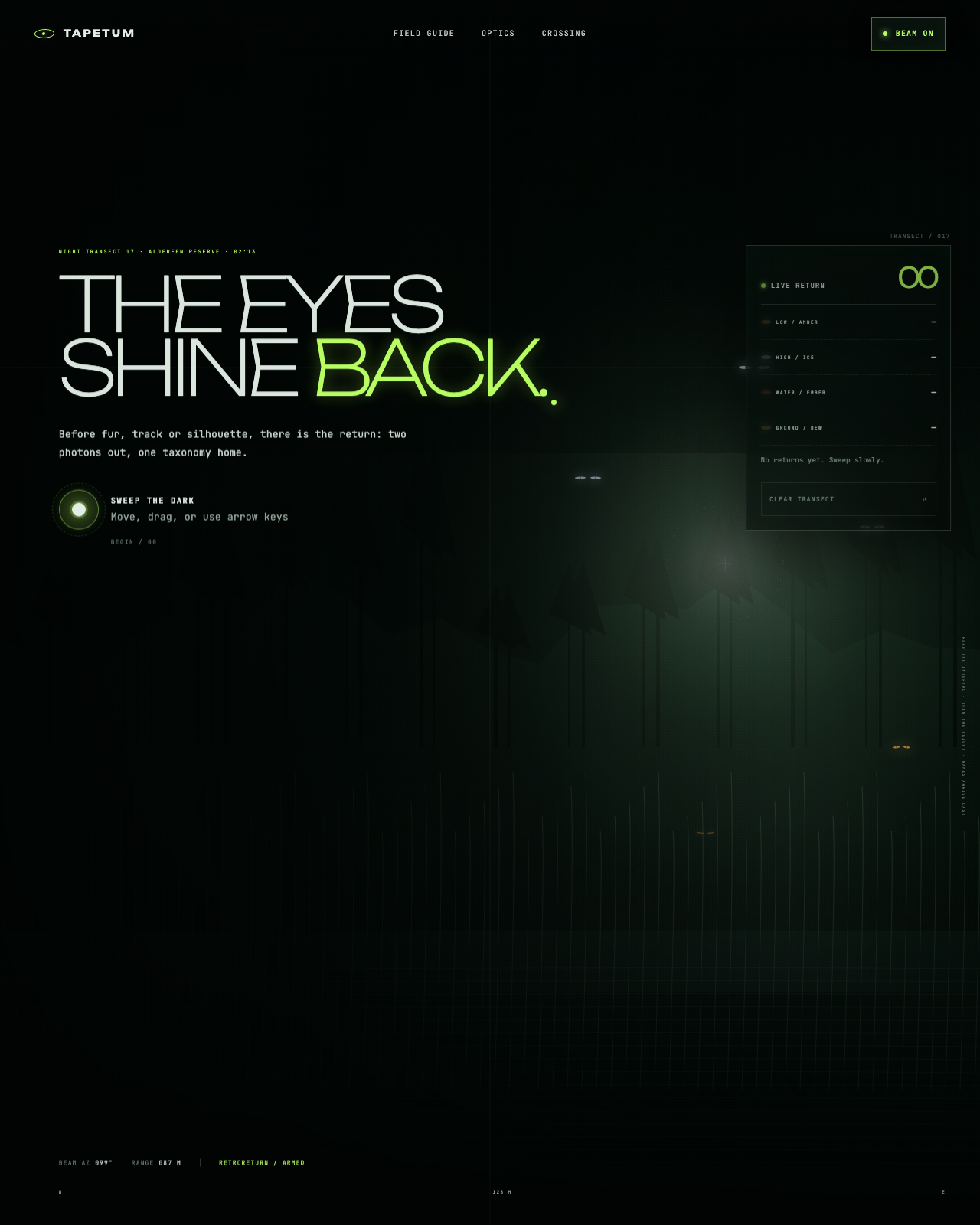
“Tapetum Lucidum — Night Survey 17” is an AI-built exhibition room about eyeshine and the hidden life of a wetland. Its premise is a reversal: instead of showing visitors labelled animals, it gives them a moving beam and lets reflected light become the guide. The room belongs to a fictional survey, not a real wildlife organization. Its invented fieldwork is the frame for an educational encounter with nocturnal optics.
The signature move is the beam itself. Sweep it across a near-black landscape and colored returns begin to resolve at different heights. The wetland first appears empty; gradually, the visitor learns to read it. The darkness feels inviting rather than ominous, turning discovery into a quiet act of attention.
As an affiliate, we earn on qualifying purchases.
Reading the returns
The visual system treats color and elevation as field data. Ice-blue marks high returns, amber sits lower, ember signals the waterline, and dew-like points collect near the ground. Hairline rules, compact measurements, and a live discovery count reinforce the feeling of a survey instrument. Expansive display lettering carries the sense of wonder, while JetBrains Mono gives annotations and controls a measured, technical voice.
A landscape drawn in code
There are no image assets in this room: its visual world is made with canvas, SVG, and CSS. A normalized set of species positions places different kinds of eyeshine across the scene. As the visitor moves the beam, the canvas adjusts each return’s glow and opening. When a point enters the beam’s active area, the display identifies it and updates the tally. Pointer, touch, and keyboard input all operate the same beam.
Switching the beam off changes the task. The landscape recedes, leaving only the returns the visitor has already found. That afterimage turns a practical control into a small memory test: can you recall where life appeared when the light was present?
The mirror behind the retina
A hand-authored SVG cutaway makes the optical idea legible. One path traces incoming light across a retinal arc to a tapetal crescent; another shows the reflected pass returning through the eye. Adjusting the angle reshapes the diagram, giving the “second exposure” a spatial explanation. A comparison panel extends the idea with a draggable divide between a darker, sharper human-view interpretation and a brighter, softer simulation of tapetal sensitivity. It presents a teaching model, not a literal claim about how every animal sees.
The palette stays restrained so the returns carry meaning instead of acting as decoration. Forest black forms the background, beam white supplies a point of focus, and a sharp green marks the interface. The display type opens the composition; the monospaced notes keep its fictional survey grounded in the rhythms of observation.
Want this? Paste this into your AI coding agent
Build a single-page showcase website from this art-direction brief. Work like an elite creative frontend engineer; commit totally to the direction.
BRIEF (room 173 of 175, “tapetum”):
TAPETUM — TAPETUM LUCIDUM: the eyes that shine back (fictional night-survey, real retroreflection optics). Aesthetic: a dark field full of watchers; taxonomy by glow. Palette: night-forest black, eyeshine palette (cat green, deer blue-white, croc ember red, moth-constellation orange), beam white. Fonts: unbounded (display), jetbrains-mono (survey). SIGNATURE: EYESHINE — a dark landscape where pairs of eyes OPEN and catch your cursor’s beam: each species shines its true color at its true height (fox low amber pair, deer high blue-white, spider a dew of tiny points, crocodile embers at waterline) — a field guide you learn to read by shine alone before any names appear. THE SPOTLIGHT SURVEY: sweep the beam along a transect and count what looks back (tally card fills in). The optics diagram: light path doubling through retina off the tapetum (mirror-behind-the-film metaphor drawn live), why human eyes only red-eye in flash photos (the trade-off: acuity vs sensitivity, told beautifully), wildlife-crossing design coda. Unforgettable: being watched, taxonomically.STACK: pure HTML/CSS/JS, no build step, no frameworks, no CDNs or external requests of any kind; self-hosted fonts only; every visual is code (CSS/SVG/canvas/WebGL) — no image assets required.
QUALITY BAR: flawless at 390px, 834px and 1440px with zero horizontal overflow; tap targets >= 44px; semantic landmarks, focus-visible styles, body-text contrast >= 4.5:1; prefers-reduced-motion pauses or simplifies heavy animation; rAF loops pause when the tab is hidden; hold 60fps (cap particle counts, avoid layout thrash); rich invented content everywhere — real-sounding names, numbers and program notes, never lorem ipsum; orchestrate one beautiful staggered load moment plus scroll and hover surprises. FORBIDDEN: Inter/Roboto/Arial/system-ui, purple-gradient-on-white, and cookie-cutter hero+cards+footer layouts.
PROCESS: iterate in three documented passes — (1) build plus builder self-critique, (2) merciless external critique finding and fixing at least ten real problems, (3) art-director elevation from good to unforgettable. Screenshot at all three widths every pass and fix everything you can see.
— Original brief by Claude Fable 5 (art director), executed by the FABLE/175 pipeline.
— This room lives at https://fable-25-830.netlify.app/sites/tapetum/
This is the verbatim art-direction brief that produced the room — exposed by the exhibition itself via the “Prompt” link in the room’s footer.
infrared flashlight for wildlife observation
As an affiliate, we earn on qualifying purchases.
As an affiliate, we earn on qualifying purchases.
From interaction to exhibit
The guide describes a three-pass pipeline: build the room around the beam interaction, critique it mercilessly for clarity and craft, then certify it through an art director’s review. Its implementation notes cover the canvas landscape, SVG optics, comparison control, typography, and access requirements. The result is an AI-built site whose construction is part of the story: code does the work of images while reduced-motion behavior, keyboard control, visible focus, and responsive navigation keep the instrument usable.
The full build notes live in the room’s design guide.
As an affiliate, we earn on qualifying purchases.
Enter the survey
Visit the live room, sweep the beam, and see what the dark gives back: Tapetum Lucidum — Night Survey 17. Then browse all 175 exhibition rooms at the hub and explore how each turns a web interaction into a small lesson.
Visit the live room → · Browse all 175 rooms
Previously in Wing VII
- Room 171: BLACKOUT — 03:12–05:47, Verlicht
- Room 161: Station Chiroptera — Read the Dark by Echo
- Room 169: Hibernaculum — Where Winter Sleeps
FABLE / 175 is a finished exhibition of 175 fundamentally different websites, each built end-to-end by an AI. This article is part of our series walking through it room by room.
animal eyeshine detection device
As an affiliate, we earn on qualifying purchases.
As an affiliate, we earn on qualifying purchases.
Halloween Picks
halloween
As an affiliate, we earn on qualifying purchases.