STEM learning board games can make math, logic, engineering, and geography feel like play, but the right choice depends on a child’s age and preferred challenge. I’d put ThinkFun Gravity Maze first for its hands-on engineering puzzles, with the 3D Circuit Puzzle standing out for circuit concepts and Proof! for quick mental-math rounds. The main tradeoff is between focused solo puzzles and more social, turn-based games; age fit and adult help also vary. Some options build a narrow skill, while others offer broader play but less direct instruction. Read on for the full breakdown and a guide to choosing the best fit.

Prime made for students and young adults
- Fast, free delivery for dorm and study essentials
- Prime Video and Amazon Music included
- Member-only deals
Key Takeaways
- Gravity Maze leads for hands-on engineering logic, while the 3D Circuit Puzzle is the more focused choice for exploring circuits through challenges.
- Proof! favors quick mental-math practice, whereas Sumology and Matheroni Pepperoni make number work feel more like a shared game.
- The roundup spans early learners through older elementary-age kids, so age suitability matters more than choosing the game with the most challenges.
- Number Hunter and Math Island target foundational arithmetic, while Brainometry emphasizes visual-spatial reasoning rather than number practice.
- The lineup’s strongest contrast is between screen-free, hands-on puzzles and social board or card games; choose based on whether your child learns best by building, solving, or playing with others.
| Scholastic Race Across the USA Geography Board Game for Kids, Ages 8+ |  | Best for Geography and Group Play | Recommended age: 8+ | Players: 2–4 | Listed playing time: 20 minutes | VIEW LATEST PRICE | See Our Full Breakdown |
| STEM Logic Board Game for Kids with 200+ Challenges |  | Best for Beginners and Challenge Variety | Recommended age: 3 years and up | Players: 2 | Challenges: 200+ | VIEW LATEST PRICE | See Our Full Breakdown |
| 3D Circuit Puzzle STEM Kit with 60 Challenges |  | Best for Layered Circuit Exploration | Listed age range: 8–14 years | Manufacturer age recommendation: 12 years and up | Material: ABS plastic | VIEW LATEST PRICE | See Our Full Breakdown |
| ThinkFun Gravity Maze Marble Logic Game |  | Best for Visual Path-Planning Puzzles | Recommended age: 8+ | Challenges: 60 | Challenge range: Beginner to expert | VIEW LATEST PRICE | See Our Full Breakdown |
| Matheroni Pepperoni Multiplication and Division Math Game for Kids Ages 8–12 |  | Best for Multiplication and Division Practice | Age range: 8–12 years | Players: 1–4 | Educational skills: Multiplication, division, number sense, problem-solving, strategic thinking | VIEW LATEST PRICE | See Our Full Breakdown |
| Proof! Mental Math Card Game |  | Best for Flexible Mental-Math Practice | Brand: Evermade | Model: SZB-200 | Players: 2–6, with solo play supported | VIEW LATEST PRICE | See Our Full Breakdown |
| SimplyFun Sumology Math Game |  | Best for Strategic Equation Building | Brand: SimplyFun | Players: 2 or more | Recommended age: 8 years and up | VIEW LATEST PRICE | See Our Full Breakdown |
| Number Hunter Math Board Game for Kids 5-7, 1st Grade & Kindergarten |  | Best for Early Math Adventures | Brand: Clever Fox Play | Players: 2 or more | Minimum age recommendation: 5 years and up | VIEW LATEST PRICE | See Our Full Breakdown |
| Learning Resources Math Island Addition & Subtraction Game | 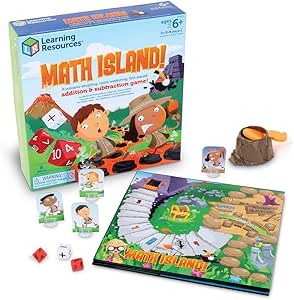 | Best for Guided Addition and Subtraction | Brand: Learning Resources | Players: 2–4 | Age range: 6–10 years | VIEW LATEST PRICE | See Our Full Breakdown |
| Montessori Wooden Stick and Ball Board Game for Kids |  | Best for Hands-On Counting and Motor Skills | Brand: WhimsiPlay | Material: Wood | Players: 2–6 | VIEW LATEST PRICE | See Our Full Breakdown |
| Learning Resources STEM Explorers Brainometry Puzzle |  | Best for Hands-On Spatial Logic | Brand: Learning Resources | Model: LER9306 | Recommended age: 5–10 years | VIEW LATEST PRICE | See Our Full Breakdown |
| STEM learning board game | Players | Included components | Brand | Recommended age |
|---|---|---|---|---|
| Scholastic Race Across the USA | 2–4 | — | — | 8+ |
| STEM Logic Board Game for Kids | 2 | 10 balls, 28 blocks, 4 boards, 2 cars, 4 points | — | 3 years and up |
| 3D Circuit Puzzle STEM Kit wit | — | — | — | — |
| ThinkFun Gravity Maze Marble L | — | Game grid, 9 towers, 3 marbles, target piece, 60 challenge cards | ThinkFun | 8+ |
| Matheroni Pepperoni Multiplica | 1–4 | 4 pizza slices, 51 pepperonis, 1 spinner, instructions | Pidoko Kids | — |
| Proof! Mental Math Card Game | 2–6, with solo play supported | 100 number cards | Evermade | 9 years and up |
| SimplyFun Sumology Math Game | 2 or more | Board game and pieces | SimplyFun | 8 years and up |
| Number Hunter Math Board Game | 2 or more | Game board, 5 game pieces, 2 number dice, 1 operation die, 50 challenge cards, and rules | Clever Fox Play | — |
| Learning Resources Math Island | 2–4 | Game board, 4 character pieces, volcano popper, 2 number dice, 1 operation die, and instructions | Learning Resources | — |
| Montessori Wooden Stick and Ba | 2–6 | 42 sticks, 1 wooden tower, 12 balls, 1 die, and 1 manual | WhimsiPlay | 3 years and up |
| Learning Resources STEM Explor | — | — | Learning Resources | 5–10 years |
More Details on Our Top Picks
Scholastic Race Across the USA Geography Board Game for Kids, Ages 8+
Race Across the USA is the geography-focused pick in this lineup: players visit six states, answer questions, and race home, turning U.S. map knowledge into a shared goal. Questions matched to each player’s grade level make it easier for children at different school stages to play together, while using the board as a clue supports recall and map-reading. Compared with Gravity Maze, which asks one player to reason through a physical path puzzle, this game gets more value from conversation and friendly competition. Its STEM scope is narrower, though: it emphasizes geography and cognitive skills rather than circuits, multiplication, or spatial construction. The 20-minute listed play time suits a short family or classroom activity, but question-based play may be less appealing to kids who want to build or manipulate a puzzle.
Pros:- Grade-level question matching supports mixed-age play
- Board clues connect questions to map reading
- Six-state race gives geography practice a clear objective
- Designed for two to four players and listed at about 20 minutes
Cons:- Learning focus is U.S. geography rather than broad STEM topics
- Question-and-race play offers less physical problem-solving than Gravity Maze
- Requires reading and answering questions, which may not suit every younger player
Best for: Families or teachers looking for a short geography game that lets children in different grades play together.
Not ideal for: Buyers seeking hands-on engineering, circuit-building, or math practice; the core activity is answering U.S. geography questions.
- Recommended age:8+
- Players:2–4
- Listed playing time:20 minutes
- Learning focus:U.S. geography and cognitive skills
- Game objective:Visit six states, answer questions, and return to your home state
- Question format:Questions geared to each player’s grade level
- Material:Paperboard
- Board dimensions:10.5 × 10.5 inches
Our verdict“Choose this for collaborative U.S. geography practice, not for building or engineering challenges.”
STEM Logic Board Game for Kids with 200+ Challenges
This STEM Logic Board Game is the broadest entry point for younger puzzle fans here: more than 200 challenges, four difficulty levels, and pieces such as blocks, cars, and balls give children several ways to practice spatial reasoning and logic. Its listed starting age of three is younger than Gravity Maze or the 3D Circuit Puzzle, making it a better fit when a child is not ready for those more specialized challenges. The range of levels also gives families room to progress without changing games. The tradeoff is that the supplied information describes general logic and spatial skills rather than a specific science concept or a clear progression in STEM subject matter. It is a two-player, indoor game, and its plastic construction may disappoint buyers who prefer natural materials.
Pros:- More than 200 challenges provide varied replay
- Four difficulty levels offer a route from easier to harder puzzles
- Blocks, cars, and balls support hands-on spatial reasoning
- Compact carrying case helps with storage and portable play
Cons:- Designed for two players, limiting larger-group participation
- Indoor use only
- Plastic construction may not suit buyers seeking wooden game pieces
Best for: Families with young children who want a portable logic game with many challenges and room to increase difficulty.
Not ideal for: Buyers wanting a focused circuit lesson, a larger group game, or wooden components.
- Recommended age:3 years and up
- Players:2
- Challenges:200+
- Difficulty levels:4
- Material:Plastic
- Included components:10 balls, 28 blocks, 4 boards, 2 cars, 4 points
- Use:Indoor
- Operation:Manual
Our verdict“Pick this for younger children who benefit from many graded logic puzzles, rather than a single specialized STEM activity.”
3D Circuit Puzzle STEM Kit with 60 Challenges
The 3D Circuit Puzzle stands apart from the lineup by pairing guided challenges with open-ended building: players can work through 60 cards, then use the modular pieces to create structures up to three layers tall. Eight functional modules offer visual and hands-on feedback, giving the activity a more circuit-centered purpose than the general spatial puzzles in STEM Logic Board Game. The two play modes also make it more flexible than a challenge-card-only format. That specialization brings a learning curve, and the age guidance is inconsistent: one listing gives 8–14, while the manufacturer recommendation is stated as 12 and up. The descriptions also do not identify every module, so buyers cannot easily judge the exact concepts covered before choosing it.
Pros:- Three-layer building adds vertical planning beyond flat puzzles
- 60 challenge cards provide structured progression
- Puzzle and open-building modes support both guided and self-directed play
- Eight functional modules provide visual and hands-on feedback
Cons:- Conflicting age guidance makes age suitability harder to judge
- The description does not explain the function of all eight modules
- More specialized and potentially less accessible than the general logic challenges in STEM Logic Board Game
Best for: Older children who enjoy construction puzzles and want to move from guided circuit challenges to free building.
Not ideal for: Families buying for a younger child based only on the 8–14 age claim, or shoppers who need clearly documented module functions.
- Listed age range:8–14 years
- Manufacturer age recommendation:12 years and up
- Material:ABS plastic
- Challenge cards:60
- Functional modules:8
- Maximum stacking:Up to 3 layers
- Play modes:Puzzle mode and build mode
- Manufacturer part number:7077
Our verdict“Choose this for a child ready to explore layered circuit-style construction, after checking the age guidance against their readiness.”
ThinkFun Gravity Maze Marble Logic Game
Gravity Maze turns spatial reasoning into a concrete task: arrange towers so a marble can travel to the target. Its 60 challenges progress from beginner to expert, giving players a clear path from learning the setup to tackling more demanding plans. Compared with the 3D Circuit Puzzle, it focuses on gravity and route construction rather than circuit modules or open-ended builds; that narrower format makes the objective easier to grasp, but offers less variety in what children create. The screen-free towers, grid, and marbles make each move visible, which can help a child reason through cause and effect. Younger players may find the planning demanding, and the supplied details do not state a player count, so it is best approached as an individual puzzle activity rather than assumed group play.
Pros:- 60 challenges span beginner through expert
- Marble paths make cause and effect visible
- Screen-free tower arrangement supports hands-on spatial reasoning
- A defined target gives each puzzle a clear goal
Cons:- Planning tower placement may challenge younger or less experienced players
- The focus is path logic rather than broad STEM topic coverage
- Provided product details do not specify the number of players
Best for: Children aged eight and up who enjoy working independently through visual, hands-on logic challenges.
Not ideal for: Younger children who need simpler play, or buyers looking for open-ended construction or explicit circuit learning.
- Recommended age:8+
- Challenges:60
- Challenge range:Beginner to expert
- Included components:Game grid, 9 towers, 3 marbles, target piece, 60 challenge cards
- Brand:ThinkFun
- Model number:44001006
- Color:Multicolor
Our verdict“Choose Gravity Maze for structured, visual route-planning practice rather than the broader building options of the 3D Circuit Puzzle.”
Matheroni Pepperoni Multiplication and Division Math Game for Kids Ages 8–12
Matheroni Pepperoni gives math practice a visible collection goal: players solve multiplication and division problems to gather five colors of pepperoni and fill a pizza slice. The spinner’s special actions add a strategic wrinkle, distinguishing it from the more direct question-and-answer geography race in Race Across the USA. Support for one to four players also makes it adaptable for solo practice or a small group. Its focus is deliberately narrow, however: children looking for circuits, engineering, or broader math topics will find more variety in other picks, such as Gravity Maze for spatial logic. Timed turns may add energy for some players but pressure for others, and the product is aimed at ages 8–12, so it is not a general early-math game.
Pros:- Multiplication and division problems are tied to a clear collection objective
- Spinner actions add variety and strategic choices
- Supports solo play or groups of up to four
- Listed for family, classroom, and homeschool use
Cons:- Timed turns may create pressure for some learners
- Practice is limited mainly to multiplication and division
- The age range may not suit children who need early addition or subtraction practice
Best for: Families or educators seeking a small-group game to reinforce multiplication and division for children ages 8–12.
Not ideal for: Children who feel pressured by timed turns, or buyers seeking broad STEM coverage beyond arithmetic practice.
- Age range:8–12 years
- Players:1–4
- Educational skills:Multiplication, division, number sense, problem-solving, strategic thinking
- Included components:4 pizza slices, 51 pepperonis, 1 spinner, instructions
- Brand:Pidoko Kids
- Model:PKSK011
- Special game element:Spinner with special actions
Our verdict“Choose this for focused multiplication and division practice with a game goal, not for wide-ranging STEM exploration.”
Proof! Mental Math Card Game
Proof! earns this spot for packing several arithmetic operations into a quick card game. Players combine number cards with addition, subtraction, multiplication, division, and square roots to make equations, so the challenge can grow beyond basic sums. Its adaptable rules, solo option, and 2–6-player format give it more ways to fit different skill levels than Learning Resources Math Island, which focuses on counting and addition and subtraction up to 20. At about 15 minutes, it also suits a short practice session without a large board setup. The tradeoff is that players need enough number fluency to work with the operations, and the recommended age of 9 and up makes it a poor match for younger learners. Card-based play offers less of a physical adventure than Number Hunter or Math Island.
Pros:- Practices addition, subtraction, multiplication, division, and square roots.
- Adaptable rules support solo play and different skill levels.
- About 15 minutes of play fits short practice sessions.
- 100 number cards make for a compact, board-free format.
Cons:- The recommended age of 9 and up limits its usefulness for younger children.
- Players need enough arithmetic fluency to form equations using several operations.
- Card play has less movement and shared-board interaction than Number Hunter or Math Island.
Best for: Families with math-ready children around age 9 and up who want a compact game that can support solo practice and changing skill levels.
Not ideal for: Parents seeking an introductory counting game for preschool or early-elementary children, since the age recommendation and range of operations may be too advanced.
- Brand:Evermade
- Model:SZB-200
- Players:2–6, with solo play supported
- Recommended age:9 years and up
- Playing time:About 15 minutes
- Math skills:Addition, subtraction, multiplication, division, and square roots
- Included components:100 number cards
- Material:Cardstock
- Battery required:No
Our verdict“Choose Proof! for quick, adjustable arithmetic practice with older children; pick Math Island instead for a more guided, movement-based introduction.”
SimplyFun Sumology Math Game
Sumology is the pick for children who are ready to treat arithmetic as a planning problem, not just an answer to call out. Players build connected equations with tiles, choose which operators to use, and score based on the numbers played. That creates more board-position strategy than Proof! Mental Math Card Game, where the central task is finding equations from cards, while still practicing four basic operations. The recommended age of 8 and up and roughly 30-minute playtime suit a family game session for children comfortable checking their own arithmetic. That structure has a learning curve: players must form valid equations that connect to existing tiles, which can frustrate beginners. Small pieces also call for care around young children, and the supplied information does not specify a player maximum.
Pros:- Practices addition, subtraction, multiplication, and division.
- Combines arithmetic with strategic tile placement and scoring.
- Players can choose which operators to use, allowing different equation approaches.
- Board-based play encourages players to respond to existing equations.
Cons:- Valid equations must connect to existing tiles, adding a rule hurdle for beginners.
- Small pieces present a choking hazard for young children.
- The approximately 30-minute session is longer than Proof!’s quick card-game format.
Best for: Families with children age 8 and up who already know basic arithmetic and enjoy planning moves on a shared board.
Not ideal for: Households with toddlers or children who need very simple, guided math prompts; small pieces and equation-placement rules may be a poor fit.
- Brand:SimplyFun
- Players:2 or more
- Recommended age:8 years and up
- Playing time:About 30 minutes
- Math skills:Addition, subtraction, multiplication, and division
- Included components:Board game and pieces
- Material:Plastic
- Dimensions:11.77 × 2.4 × 0.1 inches
- Language:English
Our verdict“Choose Sumology for math-ready players who want arithmetic practice woven into board strategy, rather than a fast equation-finding game.”
Number Hunter Math Board Game for Kids 5-7, 1st Grade & Kindergarten
Number Hunter gives younger learners a story-driven way to work on addition, subtraction, and odd/even ideas through dice rolls and challenge cards. Its board, pieces, and operation die make the math feel like part of a shared adventure, a better fit for children who need movement and prompts than Proof! Mental Math Card Game, which asks older players to assemble equations from cards. It also offers a broader practice setup than Math Island in the stated inclusion of odd/even concepts, though Math Island’s skills are clearly capped at 20. Number Hunter’s listed minimum age is 5, despite the title referencing ages 5–7 and the description mentioning ages 4–8, so buyers should use the minimum-age guidance. The session is about 20 minutes, and one set may not serve a large classroom group at once.
Pros:- Uses dice and challenge cards to make early addition and subtraction interactive.
- Includes odd/even concepts alongside core arithmetic practice.
- Screen-free board play supports conversation and turn-taking.
- Game board, pieces, dice, and 50 challenge cards provide varied prompts.
Cons:- The title, description, and minimum-age listing give differing age ranges, so age fit may need a closer check.
- A roughly 20-minute session may require several rounds for a longer activity.
- One set of components may be limiting for larger classrooms or groups.
Best for: Parents and early-elementary educators seeking a screen-free, shared math activity for children around ages 5–7 who are learning addition and subtraction.
Not ideal for: Buyers seeking advanced arithmetic or a game for a large group to play simultaneously; its listed focus is early math and one component set may limit participation.
- Brand:Clever Fox Play
- Players:2 or more
- Minimum age recommendation:5 years and up
- Estimated playing time:20 minutes
- Edition:Addition and Subtraction
- Skills:Addition, subtraction, odd/even concepts, critical thinking, and problem-solving
- Included components:Game board, 5 game pieces, 2 number dice, 1 operation die, 50 challenge cards, and rules
- Language:English
- Model number:CFP-NUMBHUNT
Our verdict“Choose Number Hunter for younger children who benefit from dice-led, screen-free math play, but look to Sumology or Proof! for more advanced operations.”
Learning Resources Math Island Addition & Subtraction Game
Math Island is a straightforward choice for children who need practice with counting and addition and subtraction up to 20. Players solve equations to move around the board, while obstacles and a volcano popper add a physical hook that can keep turns lively. Compared with Number Hunter, it has a more clearly bounded math range and a smaller player count of 2–4; that makes it easier to match to a focused early-arithmetic goal, but less flexible for a larger group. Its 6–10 age range also reaches older children who still need fluency practice. The limitation is the narrow skill scope: players will not move into multiplication or division as they can with Sumology or Proof!. The included dice and characters are ready for board play, but the game is not designed for solo practice.
Pros:- Targets counting, addition, and subtraction up to 20.
- The volcano popper adds a tactile, playful element to dice turns.
- Supports a small family or classroom group of 2–4 players.
- Includes the board, character pieces, dice, and instructions.
Cons:- Math practice is limited to counting, addition, and subtraction up to 20.
- Designed for children ages 6 and up, so it may not fit younger learners.
- The 2–4-player format does not support solo play or larger groups.
Best for: Families or small classrooms with children ages 6–10 who need hands-on practice counting and solving addition and subtraction problems up to 20.
Not ideal for: Buyers seeking solo play, a large-group game, or a route into multiplication and division; Math Island is built for 2–4 players and early arithmetic.
- Brand:Learning Resources
- Players:2–4
- Age range:6–10 years
- Math skills:Counting, addition, and subtraction up to 20
- Included components:Game board, 4 character pieces, volcano popper, 2 number dice, 1 operation die, and instructions
- Model number:LER5025
- ASIN:B09SP3TK8G
Our verdict“Choose Math Island for focused, movement-based addition and subtraction practice; choose Sumology when players are ready for more operations and strategic equation building.”
Montessori Wooden Stick and Ball Board Game for Kids
Montessori Wooden Stick and Ball takes a different route from the arithmetic-focused games in this roundup: players roll a die and pull sticks while trying to let as few balls as possible fall. That gives young children a tactile way to practice counting, focus, and controlled movement, rather than building equations as they do in Math Island or Sumology. Its 2–6-player capacity and flexible rules make it adaptable for family play, and the wooden pieces offer a distinct feel from Number Hunter’s card-and-dice challenges. This is a lighter STEM fit, though: the supplied description centers on fine motor skills and counting, not a structured progression through math operations. Small balls pose a choking hazard, and the stated dimensions include a 0.1-inch measurement that may not describe the assembled tower clearly.
Pros:- Encourages counting, focus, hand-eye coordination, and fine motor control.
- Wooden sticks and tower provide a tactile alternative to card-based math games.
- Accommodates 2–6 players with flexible rules.
- Includes a pouch for storage and portability.
Cons:- Math practice is less structured than the equation work in Math Island, Sumology, or Proof!.
- Small balls present a choking hazard and require supervision around young children.
- The listed dimensions may not clearly describe the assembled game.
Best for: Families with children age 3 and up who want a tactile counting and fine-motor activity for supervised, turn-based play.
Not ideal for: Buyers seeking explicit arithmetic instruction or households with children who may put small balls in their mouths; this game focuses on motor control and presents a choking hazard.
- Brand:WhimsiPlay
- Material:Wood
- Players:2–6
- Recommended age:3 years and up
- Included components:42 sticks, 1 wooden tower, 12 balls, 1 die, and 1 manual
- Dimensions:8.27 × 3.94 × 0.1 inches
- Batteries:Not required
- Caution:Choking hazard: contains small balls
Our verdict“Choose this wooden game for supervised counting and motor-skill play, not as a substitute for a board game focused on arithmetic instruction.”
Learning Resources STEM Explorers Brainometry Puzzle
Brainometry is a compact, screen-free puzzle for children who learn by moving pieces and testing patterns. Its 34 tactile blocks and double-sided challenge cards build from simpler tasks toward harder logic problems, giving young players a way to practice spatial reasoning, concentration, and fine motor control at their own pace. Compared with ThinkFun Gravity Maze, this puzzle centers on matching shapes and patterns rather than planning a marble’s route through a structure; it is a better fit for younger children or shorter independent play sessions. The tradeoff is less variety in the challenge format: ten cards provide a defined set of activities, not the broad range of problems found in games advertised with hundreds of challenges. The small pieces can also get lost, and the cards are in English.
Pros:- Progressive card challenges give children a manageable path from easier patterns to harder problems.
- Tactile blocks make spatial reasoning and shape matching concrete.
- Supports concentration and fine motor practice alongside logic skills.
- Portable storage box helps keep the pieces together for travel.
Cons:- The small blocks can be misplaced, especially during travel or play with younger siblings.
- Ten double-sided cards offer less challenge variety than options such as STEM Logic Board Game with 200+ Challenges.
- English-language challenge cards may limit independent use for children who do not read English.
Best for: Families with children ages 5–10 who want a portable, hands-on logic activity for independent screen-free play.
Not ideal for: Buyers seeking a multiplayer board game, a large library of challenges, or materials that avoid small pieces and English-language instructions.
- Brand:Learning Resources
- Model:LER9306
- Recommended age:5–10 years
- Included pieces:34
- Challenge cards:10 double-sided cards
- Material:Plastic
- Warranty:2-year limited warranty
Our verdict“Choose Brainometry for a portable, hands-on spatial-logic puzzle for younger children, but pick a game with a larger challenge library if variety is your priority.”
How We Picked
I compared these 11 STEM learning board games by the skill each one actually asks a child to use: arithmetic, logic, spatial reasoning, engineering, circuits, or geography. I also considered age fit, how clearly the challenge can be understood, whether children can play independently or need adult support, and how well the activity invites another round. A high challenge count can be useful, but it does not automatically make a game a better fit if the concept is too advanced or the play style does not suit the child.
The ranking favors games with a clear learning purpose, engaging hands-on or strategic play, and a useful fit for a distinct buyer. Gravity Maze ranks highly as a strong blend of engineering concepts and logic puzzles; the circuit kit has a narrower but valuable STEM focus. Math games are separated by age and format, while geography and visual puzzles serve different learning needs. I treat these as distinct options rather than assuming that every family needs the same kind of STEM play.
| STEM learning board game | Material |
|---|---|
| Scholastic Race Across the USA | Paperboard |
| STEM Logic Board Game for Kids | Plastic |
| 3D Circuit Puzzle STEM Kit wit | ABS plastic |
| ThinkFun Gravity Maze Marble L | — |
| Matheroni Pepperoni Multiplica | — |
| Proof! Mental Math Card Game | Cardstock |
| SimplyFun Sumology Math Game | Plastic |
| Number Hunter Math Board Game | — |
| Learning Resources Math Island | — |
| Montessori Wooden Stick and Ba | Wood |
| Learning Resources STEM Explor | Plastic |
Factors to Consider When Choosing STEM Learning Board Games
Before choosing, I’d match the game to the kind of thinking your child enjoys—not just the subject printed on the box. These broader factors can help you avoid a game that is technically educational but rarely gets played.
Match the challenge to the child, not just the age label
Age ranges are a starting point, not a measure of a child’s exact skill level. A young player who likes puzzles may handle visual challenges well but still find written instructions or arithmetic frustrating. Check whether the game uses reading, calculation, fine-motor work, or multi-step planning, since those demands can shape play as much as the advertised topic. If a game is too easy, it may lose its appeal quickly; if it is too hard, repeated adult coaching can turn play into a lesson. When possible, choose adjustable difficulty or a format where a child can start with simpler tasks and build confidence.
Choose a learning style: building, solving, or competing
STEM games teach through different kinds of activity, and the best format depends on what holds a child’s attention. Construction and circuit puzzles make cause and effect visible, while logic challenges reward planning and trial and error. Math card and board games add social energy, but competitive scoring may distract a child who wants to explore at their own pace. A solo puzzle can suit independent play, though it may offer less conversation than a family game. Avoid choosing by subject alone; a child who dislikes speed-based play may not enjoy a math game even if arithmetic practice is the goal.
Look beyond the number of challenges
A large challenge set sounds appealing, but variety and progression matter more than a headline count. Check whether puzzles change the underlying task or simply repeat the same idea with minor adjustments. A thoughtful sequence can help children learn a strategy, then apply it in a harder situation. For a child who likes mastery, gradually increasing difficulty may keep the game engaging; a casual player may prefer short rounds and simple setup. Consider whether the game offers different ways to play, since that can extend its usefulness across siblings or changing skill levels.
Think about group size and adult involvement
Some educational games work best with one child focused on a puzzle, while others need players to take turns, compare answers, or follow shared rules. That difference affects whether a game fits independent afternoons, family game night, or classroom use. Read the instructions for setup time and the amount of guidance a younger child may need. A game that teaches through open-ended trial and error can be rewarding, but younger players may benefit from an adult nearby. If you want children to play together without supervision, prioritize clear rules and a format suited to their ages and reading abilities.
Balance focused practice with broader play
A game built around multiplication or addition can provide targeted practice, but it may see less use once that skill becomes easy. A broader logic or spatial-reasoning game may remain appealing across a wider range of interests, though its connection to schoolwork can be less direct. Decide whether your main goal is to reinforce a particular concept or encourage general problem-solving. Families seeking a specific learning objective should favor clarity of instruction over a broad STEM label. If the goal is regular, enjoyable play, a flexible challenge format may be a better fit than a narrowly focused drill.
Frequently Asked Questions
Which type of STEM game is best if my child gets frustrated by math worksheets?
I’d start with a game that puts the challenge into a puzzle, story, or shared turn rather than asking for repeated written answers. Visual-spatial and engineering activities can build problem-solving habits without making arithmetic the main event. If math practice is still the goal, choose a format with short rounds and a low-pressure pace instead of one that rewards speed. Stay nearby at first to help with rules, then let the child take the lead once play feels familiar. The aim is to make the thinking feel manageable, not to disguise a worksheet as a game.
Should I choose a solo puzzle or a multiplayer math game for siblings?
Choose based on whether the children enjoy solving side by side or competing for turns. Solo puzzles can work well when siblings have different skill levels because each child can tackle a challenge at an individual pace. Multiplayer math games can create shared fun, but differences in speed or confidence may make one child feel left behind. Look for formats that allow teams, cooperative play, or flexible difficulty if ages and abilities vary. If you are unsure, a game with both independent challenges and a shared mode is likely to serve more situations.
Are circuit and engineering games useful if my child has not studied those topics yet?
They can be, as long as the activity explains ideas through visible actions rather than assuming prior knowledge. A puzzle that lets a child place pieces, test a solution, and see what happens can make abstract concepts easier to approach. Check whether the game includes clear instructions and a gradual path from simple tasks to harder ones. Younger players may need an adult to introduce the rules, but they do not necessarily need formal science lessons first. If the game feels too technical at the outset, a general logic puzzle may be a gentler entry point.
How do I tell whether a game will still be useful after my child learns the basic skill?
Look for rising difficulty, multiple ways to play, or challenges that call for more than one skill at a time. A narrow arithmetic game may be most useful during a particular learning stage, while an open-ended logic or spatial puzzle can stay relevant as the child becomes more capable. Check whether the rules let players adjust challenge or whether the game depends on a fixed set of simple tasks. Replayability also depends on a child’s interest: a focused game can still earn repeat play if the theme and format click. Match the expected use period to your family’s goals rather than assuming every educational game needs to grow indefinitely.
What should I prioritize when buying one STEM game for children at different ages?
Favor a game with flexible difficulty or a play format that lets children contribute in different ways. A younger child might handle setup or simpler challenges while an older sibling works through harder reasoning or calculations. Avoid games where success depends mostly on reading speed or advanced arithmetic, since that can leave the younger player watching. Cooperative play can reduce the pressure of direct competition, though it may require an adult to help balance turns. If the age gap is wide, buying separate focused games may work better than expecting one title to suit everyone equally.
Conclusion
For the strongest all-around mix of hands-on reasoning and engineering ideas, I’d choose ThinkFun Gravity Maze as best overall. Proof! is my best value-style pick for families seeking compact, repeatable mental-math play, while the 3D Circuit Puzzle is the best premium-style choice for children drawn to circuits and physical problem-solving. For beginners, Number Hunter is the clearest fit among the early arithmetic options; choose Math Island if addition and subtraction are the specific goal. For geography, consider Race Across the USA; for visual-spatial puzzles, look at Brainometry. The right game is the one whose challenge and play style your child will return to.