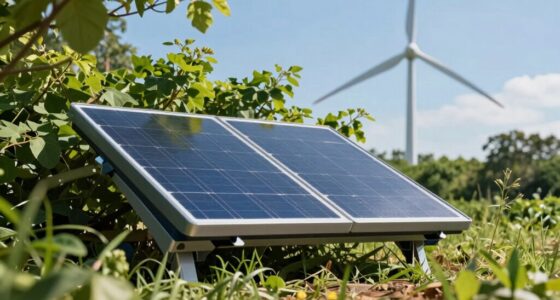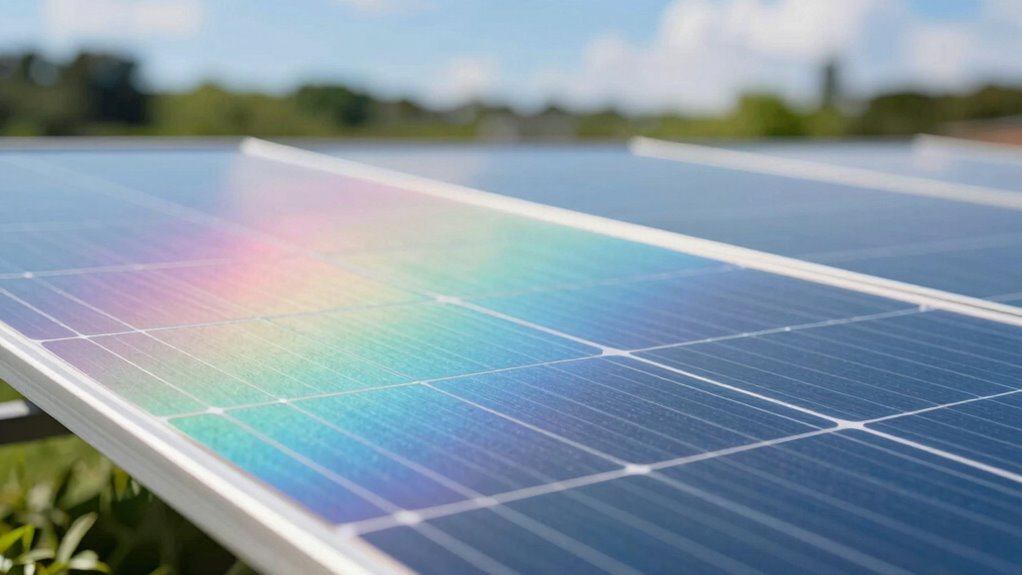

Perovskite solar cells could transform clean energy by providing higher efficiency at lower costs, making renewable power more accessible. Their lightweight, flexible nature allows for easier installation in various settings, including portable and residential areas. While challenges like stability and manufacturing need solutions, advances in material engineering and scalable production methods are promising. If you stay curious, you’ll discover how these innovations could lead to more affordable, widespread solar energy for everyone.

Prime made for students and young adults
- Fast, free delivery for dorm and study essentials
- Prime Video and Amazon Music included
- Member-only deals
Key Takeaways
- Perovskite solar cells offer higher efficiencies at lower production costs, making clean energy more affordable.
- Their lightweight and flexible design enables versatile deployment in diverse environments and applications.
- Advancements in stability and scalable manufacturing can accelerate widespread adoption of perovskite technology.
- Improved durability could extend the lifespan of solar panels, reducing long-term costs and environmental impact.
- Success in perovskite development has the potential to significantly increase renewable energy penetration globally.
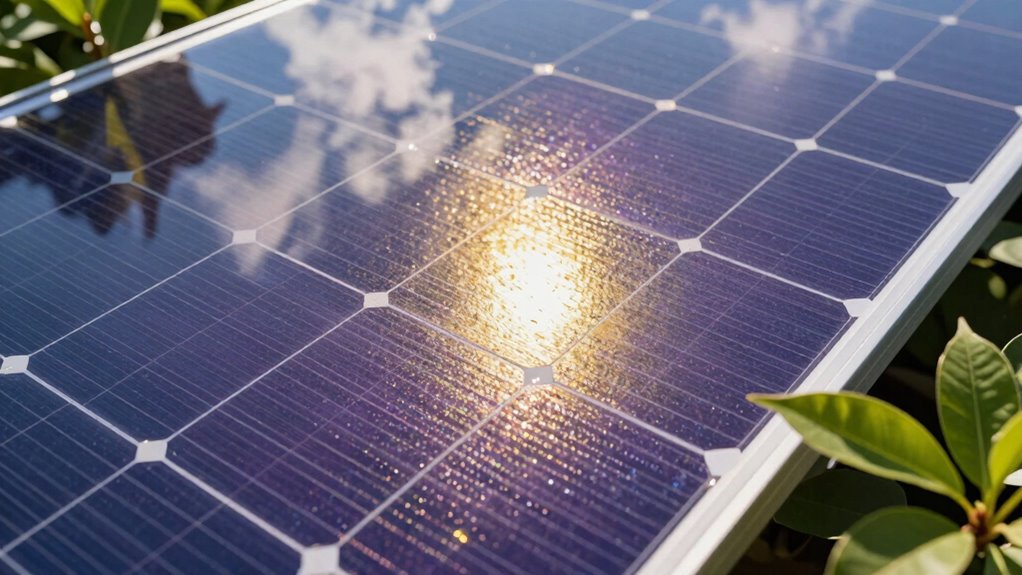
Have you ever wondered how new materials could revolutionize clean energy? Perovskite solar cells are at the forefront of this potential shift. They promise higher efficiencies and lower production costs compared to traditional silicon-based panels, making renewable energy more accessible and affordable. But before they can make a significant impact, several hurdles need to be overcome, especially concerning perovskite stability and manufacturing challenges.
Perovskite stability is a major concern. While these materials are highly efficient at converting sunlight into electricity, they tend to degrade quickly when exposed to moisture, heat, or ultraviolet light. This instability limits their lifespan and raises questions about their long-term reliability in real-world conditions. You might think that simply improving stability would be straightforward, but it’s a complex problem. Researchers are exploring ways to enhance stability through material engineering—adding protective layers, doping with stabilizers, or developing more resilient perovskite compositions. Overcoming these issues is vital if perovskite solar cells are to compete with traditional technologies and gain widespread adoption. Developing advanced stabilization techniques is crucial for extending the lifespan of perovskite panels in real-world applications. Additionally, understanding the material properties of perovskites is essential to address their inherent vulnerabilities.
Manufacturing challenges also play a significant role in the future of perovskite solar technology. Current production methods often involve delicate processes that are difficult to scale up reliably and consistently. Achieving uniformity across large-area panels remains a significant obstacle. You may imagine how small inconsistencies during manufacturing could lead to reduced efficiency or early failure of the panels. Researchers are working on scalable fabrication techniques, such as roll-to-roll printing and vapor deposition, to make mass production feasible. Scalable manufacturing techniques are essential for making perovskite solar cells commercially viable. However, integrating these methods while maintaining high quality and performance is a complex and ongoing challenge. Ensuring that manufacturing processes are cost-effective and environmentally friendly adds another layer of difficulty.
Despite these challenges, the promise of perovskite solar cells remains compelling. Their high efficiency and potential for low-cost production could drastically reduce the cost of solar energy. If scientists and engineers succeed in addressing perovskite stability and manufacturing hurdles, you could see a future where solar panels are more flexible, lightweight, and affordable than ever before. This could lead to wider deployment in residential, commercial, and even portable applications. Advances in perovskite material engineering are crucial for overcoming current limitations. The road ahead isn’t without obstacles, but the rapid pace of innovation suggests that perovskite technology could soon become a key player in the clean energy revolution, transforming how we generate and consume power around the world.
As an affiliate, we earn on qualifying purchases.
Frequently Asked Questions
What Are the Environmental Impacts of Manufacturing Perovskite Solar Panels?
Manufacturing perovskite solar panels raises environmental concerns mainly due to manufacturing emissions. You might worry about the chemicals used in production, like lead or other toxic materials, which can pose risks if not properly managed. While the process can generate some waste and emissions, advances in manufacturing techniques aim to reduce these impacts. Overall, careful regulation and innovation are key to minimizing environmental concerns associated with perovskite solar panel production.
How Long Do Perovskite Solar Panels Typically Last in Real-World Conditions?
Perovskite solar panels typically last around 5 to 10 years in real-world conditions, though this depends on durability concerns and environmental exposure. While lab tests show they can reach 20 years, outdoor conditions like moisture, temperature fluctuations, and UV exposure can shorten their lifespan. Ongoing research aims to improve their durability, so expect their lifespan estimation to increase as technology advances.
Are Perovskite Solar Cells Suitable for Large-Scale Commercial Deployment?
Perovskite solar cells are promising for large-scale commercial deployment because of their potential for high efficiency and low-cost manufacturing. You’ll find that material durability is improving, making these cells more resilient to real-world conditions. With ongoing efficiency optimization efforts, these cells could soon provide sustainable, scalable solar solutions. While challenges remain, their rapid development suggests they’re well suited for broad, commercial use in the near future.
What Are the Main Challenges in Scaling up Perovskite Solar Technology?
You face main challenges in scaling up perovskite solar technology, mainly material stability and manufacturing scalability. Perovskite materials tend to degrade over time, affecting long-term performance. Additionally, you need to develop cost-effective, large-scale manufacturing processes that guarantee consistent quality. Overcoming these issues requires ongoing research to improve material durability and to optimize production methods, making commercial deployment more feasible and reliable in the future.
How Do Perovskite Solar Panels Compare Cost-Wise to Traditional Silicon Panels?
Imagine your roof bathed in sunlight, and your energy bills shrinking. Perovskite solar panels are cheaper to produce than traditional silicon panels, thanks to their simple manufacturing process. Their cost comparison shows they could substantially lower expenses, opening up vast market potential. As technology advances, you’ll find perovskite panels becoming more affordable, making clean energy accessible and encouraging more households to adopt sustainable solutions.
As an affiliate, we earn on qualifying purchases.
Conclusion
Imagine a world where sunlight pours freely, turning rooftops into shimmering fields of energy. With perovskite solar cells, this vision becomes reality — capturing the sun’s power more efficiently and affordably. As you walk through a city bathed in radiant light, know that these tiny, revolutionary materials could fuel your life sustainably, brightening the future with every beam. The energy of tomorrow is waiting—ready to transform your world into a cleaner, greener place.
portable lightweight solar charger
As an affiliate, we earn on qualifying purchases.
As an affiliate, we earn on qualifying purchases.
scalable solar cell manufacturing equipment
As an affiliate, we earn on qualifying purchases.
As an affiliate, we earn on qualifying purchases.
Columbus Day / Indigenous Peoples' Day Picks
long weekend sales
As an affiliate, we earn on qualifying purchases.