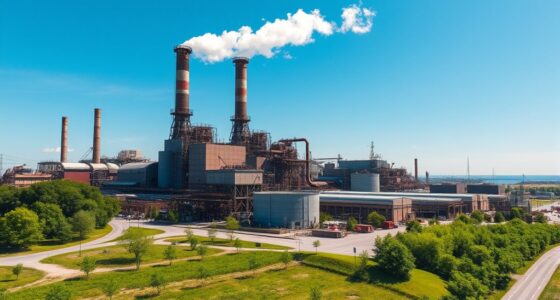
Recent breakthroughs in carbon capture technology make it easier and cheaper for you to reduce emissions. New materials and methods like highly selective sorbents and modular systems improve efficiency, allowing large-scale deployment across industries. Innovations such as direct air capture and advanced industrial systems help target legacy emissions and hard-to-decarbonize sectors. These advances pave the way for cleaner industrial processes and stronger climate action—stay with us to discover how these cutting-edge solutions are shaping a sustainable future.
Key Takeaways
- New materials and methods in DAC improve efficiency and reduce energy use for capturing CO₂ directly from ambient air.
- Advanced industrial capture systems utilize novel solvents and sorbents, lowering costs and enhancing retrofit capabilities.
- Modular, scalable technologies like cryogenic capture and membrane separation enable tailored emission reduction solutions.
- Recent breakthroughs increase the practicality and deployment of carbon capture, supporting stricter climate targets.
- Ongoing research focuses on energy-efficient, sustainable methods to expand large-scale carbon removal and mitigate climate change.
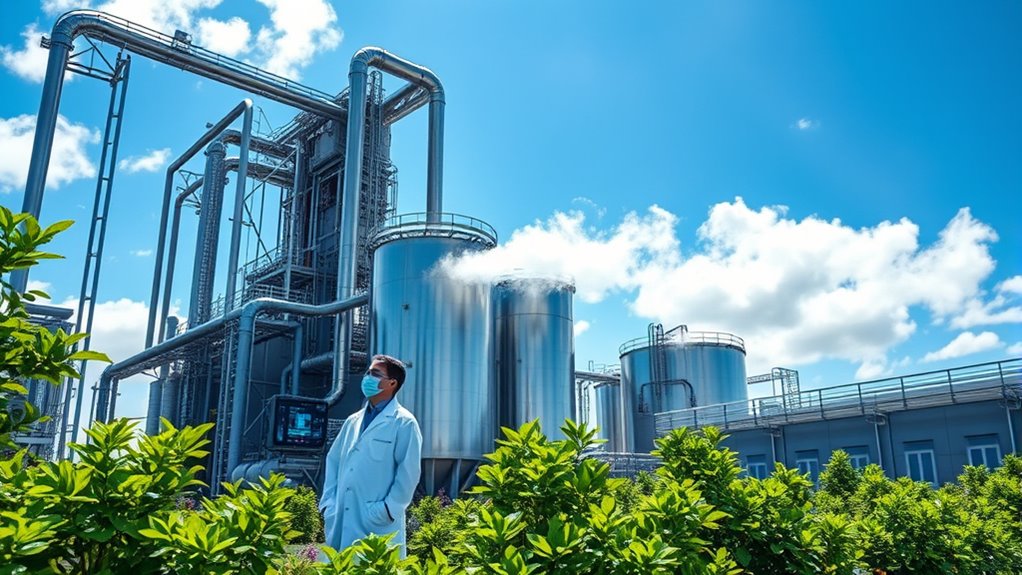
Recent breakthroughs in carbon capture technology are transforming how we address climate change, offering more efficient and cost-effective ways to trap CO₂ emissions from industrial sources and power plants. These innovations are especially promising in tackling two major challenges: capturing direct air CO₂ and reducing industrial emissions. As you explore these advances, you’ll see how they could reshape our efforts to limit greenhouse gases and mitigate global warming.
Recent breakthroughs in carbon capture are making emission reduction more efficient and accessible.
Direct air capture (DAC) is gaining momentum thanks to new materials and methods that make removing CO₂ from the atmosphere more practical. Unlike traditional capture systems that focus on emissions at the source, DAC pulls CO₂ directly from ambient air, which contains a much lower concentration of the gas. This process requires highly selective sorbents and energy-efficient systems to be viable at scale. Recent breakthroughs involve advanced chemical sorbents that can be regenerated with less energy, reducing operational costs and making DAC more accessible. These innovations mean you could soon see facilities capable of pulling significant amounts of CO₂ directly from the air, helping to offset emissions from hard-to-decarbonize sectors or even remove legacy emissions from the atmosphere.
When it comes to industrial emissions, new capture technologies are making a tangible difference. Traditional methods often involve capturing CO₂ before it’s released into the atmosphere, but they can be expensive and energy-intensive. Now, researchers are developing more streamlined, modular systems that can be retrofitted onto existing facilities. These systems employ novel solvents and solid sorbents that require less heat and energy to regenerate, lowering costs and reducing the carbon footprint of the capture process itself. You might find that upcoming industrial plants incorporate these advanced filters, effectively trapping CO₂ before it escapes into the atmosphere. This approach not only curbs emissions at the source but also integrates well with existing infrastructure, making it a practical solution for industries aiming to meet stricter climate targets.
Furthermore, innovations are making capture more scalable and adaptable. Modular units can be deployed in a variety of settings, from large power stations to smaller manufacturing sites. Technologies like cryogenic capture and membrane separation are also advancing, providing additional options to tailor solutions based on specific industrial needs. As these breakthroughs become more widespread, you’ll see a shift toward cleaner industrial processes and more comprehensive strategies for reducing overall emissions. Additionally, research into energy-efficient methods is crucial to making large-scale deployment feasible and sustainable over the long term.
Sustainable Utilization of Carbon Dioxide in Waste Management: Moving Toward Reducing Environmental Impact
As an affiliate, we earn on qualifying purchases.
As an affiliate, we earn on qualifying purchases.
Frequently Asked Questions
How Cost-Effective Are the New Carbon Capture Technologies?
You’ll find that the new carbon capture technologies are becoming more cost-effective as advancements improve their efficiency. Conducting a thorough cost analysis shows that initial investments are decreasing, making them more economically feasible for industries. While still somewhat costly, these innovations are promising, and as scale increases, the economic feasibility improves, potentially leading to widespread adoption. Overall, the technologies are moving toward a more affordable and practical solution for reducing emissions.
Can These Breakthroughs Be Implemented Globally?
You can’t build Rome in a day, but these breakthroughs could be implemented globally if you tackle technological feasibility and policy barriers. While the tech shows promise, scaling up requires significant investment, infrastructure, and supportive policies. Countries need to collaborate and adapt solutions to local contexts. With the right commitment, these innovations can become part of a worldwide effort to reduce emissions, making a real difference in combating climate change.
What Are the Environmental Impacts of New Capture Methods?
You should consider that new capture methods can positively impact the environment by reducing greenhouse gases, but they also have ecosystem effects and land use implications. These technologies might require significant land for installations or infrastructure, potentially disrupting habitats. While they help lower emissions, you need to weigh these environmental impacts carefully, ensuring that the benefits outweigh potential ecosystem disturbances and land use changes.
How Long Will It Take to See Widespread Adoption?
You might see widespread adoption within 5 to 15 years, depending on how quickly the timeline progression advances and policy incentives are implemented. As governments and industries recognize the tech’s potential, they’ll likely introduce supportive policies and funding. Your role in advocating for these incentives can speed up the process, encouraging faster adoption. Stay informed and engaged to help push these innovations into mainstream use sooner.
Are There Any Risks Associated With New Carbon Storage Techniques?
You should know that new carbon storage techniques do carry risks like storage leakage, which could release trapped CO2 back into the atmosphere. Long-term stability is crucial, so thorough monitoring and advanced sealing methods are essential. While these innovations aim to improve safety, you’ll want to stay informed about ongoing research and regulation updates to understand how effectively they address potential risks over decades.

Extract-All Portable Air Cleaner Fume Extractor and Source Capture for Airborne Contaminants Removes Dust Smoke Fume with HEPA Filter
FUME EXTRACTOR SYSTEM: If you're an artisan, DIYer, or an individual whose work environment is packed with chemical…
As an affiliate, we earn on qualifying purchases.
As an affiliate, we earn on qualifying purchases.
Conclusion
With these breakthroughs, you can see a future where emissions are reduced, where cleaner air is breathed, and where sustainable energy is achieved. You can witness technology trapping carbon, transforming industries, and protecting the planet. You can embrace innovation, support green solutions, and commit to change. Together, you and these advancements shape a world where emissions are contained, climate goals are met, and a healthier Earth is within reach. This is your chance to be part of the solution.

Carbon Capture
As an affiliate, we earn on qualifying purchases.
As an affiliate, we earn on qualifying purchases.
modular carbon capture units
As an affiliate, we earn on qualifying purchases.
As an affiliate, we earn on qualifying purchases.