TL;DR

Prime made for students and young adults
- Fast, free delivery for dorm and study essentials
- Prime Video and Amazon Music included
- Member-only deals
NASA’s Astronomy Picture of the Day for Oct. 26, 2026, features a deep image of M42, the Great Nebula in Orion. The accompanying explanation describes it as a star-forming region about 1,500 light-years away, with young stars, gas, dust and stellar jets.
NASA’s Astronomy Picture of the Day for Oct. 26, 2026, features a deep image of M42, the Great Nebula in Orion, a nearby region where stars are forming. The NASA-hosted explanation places the nebula about 1,500 light-years from Earth and describes glowing gas around hot young stars, offering viewers a look at stellar nurseries within one of the best-known nebulae in the sky.
The featured image uses assigned colors and highlights emission from hydrogen, according to the entry. The resulting view makes wisps and sheets of gas and dust particularly visible. The image is credited to Roberto Palaia; the entry lists Robert Nemiroff, Jerry Bonnell, Cecilia Chirenti and Keighley Rockcliffe as authors and editors.
The description says M42 spans about 40 light-years and lies in the same spiral arm of the Milky Way as the Sun. It contains the bright open star cluster known as the Trapezium, as well as stellar nurseries containing hydrogen gas, young stars, protoplanetary disks—called proplyds—and stellar jets that eject material at high speeds.
The nebula is also visible to the unaided eye near Orion’s distinctive three-star belt, the NASA explanation says. The image entry presents the scene as an astronomical feature, not as a report of a newly discovered object or a newly announced measurement.
A Nearby View of Star Formation
M42’s relative proximity and visibility make it a prominent setting for observing how stars form. In the NASA description, glowing gas, young stars, disks and jets appear together within one region, showing several features associated with stellar nurseries. The image gives readers a visual reference for these processes without suggesting that the photograph itself reveals a new scientific result.
The subject also connects a familiar sight in the night sky to a much larger structure. Although Orion’s belt helps observers locate the nebula, M42 spans around 40 light-years, according to the entry. Its location about 1,500 light-years away makes it one of the nearer large star-forming regions described in the source material, while its position in the Sun’s spiral arm places it within our own galaxy.
Popular right now

KitchenAid Artisan 5-Quart Tilt-Head Stand Mixer, KSM150PS, Almond Cream

Dyson V8 Cyclone Cordless Vacuum

Vitamix Propel Series 750 Professional-Grade Blender, 4 Programs, Black
As an affiliate, we earn on qualifying purchases.
Finding M42 in Orion
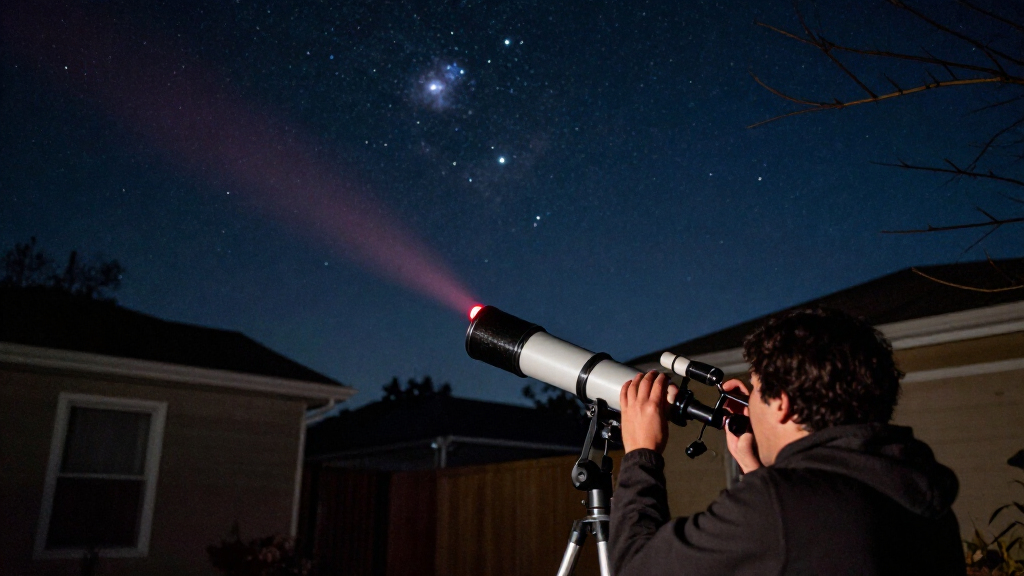
The Orion Nebula is identified in the NASA entry by its catalog name, M42, and by the common name Great Nebula in Orion. It appears near the belt of three stars in the constellation Orion, making it accessible to skywatchers even without optical equipment under suitable viewing conditions. The entry calls it one of the most famous astronomical nebulae.
NASA’s Astronomy Picture of the Day pairs a daily image or photograph with an explanation written by a professional astronomer. The Oct. 26 feature describes a deep image of the nebula and identifies its color treatment and hydrogen emission, while the accompanying text provides the distance, approximate span and objects found within it. Those details are the stated basis for the feature; the source does not report a new observation campaign or a change in scientific understanding.
What the Image Does Not Establish
The Oct. 26 entry does not announce a new discovery, provide fresh measurements or describe when the image was taken. It gives an approximate distance and span for M42 but does not explain how those values were determined or include uncertainty ranges. The source also does not identify specific stars, disks or jets in the image beyond its general description of the nebula’s features.
The assigned-color image should not be read as a direct-color view of the nebula: the entry says colors are assigned and that hydrogen emission is highlighted, but it does not provide a detailed mapping of each color to a wavelength or physical component. No separate interpretation from the image creator or additional research findings are included in the supplied report.
The Next Daily Sky Feature
The entry points readers to the next Astronomy Picture of the Day, listed as “open space.” The source does not give further details about that image or an expected publication time beyond its place in the daily series. The Oct. 26 feature stands as a presentation of M42 and its star-forming environment, with no follow-up announcement or related observing event specified.
Key Questions
What is M42?
M42 is the Orion Nebula, also called the Great Nebula in Orion. NASA describes it as a nearby region of star formation.
How far away is the Orion Nebula?
The NASA Astronomy Picture of the Day explanation places it about 1,500 light-years away.
Can people see M42 without a telescope?
According to the entry, the nebula can be found with the unaided eye near Orion’s belt of three stars. Visibility depends on observing conditions.
What does the featured image show?
The deep image uses assigned colors and highlights hydrogen emission, making wisps and sheets of gas and dust particularly evident, according to NASA’s description.
Does the Oct. 26 feature report a new discovery?
No new discovery or measurement is reported in the supplied entry. It is an Astronomy Picture of the Day feature with an image and explanatory text about the nebula.
Source: primary