
TL;DR

Prime made for students and young adults
- Fast, free delivery for dorm and study essentials
- Prime Video and Amazon Music included
- Member-only deals
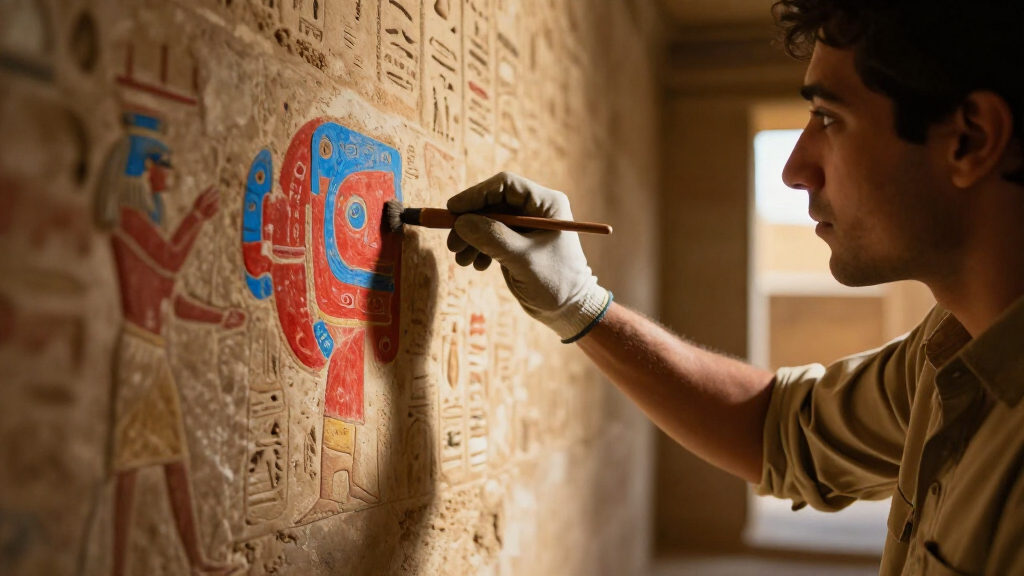
Archaeologists have discovered a 4,400-year-old tomb of an Egyptian judge at Saqqara, notable for its preserved wall colors. The find provides valuable insights into early Egyptian society and burial practices.
Archaeologists have uncovered a 4,400-year-old tomb of an Egyptian judge at Saqqara, with remarkably well-preserved wall paintings still bearing vibrant colors. This discovery, confirmed by Egyptian authorities, offers fresh insights into early Egyptian judicial figures and burial customs. The find is considered one of the most significant recent discoveries at Saqqara, a site known for its extensive ancient tombs.
The tomb was discovered during ongoing excavations at Saqqara, a vast necropolis south of Cairo. It is believed to date back to the Fifth Dynasty of Egypt, around 2400 BCE. The tomb’s walls feature colorful murals depicting scenes of judgment, offerings, and daily life, which remain remarkably intact despite the millennia.
According to Egypt’s Ministry of Tourism and Antiquities, the tomb belonged to an individual identified as a judge, whose name and titles are currently being studied. The preservation of the wall paintings, especially the use of vibrant pigments, indicates high-quality craftsmanship and suggests the importance of the tomb’s occupant. The site was uncovered by a team led by prominent Egyptian archaeologists, with international collaboration involved.
Initial analysis of the murals shows detailed depictions of religious rituals, including the weighing of the heart—a key element in Egyptian beliefs about the afterlife. The pigments used include lapis lazuli, malachite, and ochre, which are typical of elite tombs from this period.
Implications for Understanding Early Egyptian Society
This discovery provides valuable new evidence about the social structure and judicial system of ancient Egypt during the Fifth Dynasty. The presence of detailed murals depicting judgment scenes underscores the importance of legal and religious authority at that time. The preservation of the wall colors also offers insights into the artistic techniques and materials used by ancient Egyptian artisans, enriching our understanding of their craftsmanship.
Furthermore, the find at Saqqara adds to the growing body of evidence that Egypt’s early dynastic period was marked by complex social hierarchies and elaborate burial customs. It may also shed light on the roles and status of judges within the society, a topic that remains partially understood from existing texts and artifacts.
Popular right now

KitchenAid Classic Series 4.5-Quart Tilt-Head Stand Mixer, Onyx Black

Dyson Big Ball Multi Floor Canister Vacuum, Yellow

Sony WH-1000XM4C Wireless Noise-Cancelling Headphones, Black
As an affiliate, we earn on qualifying purchases.
Saqqara’s Rich Archaeological Record and Recent Discoveries
Saqqara has long been a focal point for Egyptologists, known for its step pyramids, mastabas, and numerous tombs from various dynasties. Recent years have seen a surge in excavations, revealing important artifacts and structures that deepen our knowledge of Egypt’s ancient civilization. Notable recent finds include the discovery of a large necropolis from the Old Kingdom and several well-preserved tombs of officials and priests.
The current find is part of a broader effort to explore the early dynastic period, which is less well understood compared to later eras. The use of advanced imaging and preservation techniques has enhanced the ability to uncover and study these ancient sites. The discovery has also attracted increased international interest, with scholars eager to analyze the artifacts and murals in detail.
While the tomb’s exact occupant remains under study, the find underscores Saqqara’s ongoing significance as a site of major archaeological importance.
Unconfirmed Details About the Tomb’s Occupant and Artifacts
While the tomb has been confirmed as belonging to an Egyptian judge from the Fifth Dynasty, the full identity of the individual remains under study. Researchers are still analyzing inscriptions and artifacts to determine his name, titles, and social status. The precise reason for the tomb’s exceptional preservation, especially the vibrant wall colors, is also not yet fully understood.
Additionally, the scope of the artifacts and any additional burial goods inside the tomb are still being examined, and further discoveries may be forthcoming as excavations continue.
Next Steps in Excavation and Analysis
Researchers plan to conduct detailed chemical and pigment analyses of the murals to better understand the materials used. They will also work on translating inscriptions to identify the tomb’s occupant fully. Further excavations are expected to uncover additional artifacts and possibly more tombs nearby.
International collaboration is expected to increase, with plans to employ advanced imaging technologies such as 3D scanning and ground-penetrating radar to explore the site further. The findings will be published in academic journals and presented at upcoming conferences, contributing to broader understanding of Egypt’s early history.
Key Questions
How old is the tomb?
The tomb is approximately 4,400 years old, dating back to the Fifth Dynasty of Egypt, around 2400 BCE.
What makes the wall paintings special?
The murals are remarkably well-preserved, with vibrant pigments including lapis lazuli and ochre, offering rare visual insights into ancient Egyptian religious and social life.
Who was the tomb’s occupant?
The individual was identified as an Egyptian judge from the Fifth Dynasty, but his full identity and titles are still being studied.
Why is this discovery important?
It enhances understanding of early Egyptian society, judicial roles, and artistic techniques, and highlights Saqqara’s ongoing archaeological significance.
Are there more discoveries expected?
Yes, further excavations and analyses are planned, with potential for uncovering additional artifacts, tombs, and insights into Egypt’s ancient civilization.
Source: hn