
TL;DR

Prime made for students and young adults
- Fast, free delivery for dorm and study essentials
- Prime Video and Amazon Music included
- Member-only deals
IdeaClyst is a local-first, AI-powered war room for ideas. It combines AI council debates, research-backed validation, and a founder’s workspace to help you pick the best idea—without risking your data or sanity.
Imagine juggling three promising ideas, each with the potential to reshape your business. Your stomach tightens. Which one deserves your attention—and your resources? This isn’t just about gut instinct; it’s about making decisions backed by real insights, disagreement, and clear plans. That’s where IdeaClyst steps in.
More than just a tool, it’s a digital war room—a dedicated space where your ideas are tested, challenged, and built into solid plans. No cloud account, no data leaks, just a local workspace that keeps your thinking safe and your ideas sharp. Ready to see how this could change your startup game? Let’s dive in. For more on innovative startup tools, visit farmingtips.org.
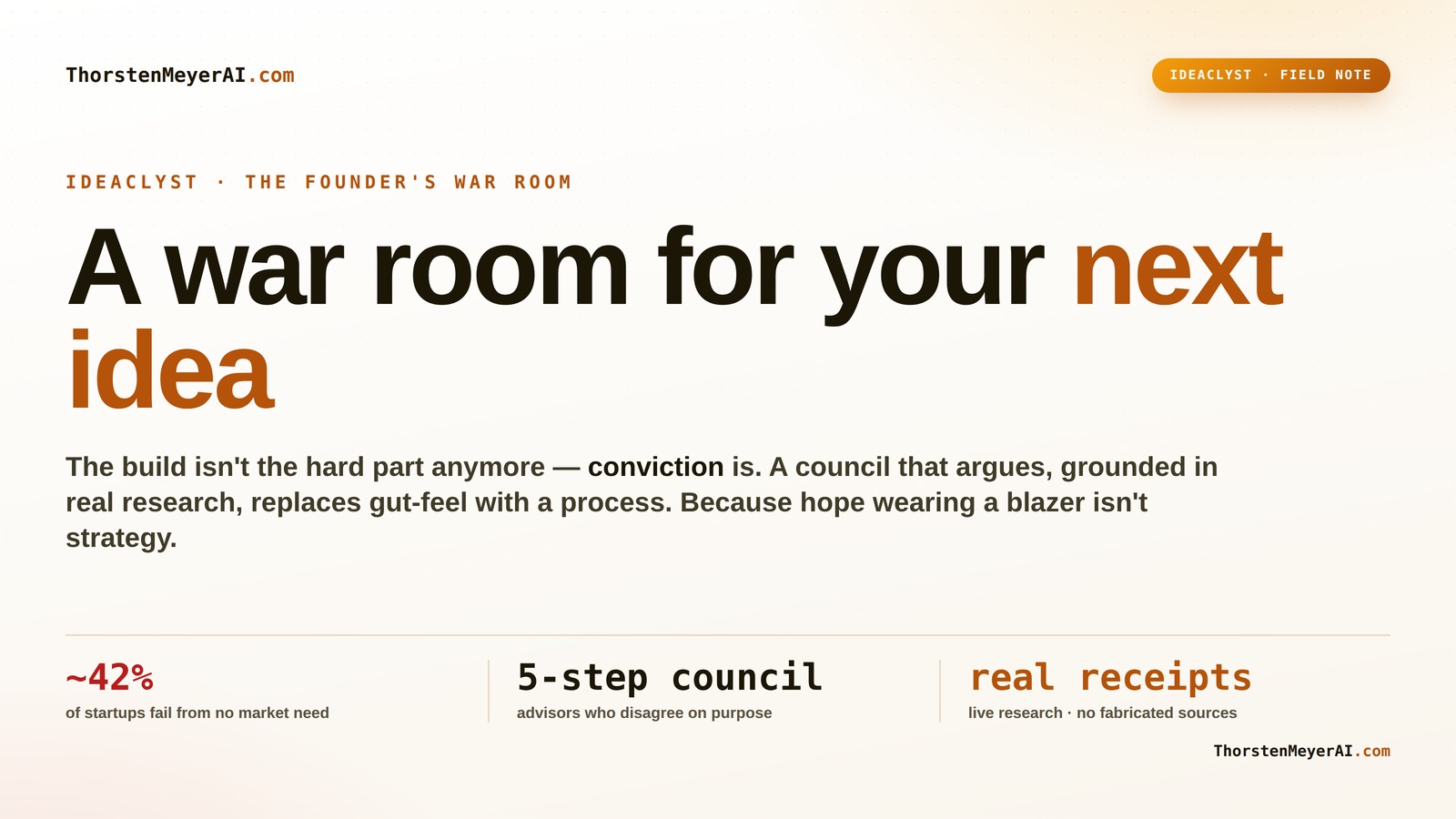
A war room for your next idea
The build isn’t the hard part anymore — conviction is. Knowing which idea deserves the next six months, and being able to defend it. Most founders answer with gut feel and optimistic math. That’s hope wearing a blazer. IdeaClyst replaces it with a process.
The most expensive decision is what to build
The single most valuable thing a tool can do is talk you out of the wrong six months. The numbers make the case better than any pitch.
Three tools in one — on your own machine
Strip away the framing and IdeaClyst is three things at once, all running locally with nothing leaving your laptop.
An AI council
Pressure-tests an idea you bring it — advisors who argue on purpose.
A discovery engine
Finds ideas you didn’t know to look for by hunting real demand signals.
A founder’s workspace
Carries winners from “interesting” all the way to “ready to build.”
Advisors who disagree on purpose
Not one confident, agreeable answer — a structured five-step deliberation where models play different roles and turn on their own work. The disagreement is the feature.
The five-step deliberation
A council that leads with the bad news surfaces the objections you’d otherwise find the expensive way, on month five.
Product strategy
Who’s it for, what’s the wedge, why now, what’s the business model.
Technical architecture
What would it actually take to build — and where’s the risk.
Critique pass
The council turns on its own work. Where’s the hand-waving? What kills this?
Second, independent critique
A different voice, a different angle — so blind spots don’t survive.
Final synthesis
Everything into one coherent founder packet: strategy, architecture, validation, plan.
When IdeaClyst cites a source, it actually fetched it
The hard departure from “ask an AI what it thinks of my startup.” It runs in a strict, real-data-only mode — if it can’t gather genuine evidence, it says so plainly rather than inventing a plausible paragraph.
Confidence with receipts
No fabricated statistics, no imaginary competitors, no made-up citations. The packet survives a skeptical co-founder or a sharp investor because the reasoning has receipts.
Market research first
Scouts the landscape before the council reasons about anything.
Competitor read
Real positioning, pricing signals, feature claims — differentiation vs. reality.
Validation with links
Not “talk to customers” — concrete signals & sources you can click.
From the blank page to build-ready
Evaluation is half the problem; the blank page is the other half. And a plan is worthless if it dies in a tab you never reopen.
Bring a space, not an idea
“AI for accountants,” “tools for indie game studios” — plus your goal and real capacity. It hunts demand signals across HN, Reddit, Product Hunt, GitHub, pricing pages.
- An honest market read — leads with the bad news when a space is hard
- An opportunity map — high pain, thin competition
- Ranked candidates — wedge, who pays, effort, risk, confidence
- each with KILL CRITERIA — when to walk away
A home and a forward path
Every promising idea gets carried forward, with every artifact in plain files on your disk.
- Validation tooling — sprint board, interview list, evidence browser
- Founder profile — a personal-fit lens; same discovery, different advice
- Build workspaces — funnel, personas, landing draft, version history
- “Build this idea” → a PRD + task queue, ready for a coding agent
Key Takeaways
- IdeaClyst combines a structured AI council with live web research to validate ideas based on evidence, not just hype.
- The local-first design keeps all your ideas, critiques, and plans private—perfect for sensitive projects.
- Disagreement among AI models surfaces weaknesses early, saving you from costly failures.
- A comprehensive final report consolidates debates into a clear, ready-to-act plan.
- You can set up your own idea war room today with simple tools—no big budgets or cloud dependencies needed.
As an affiliate, we earn on qualifying purchases.
What makes IdeaClyst a real game-changer for startup founders?
IdeaClyst is a local-first, AI-powered toolbox designed for founders serious about making the right call. It’s a war room in your pocket, where ideas are debated, dissected, and validated with razor-sharp clarity. Unlike typical brainstorming apps, it enforces disagreement—because we know the best ideas come from healthy conflict. Learn more about creative problem-solving at IdeaClyst.
Picture this: you bring a half-formed concept, and the AI council challenges every assumption. It’s like having a panel of seasoned advisors, each with a different perspective, arguing their case. This clash isn’t just for show; it’s a deliberate process to surface potential flaws, unexamined risks, and overlooked opportunities. The tradeoff is that this rigorous debate takes time and mental effort, but it’s a small price for clarity and confidence in your decisions.
And it’s built to stay private. All your ideas, reports, and plans stay on your machine, in plain files—perfect for founders who want control over their data. It’s open source, transparent, and designed to support your thinking, not collect it.
As an affiliate, we earn on qualifying purchases.
How the AI council stages a debate that reveals the truth about your idea
Think of the AI council as a boardroom of experts—each with a role, each with a voice. When you feed in an idea, it kicks off a five-step process: For more insights into structured decision-making, see designthinkingblog.com.
- Product strategy: Who’s the customer? What’s the wedge? Why now?
- Technical architecture: What does it take to build this? Where are the risks?
- Critique pass: The council digs into weaknesses, unproven assumptions, and blind spots.
- Second critique: A fresh set of eyes from a different angle catches what was missed.
- Synthesis: All critiques merge into a clear plan—strategy, architecture, validation, next steps.
This structured disagreement is crucial because it forces you to confront assumptions and blind spots that are easy to overlook. Early validation helps avoid costly mistakes later in development or market entry. The tradeoff is the extra time spent in debate, but this investment often saves much more in the long run by preventing failed pivots or misaligned products.
research-backed startup idea validation tools
As an affiliate, we earn on qualifying purchases.
As an affiliate, we earn on qualifying purchases.
Why grounding ideas in real research beats empty hype every time
Ideas aren’t just about what sounds good—they need proof. IdeaClyst stands apart by grounding its council’s debates in live web research, not just model guesses. It pulls in real data, current market trends, and competitor info, making sure your idea isn’t just plausible—it’s justified. Discover how evidence-based research can improve your strategies at curiousminds.info.
For example, instead of a vague claim like “the market is growing,” it provides concrete stats: “the market grew 15% in 2025,” or “competitors increased by 20%,” backed by recent sources. This approach ensures that your assumptions are anchored in reality, reducing the risk of pursuing ideas based on outdated or inaccurate information. The implication is that decisions are more reliable, and strategies are more aligned with actual market conditions. The tradeoff is that relying on live data requires continuous updates and verification, but this is a small price for increased confidence and reduced bias from over-optimism or confirmation bias.
This focus on evidence helps founders avoid the trap of false confidence—hearing “great idea” from a chatbot isn’t validation, but real data-driven insights are.
As an affiliate, we earn on qualifying purchases.
The local-first advantage: Your ideas stay private and under your control
Many founders worry about their ideas leaking or being exposed to third parties. IdeaClyst’s local-first approach solves that. Everything stays on your machine. No cloud, no API keys, no data sharing. It’s open source under the MIT license—your raw ideas, reports, and plans are written as plain files that you own.
Imagine a solo founder working in a coffee shop. They can brainstorm, validate, and plan without fear of data breaches or losing control. This setup isn’t just about privacy—it’s about peace of mind, knowing your ideas are safe and yours alone. This privacy-centric approach also encourages more honest and open exploration, as you’re not constrained by fears of data exposure or third-party access. The tradeoff is that you need to manage your own data security, but for many founders, this level of control outweighs the convenience of cloud-based solutions.
Plus, this local-first model makes it easy to integrate with your existing tools and workflows, like version control or custom templates.
Turning disagreement into clarity: How the final report guides your decision
After all the debates and critiques, IdeaClyst generates a clear, actionable founder packet. Think of it as your strategic playbook, with tabs for each critical part: research, architecture, validation tests, critiques, and the final plan. This synthesis consolidates all the insights, objections, and validations into a cohesive document that captures the rationale behind each decision. It’s not just a summary; it’s a transparent record of the debate process, enabling you to revisit, adjust, or defend your choices later. The act of compiling this report encourages reflection, ensuring you’ve considered all angles before committing resources.
This final report acts as a decision-making anchor—helping you weigh the evidence, objections, and recommendations objectively. For example, if you’re torn between two ideas, the report lays out the evidence, objections, and a recommended path, helping you pick with confidence. The tradeoff is that it requires a disciplined approach to document the debates thoroughly, but this discipline leads to more robust and defendable decisions. For more on effective decision-making, visit cryptogramplatform.com.
Practical steps to set up your own idea war room today
Starting your own idea war room doesn’t require a fancy conference table or expensive software. Here’s a simple step-by-step:
- Select your tools: Use IdeaClyst for AI debate, plus simple markdown editors and version control.
- Gather your ideas: Write down your top concepts, no matter how rough.
- Run the council: Input each idea into IdeaClyst, and let the AI debate unfold—disagreeing and questioning.
- Review critiques and synthesize: Read the final report and decide which idea stands strongest.
- Act confidently: Use the report to plan your next steps—funding, development, or pivoting.
This process transforms guesswork into evidence-based decisions, saving months and thousands of dollars.
Frequently Asked Questions
What exactly is a war room for ideas?
A war room for ideas is a dedicated space—digital or physical—where your team or yourself gather to develop, challenge, and validate ideas systematically. It’s designed to keep everyone focused and aligned, reducing the risk of costly mistakes.
Can I use IdeaClyst if I’m a solo founder?
Absolutely. IdeaClyst is built for solo founders too. Its local-first setup makes it easy to organize, validate, and plan ideas without sharing sensitive info online. It’s your private think tank, right on your machine.
How does IdeaClyst help prevent building the wrong product?
By grounding every idea in real-time web research and structured debate, it highlights risks and weaknesses early. This process reduces the chances of you investing months and thousands of dollars into something the market doesn’t want.
Is IdeaClyst hard to set up?
Not at all. It’s designed to be straightforward—install the software, write down your ideas, and run the council. No complex integrations or cloud accounts needed. It’s a simple, powerful way to keep your ideas sharp and your plans clear.
Can IdeaClyst grow with my startup?
Yes. As your ideas evolve, the war room adapts. You can keep adding new concepts, refining plans, and tracking progress—all in your private workspace, ready to scale alongside your venture.
Conclusion
Thinking through your ideas in a dedicated war room changes everything. It’s not just about brainstorming; it’s about making smart, evidence-backed choices—fast, private, and confident.
Imagine having a personal panel of experts arguing your case, with every objection turned into a stepping stone. That’s the power of IdeaClyst. Your next big idea deserves a war room—start building yours today.
Halloween Picks
halloween
As an affiliate, we earn on qualifying purchases.