
Finding the right microphone for podcasting involves balancing sound quality, ease of use, and budget. The Shure MV7+ stands out as the best overall choice thanks to its versatile USB/XLR connectivity and auto level feature. For those on a tighter budget, the FIFINE K688 offers solid performance with an easy setup, while the Logitech Blue Yeti remains popular for its plug-and-play convenience. The main tradeoffs in this category usually involve choosing between professional-grade XLR options and simpler USB models, or balancing sound quality with affordability. Continue reading for a detailed breakdown of each microphone’s strengths and weaknesses to find your perfect match.
Key Takeaways
- The best microphones for podcasting combine good sound quality with user-friendly features like easy connectivity and controls.
- XLR microphones tend to deliver higher sound fidelity but require additional equipment and setup knowledge.
- USB microphones are more accessible for beginners and streamers but may sacrifice some professional sound nuances.
- Build quality and durability can vary significantly, impacting long-term reliability and ease of use.
- Features like noise cancellation, monitoring, and auto level adjustment can make a noticeable difference in recording quality.



More Details on Our Top Picks
This model makes the most sense for creators seeking studio-like quality with easy setup, especially compared with the FIFINE K688, which offers more connectivity options but less integrated control. Its noise reduction features and wide frequency response make it suitable for producing clean, professional-sounding podcasts or streams. The plug-and-play USB-C and Lightning compatibility simplify multi-device use, and real-time monitoring with zero latency is a significant plus. The main tradeoff is its USB-only design, which excludes XLR enthusiasts or those wanting more advanced hardware integration. Overall, it’s a reliable choice for digital content creators who want high-quality audio with straightforward controls.
Pros:- Studio-quality sound with noise reduction
- Plug-and-play with multiple devices
- Real-time zero-latency monitoring
- Intuitive physical controls for gain and echo
Cons:- Limited to USB connections, no XLR option
- Some users find physical controls less precise than software
Best for: Podcasters and streamers who prioritize ease of use and studio-quality sound on multiple devices
Not ideal for: XLR users or those requiring advanced hardware integration, as it lacks XLR connectivity
- Frequency Response:40Hz–18kHz
- Sampling Rate:46kHz
- Sensitivity:–45dB ±3dB
- Connectivity:USB-C, Lightning, 3.5mm
Bottom line: Ideal for digital content creators who want quick setup and high-quality sound across various platforms.
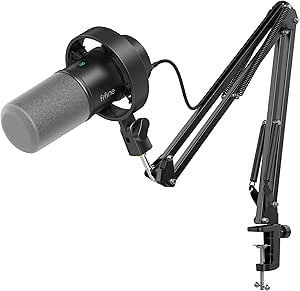
FIFINE K688 Podcast Microphone Kit with Boom Arm – USB/XLR Dynamic Microphone for Streaming, Voice-Over, Music Recording
The FIFINE K688 distinguishes itself through its dual USB and XLR connectivity, offering flexibility for those who might start with USB but later expand to more professional setups with XLR interfaces. Unlike the ZealSound, which is primarily USB, this kit includes a robust boom arm, making it more suitable for fixed, professional environments. Its noise reduction and mute features support clearer voice recordings, though the need for proper positioning and the disabled function keys when using XLR can pose challenges. This makes it a strong choice for podcasters who want a versatile, expandable solution but are willing to handle some setup complexity.
Pros:- Dual connectivity options for flexibility
- Includes durable boom arm and accessories
- Features noise reduction and mute controls
- Clear, natural sound quality
Cons:- Function keys disabled on XLR connection
- Proper positioning is essential for best input volume
Best for: Podcasters who want a flexible microphone capable of both USB and XLR connections, with room to grow
Not ideal for: Beginners or those who require simple one-device plug-and-play, due to its more involved setup
- Connectivity Technology:USB, XLR
- Maximum Frequency:16 KHz
- Signal-to-Noise Ratio:80 dB
- Includes:Boom arm, shock mount, windscreen
Bottom line: Perfect for evolving podcasters who need a versatile microphone that adapts to their growing studio setup.
FIFINE XLR/USB Gaming Microphone Set with Boom Arm, RGB Lighting, Mute Button, and Headphone Jack
The FIFINE AM8T caters well to gamers and streamers who want both XLR and USB options, with a focus on aesthetic appeal thanks to its RGB lighting. While the dual connectivity is a strength, the absence of an included XLR cable and the need for manual RGB control are notable drawbacks. Its built-in mute and gain controls support live adjustments, but the lack of detailed specifications makes it less ideal for professional studio work. Compared with the FIFINE K688, it emphasizes style and versatility for gaming setups, though it may fall short for those seeking a purely audio-focused professional microphone.
Pros:- Dual USB and XLR compatibility
- Sturdy boom arm included
- Customizable RGB lighting
- Built-in mute and gain controls
Cons:- XLR cable not included
- RGB lighting requires manual control
- Lack of detailed technical specs
Best for: Gamers and streamers who want a visually striking microphone with flexible connectivity
Not ideal for: Podcasters seeking a more subdued, purely audio-focused setup or those requiring included accessories
- Connectivity:USB and XLR
- Microphone Type:Dynamic cardioid
- Sensitivity:-50dB
- Included Accessories:Boom arm, C-clamp
Bottom line: A stylish and versatile microphone best suited for gamers and streamers who prioritize visual flair alongside audio quality.
Shure MV7+ Podcast Dynamic Microphone with Stand – OBS Certified, USB-C & XLR, Auto Level, Digital Pop Filter, LED Panel, Black
The Shure MV7+ stands out as the most adaptable option, combining both USB-C and XLR outputs, unlike the Blue Yeti, which is solely USB, and the MAONO PD200W, which offers wireless but less high-end features. Its OBS certification and real-time noise reduction give it a professional edge, making it ideal for serious podcasters seeking clean, broadcast-quality audio. The auto level mode helps maintain consistent sound, but this feature may overwhelm beginners unfamiliar with audio settings. Additionally, the customizable LED panel offers visual feedback, which is absent in the other two options. However, its complexity and need for extra XLR equipment in some setups might be a barrier for newcomers. Overall, this pick is perfect for creators who want a long-term, flexible solution that adapts as their needs grow, despite a steeper learning curve.
Pros:- High-quality, clear audio with advanced noise reduction
- Customizable LED panel for visual level monitoring and mute control
- Flexible connectivity options for various setups
- Auto Level Mode maintains consistent sound regardless of distance
Cons:- May be complex for users unfamiliar with audio settings
- Requires additional equipment for XLR connection in some cases
Best for: Podcasters and streamers who want a professional-grade, versatile microphone with both USB and XLR options and are comfortable with advanced settings.
Not ideal for: Beginners looking for a straightforward plug-and-play solution without additional equipment or setup complexity.
- Connectivity:USB-C, XLR
- Color:Black
- Features:OBS Certified, Auto Level Mode, Digital Pop Filter, LED Touch Panel, Voice Isolation Technology, Real-Time Denoiser
- Included Accessories:Microphone stand
Bottom line: This is best suited for serious creators who need a flexible, professional-quality microphone that adapts to different setups, despite its complexity.
Logitech Blue Yeti USB Microphone for PC, Mac, Gaming, Streaming, Podcasting, Studio, Midnight Blue
Compared with the Shure MV7+, the Blue Yeti offers a simpler, entirely USB-based experience, making it more accessible for newcomers. Its four pickup patterns—cardioid, omni, bidirectional, and stereo—allow for a range of recording scenarios, from solo podcasts to group interviews, but this versatility comes at the expense of audio precision compared to the MV7+’s noise-reduction tech. The onboard controls and Blue VO!CE effects make live adjustments easy, though they depend on the Logitech G HUB software, which might be an extra step for some users. The bulkier desktop stand saves space but can be less portable. This microphone is ideal for users who prioritize ease of use and flexibility over pro-level audio, but it might fall short for those needing advanced noise management or XLR connectivity.
Pros:- Four versatile pickup patterns for different recording needs
- High-quality broadcast sound suitable for streaming and podcasts
- Onboard controls for quick adjustments during recording
- Included desktop stand provides stability
Cons:- Requires Logitech G HUB software for full functionality
- Bulkier stand takes up desk space
- Limited to USB, lacking XLR flexibility
Best for: Beginners, streamers, and casual podcasters seeking a simple, plug-and-play USB microphone with multiple pickup patterns.
Not ideal for: Professional creators or those with complex setups requiring XLR connections and advanced noise control.
- Pickup Patterns:Cardioid, Omni, Bidirectional, Stereo
- Connectivity:USB
- Color:Midnight Blue
- Software:Blue VO!CE
- Controls:Headphone volume, pattern selection, mute, mic gain
- Included Accessories:Desktop stand
Bottom line: Ideal for entry-level users who want a flexible, easy-to-use microphone that covers multiple recording scenarios without the complexity of professional gear.
MAONO PD200W Hybrid Wireless Podcast Microphone for PC, Dynamic XLR USB Mic with Desktop Stand, Software, Noise Cancellation, for Vocal Recording, Streaming, Content Creation, Home Studio, Voiceover
The MAONO PD200W offers a distinctive advantage with its wireless connectivity alongside USB and XLR, making it ideal for creators who prioritize mobility and setup flexibility. Unlike the Blue Yeti, which is fixed in place, the PD200W’s wireless range of 60 meters and 60-hour battery life facilitate dynamic recording environments. Its studio-quality sound and noise cancellation outperform many typical USB mics, especially in noisy settings. The support for dual microphones makes it suitable for interviews or collaborative podcasts, but setup can be a bit involved, particularly for dual-mic configurations. Additional accessories, like camera or lighting, are sold separately, which might add to total costs. This microphone is perfect for mobile content creators or home studios seeking wireless freedom without sacrificing audio quality, though it involves more setup complexity.
Pros:- Wireless, USB, and XLR connectivity for maximum flexibility
- Studio-quality sound with noise cancellation and high SPL handling
- Supports dual microphones for interviews or duo podcasts
- Long battery life and wide wireless range
Cons:- Additional accessories like camera or lighting are sold separately
- Setup complexity for dual-mic configurations
- RGB lighting features may be unnecessary for some users
Best for: Content creators who need wireless mobility, dual-mic support, and high-quality sound for podcasts and streaming in flexible environments.
Not ideal for: Users seeking an ultra-simplified setup or those on a tight budget, as accessories and setup may increase costs and complexity.
- Microphone Type:Dynamic
- Connectivity:Wireless, USB, XLR
- Pickup Pattern:Cardioid
- Signal-to-Noise Ratio:82dB
- Maximum SPL:128dB
- Wireless Range:60 meters
- Battery Life:Up to 60 hours
Bottom line: Best suited for mobile and flexible podcasting setups where wireless freedom and dual-mic capability outweigh the need for simplicity.
How We Picked
These microphones were selected based on a combination of performance, usability, build quality, and value. We prioritized models that offer clear, professional sound reproduction suitable for podcasting, whether they connect via USB or XLR. Ease of setup and included features such as mute buttons, monitoring, and noise reduction played key roles in the ranking. Price was also considered to provide options for different budgets, but higher-end models were favored if they offered significant audio improvements. Our goal was to highlight microphones that strike a balance between quality and practicality for both newcomers and experienced podcasters.Factors to Consider When Choosing Microphones Podcasting
Choosing the right microphone for podcasting depends on several factors beyond basic sound quality. Understanding these can help you avoid common pitfalls and make a more informed purchase. Consider your technical setup, budget, and future-proofing needs to select a microphone that grows with your skills. Let’s explore key factors to keep in mind during your decision process.Connectivity: USB vs. XLR
USB microphones offer plug-and-play simplicity, making them ideal for beginners or those streaming directly to platforms. XLR microphones, on the other hand, typically provide higher audio fidelity and are suited for professional setups, but they require additional gear like audio interfaces. Deciding between these depends on your current setup and willingness to invest in extra equipment. For casual podcasting or quick setups, USB is often sufficient, but for studio-quality sound, XLR is the better choice despite the complexity.
Sound Quality and Audio Fidelity
The core of great podcast audio lies in sound clarity and noise handling. Higher-end microphones often feature better diaphragms, noise reduction, and dynamic range, which contribute to cleaner recordings. Cheaper models may pick up more background noise or produce muffled audio, which can detract from professionalism. When choosing, consider whether your environment is controlled or noisy, and select a microphone that can handle those conditions effectively.
Features and Controls
Features like mute buttons, headphone monitoring, gain controls, and noise cancellation can significantly streamline recording sessions. These controls allow for real-time adjustments and help maintain consistent audio levels. However, added features often mean higher costs. Assess which features are essential for your workflow—overloading on unnecessary controls can complicate use, while missing key features might require additional equipment or adjustments later.
Build Quality and Durability
Microphones are an investment, so durability matters. Look for solid metal construction and reliable mounting options. Cheaper plastic models might be tempting for their low price but can break or degrade faster. If you plan to move or travel with your microphone, a sturdy build and included accessories like a shock mount or sturdy stand can prevent damage and improve sound isolation.
Budget and Future-Proofing
While sticking to a budget is understandable, investing slightly more can yield better long-term value, especially if you plan to upgrade your setup later. Consider how the microphone fits into your future plans—will you need higher quality for professional growth? Are you okay with starting simple and upgrading later? Balancing current needs with future aspirations helps you avoid unnecessary repurchases or missed opportunities for improved audio quality.
Frequently Asked Questions
Is a USB microphone good enough for professional podcasting?
Many podcasters successfully produce high-quality content using USB microphones, especially if their environment is controlled and they prioritize ease of use. While XLR setups can offer superior audio fidelity, a good USB microphone with proper placement and acoustics can deliver professional results for most listeners. The key is choosing a model with good noise handling and clear audio reproduction, which many USB mics now provide at accessible prices.
Should I invest in an XLR microphone for podcasting?
Investing in an XLR microphone makes sense if you aim for the highest audio quality and have the space and budget for extra equipment like an audio interface or mixer. XLR mics generally provide better dynamic range and noise rejection, which can improve your sound in less-than-ideal environments. However, they also involve a steeper learning curve and higher upfront costs, so weigh these factors against your current needs and future plans.
What features should I prioritize for beginner podcasting microphones?
For beginners, features like easy USB connectivity, built-in mute controls, and good noise rejection are most helpful. A microphone that’s simple to set up and doesn’t require extra gear reduces barriers to starting. Additionally, a model with a sturdy stand or shock mount can improve sound quality by reducing handling noise. Focus on clarity and ease of use to make your first recordings smooth and enjoyable.
How important is build quality for a podcasting microphone?
Build quality influences both durability and sound isolation. A well-constructed microphone with metal components can withstand frequent use and transport, minimizing damage and maintenance. Better build quality often correlates with more consistent performance over time, especially in dynamic or mobile recording situations. Investing in a durable model can save money and frustration in the long run, especially if you record regularly or travel for podcasts.
Can I upgrade my microphone later, or should I buy the best now?
It’s possible to upgrade later, but starting with a quality microphone that matches your current needs can save time and effort. Budget options might limit your sound quality initially, prompting an upgrade sooner than expected. Conversely, investing in a good microphone now, especially if you see your podcast growing, ensures better audio from the start and reduces the need for costly replacements or additional gear later. Consider your growth trajectory and choose accordingly.
Conclusion
For casual podcasters or those just starting out, the Logitech Blue Yeti offers straightforward setup and decent sound quality. Serious hobbyists or professionals seeking studio-grade audio should consider the Shure MV7+ or high-end XLR options for their superior fidelity and features. Budget-conscious creators will find the FIFINE K688 provides reliable performance without a hefty price tag. Content creators prioritizing mobility and versatility might lean toward the MAONO PD200W. Ultimately, your choice depends on your current setup, future goals, and how much you’re willing to invest in sound quality.