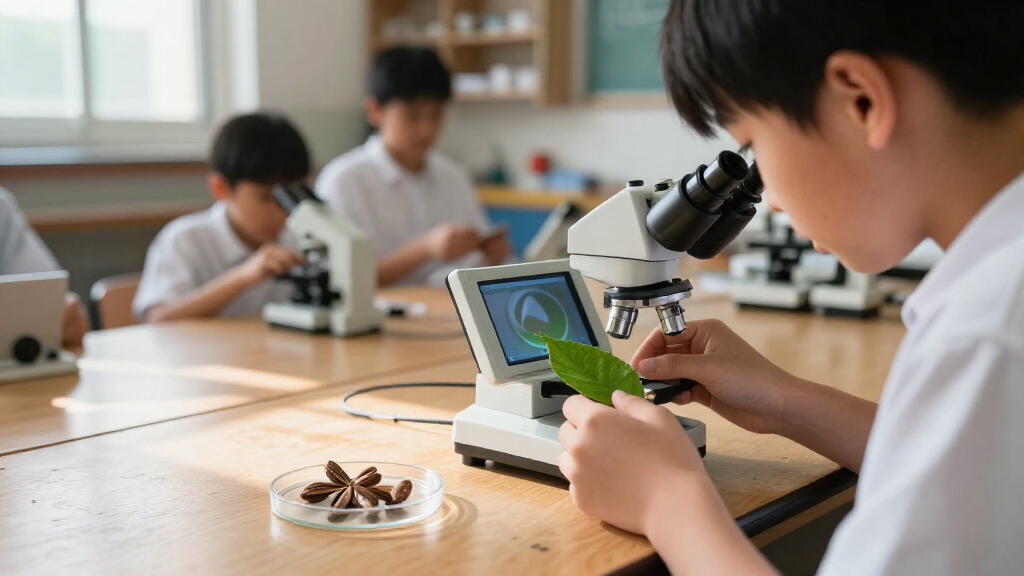
For most students, I would start with the TOMLOV DM301 Pro: its built-in 7-inch screen offers a direct way to inspect and share specimens without requiring a separate monitor. The Celestron TetraView is a stronger fit for learners who want a traditional microscope format, while the Andonstar AD266S suits advanced projects that benefit from multiple lenses and HDMI output. The main tradeoff is between straightforward, screen-based viewing and more specialized tools for coins, soldering, or varied magnification needs. I also weigh setup, specimen compatibility, and how easily students can work together around the display. Read on for the full breakdown and a recommendation by student type.

Prime made for students and young adults
- Fast, free delivery for dorm and study essentials
- Prime Video and Amazon Music included
- Member-only deals
Key Takeaways
- The DM301 Pro is the most balanced classroom-style pick in this lineup, pairing a large built-in display with a general-purpose format rather than a coin- or soldering-specific design.
- The TetraView offers a different learning experience: its 180-degree swivel screen and conventional microscope layout favor guided observation, while the TOMLOV screen models are more directly suited to bench viewing.
- Specialized features matter only when they match the lesson. The DM4W and DM4W Max add weighing and precision-scale functions for coins or small objects, but those features do not replace a broad specimen setup.
- The AD266S is the most adaptable option for varied projects because it includes five lenses and HDMI connectivity, though its greater flexibility may bring more setup complexity than a beginner needs.
- A bigger magnification figure is not a complete measure of usefulness. Working distance, lighting, screen access, and whether a specimen fits under the stage can matter more in everyday student work.
| TOMLOV DM4W Digital Microscope with Built-in Precision Scale |  | Best for Coin and Mineral Lessons | Model: DM4W | Display: 4.3-inch IPS, 500 cd/m² brightness, 178° viewing angle | Zoom range: 10X to 200X | VIEW LATEST PRICE | See Our Full Breakdown |
| Celestron TetraView LCD Digital Microscope with 180° Swivel Screen |  | Best for Classroom Biology | Model: 44347 | Screen: 4.3-inch full-color TFT LCD with 180° rotating head | Magnification: 40x–400x optical; up to 1600x digital | VIEW LATEST PRICE | See Our Full Breakdown |
| TOMLOV DM4W Max Digital Coin Microscope with Weighing Scale, 7-Inch Screen |  | Best for Shared Object Study | Model: DM4W Max | Screen: 7 inches; 800 × 480 resolution | Photo resolution: Up to 5440 × 3060 (16MP) | VIEW LATEST PRICE | See Our Full Breakdown |
| TOMLOV DM9 7″ Digital Coin Microscope with 1200X Magnification |  | Best for General Close-Up Projects | Model: DM9 (TM-DM9) | Screen: 7-inch LCD | Magnification: Up to 1200X | VIEW LATEST PRICE | See Our Full Breakdown |
| TOMLOV TM3K-3D 3D Digital Soldering Microscope with 7-Inch Screen |  | Best for Electronics and Soldering Projects | Model: TM3K-3D | Display: 7-inch IPS screen | Resolution: 3K UHD | VIEW LATEST PRICE | See Our Full Breakdown |
| TOMLOV DM301 Pro Digital Microscope with 7-Inch Screen |  | Best for Shared Classroom Viewing | Display: 7-inch IPS screen | Magnification: Up to 1200× | Lenses: Three achromatic lenses | VIEW LATEST PRICE | See Our Full Breakdown |
| TOMLOV DM301 Max Digital Microscope with 7-Inch Screen |  | Best for Hands-On Slide Positioning | Screen: 7-inch full-color IPS | Magnification: Up to 1200× | Lenses: 3 achromatic lenses | VIEW LATEST PRICE | See Our Full Breakdown |
| Andonstar AD266S 20X-5000X HDMI Digital Microscope with 5 Lenses and 2160P UHD Video |  | Best Advanced, Multi-Discipline Pick | Magnification range: 20×–5000× | Screen: 7-inch IPS LCD | Lens count: 5 interchangeable lenses | VIEW LATEST PRICE | See Our Full Breakdown |
| digital microscopes for student | Connectivity | Model | Screen | Video resolution |
|---|---|---|---|---|
| TOMLOV DM4W Digital Microscope | USB; compatible with macOS and Windows | DM4W | — | — |
| Celestron TetraView LCD Digita | — | 44347 | 4.3-inch full-color TFT LCD with 180° rotating head | — |
| TOMLOV DM4W Max Digital Coin M | USB output; compatible with Windows and Mac | DM4W Max | 7 inches; 800 × 480 resolution | 2K |
| TOMLOV DM9 7" Digital Coin Mic | USB; compatible with Windows and Mac | DM9 (TM-DM9) | 7-inch LCD | 1080P |
| TOMLOV TM3K-3D 3D Digital Sold | HDMI and USB | TM3K-3D | — | — |
| TOMLOV DM301 Pro Digital Micro | Wi-Fi app support, USB, and HD output | — | — | 1080p |
| TOMLOV DM301 Max Digital Micro | Wi-Fi app viewing, USB, and HD connections | — | 7-inch full-color IPS | 1080p |
| Andonstar AD266S 20X-5000X HDM | HDMI and USB | — | 7-inch IPS LCD | 2160P UHD |
More Details on Our Top Picks
TOMLOV DM4W Digital Microscope with Built-in Precision Scale
For students studying coins, minerals, or other small specimens, the TOMLOV DM4W links magnified inspection with weighing on the same stable stand. Its 10X–200X zoom and bright 4.3-inch IPS display suit close-up classroom viewing, while the scale lets students compare an object’s appearance with its weight without moving it to a second tool. Compared with the larger-screen TOMLOV DM4W Max, this model is more compact, but its smaller display gives the teacher and student less room to view together. The cordless battery is useful for moving between tables or taking the microscope outdoors. The tradeoff is that the stated ±0.5 g accuracy is not suited to precise lab measurements, and recording or sharing on a computer requires a USB connection. I’d choose it for hands-on object studies, not as a general-purpose biological microscope.
Pros:- Combines magnified viewing and weighing for connected specimen activities.
- 4.3-inch IPS display has a 178° viewing angle for flexible positioning.
- Built-in battery supports cordless classroom or field use.
- Stable 8-inch stand and enlarged base help keep the view steady during adjustments.
Cons:- Scale accuracy of ±0.5 g is too limited for fine measurement work.
- USB is needed to record or share on a computer.
- Its 4.3-inch screen is smaller for shared viewing than the DM4W Max’s 7-inch display.
Best for: Students and teachers comparing the visible features and approximate weight of coins, gemstones, and other small objects.
Not ideal for: Biology classes that need prepared-slide magnification, or lab work requiring more precise weighing than ±0.5 g.
- Model:DM4W
- Display:4.3-inch IPS, 500 cd/m² brightness, 178° viewing angle
- Zoom range:10X to 200X
- Scale resolution:0.1 g
- Scale accuracy:±0.5 g
- Weighing units:g, oz, ct
- Stand height:8 inches
- Connectivity:USB; compatible with macOS and Windows
- Power:Built-in battery
Our verdict“Choose the DM4W for student activities that pair close-up inspection with approximate weighing, but skip it for slide biology or precision measurements.”
Celestron TetraView LCD Digital Microscope with 180° Swivel Screen
The Celestron TetraView is the clearest fit here for lessons built around prepared slides rather than coins or circuit boards. Its 4x, 10x, 20x, and 40x objective lenses provide a more biology-focused setup than the object-oriented TOMLOV DM9, and the mechanical stage helps students position specimens for repeatable viewing. A 180° swivel LCD lets a teacher turn the image toward a small group, while the 5MP camera and included prepared slides make it easier to document and begin class activities. Its quoted 1600x figure includes digital magnification; the optical range tops out at 400x, so students should not expect digital zoom to reveal the detail of additional optical magnification. Compared with the DM9’s larger 7-inch screen, the TetraView’s 4.3-inch display is less generous for group viewing, and battery operation requires four AA batteries that are not included.
Pros:- Four objective lenses and a mechanical stage suit structured slide-based lessons.
- 180° swivel screen allows a teacher to share the view without eyepieces.
- 5MP camera supports still-image and video documentation.
- Includes prepared slides, a carrying case, cables, and a microSD card.
Cons:- The 4.3-inch screen is smaller than the 7-inch displays on the TOMLOV DM9 and DM4W Max.
- Digital magnification beyond the 400x optical range does not add optical detail.
- Four AA batteries for portable use are not included.
Best for: Middle- and high-school biology classes that need objective lenses, a mechanical stage, prepared slides, and a screen that can face a group.
Not ideal for: Students focused on electronics or larger specimens who would benefit more from a larger display and flexible work lighting.
- Model:44347
- Screen:4.3-inch full-color TFT LCD with 180° rotating head
- Magnification:40x–400x optical; up to 1600x digital
- Objective lenses:4x, 10x, 20x, 40x
- Camera:5MP; 3648 × 2048 pixels
- Video frame rate:20–30 fps
- Power:AC adapter or 4 AA batteries (not included)
- Included accessories:MicroSD card, 7 prepared slides, dust cover, carrying case, AV cable, USB cable, touch pen, AC adapter
- Warranty:2-year limited warranty
Our verdict“Pick the TetraView for classroom slide biology and group demonstrations, but favor a 7-inch model for larger on-screen viewing.”
TOMLOV DM4W Max Digital Coin Microscope with Weighing Scale, 7-Inch Screen
The TOMLOV DM4W Max makes the most sense when students need to examine and weigh coins or small valuables while keeping the image large enough for side-by-side discussion. Its 7-inch screen is easier to share than the 4.3-inch display on the standard DM4W, and the full-view area accommodates coins up to 32 mm without repositioning. It also captures 2K video and high-resolution photos, giving students material to review after a lesson. However, the screen itself is only 800 × 480, so the high photo-resolution figure should not be mistaken for a similarly detailed live display. Like the smaller DM4W, the built-in scale has ±0.5 g accuracy; it is useful for basic comparisons, not precise lab work. Compared with the Celestron TetraView, this is better for object-based lessons than prepared-slide biology.
Pros:- 7-inch display is more suitable for shared viewing than the standard DM4W’s 4.3-inch screen.
- Full-view area handles coins up to 32 mm.
- Scale supports grams, ounces, carats, and troy ounces.
- 2K video capture and USB output support documentation and larger-screen viewing.
Cons:- The 800 × 480 screen has less resolution than the maximum captured photo resolution.
- ±0.5 g scale accuracy limits its use for precise measurements.
- Coins larger than 32 mm may need repositioning for full inspection.
Best for: Students and teachers who want a larger shared screen for inspecting and comparing coins, jewelry, and gemstones alongside their approximate weights.
Not ideal for: Biology students who need objective lenses and slide-stage controls, or lab users who need precise weight measurements.
- Model:DM4W Max
- Screen:7 inches; 800 × 480 resolution
- Photo resolution:Up to 5440 × 3060 (16MP)
- Video resolution:2K
- Scale resolution:0.1 g
- Scale accuracy:±0.5 g
- Weighing units:g, oz, ct, ozt
- Full-view coin size:Up to 32 mm
- Connectivity:USB output; compatible with Windows and Mac
Our verdict“Choose the DM4W Max for shared coin and gemstone study with approximate weighing, not for slide-based biology or precision measurement.”
TOMLOV DM9 7″ Digital Coin Microscope with 1200X Magnification
For students moving between coins, plant surfaces, and small electronics, the TOMLOV DM9 is a more flexible general close-up station than either scale-equipped DM4W model. Its 7-inch screen, metal stand, and two flexible gooseneck lights help students keep objects steady and adjust illumination to reduce shadows. The included 16GB card supports saving images and 1080P video without making a computer the only way to document work. Compared with the Celestron TetraView, the DM9 is aimed at surface inspection rather than slide biology: its quoted 1200X magnification does not replace the TetraView’s objective-lens setup and mechanical stage. Lighting and stability are strong points, but the magnification is fixed, and the most expansive viewing option requires a computer connection. Students seeking scale-based coin study should look instead at the DM4W models.
Pros:- 7-inch LCD provides a larger viewing area than the standard DM4W.
- Metal stand and base support steadier close-up work.
- Built-in LEDs plus two flexible gooseneck lights help control shadows and glare.
- Includes a 16GB microSD card and supports 1080P video capture.
Cons:- Fixed 1200X magnification offers less flexibility than a microscope with multiple objective lenses.
- A computer connection is needed for the largest viewing experience.
- Unlike the DM4W models, it has no integrated weighing scale.
Best for: Students exploring surface details on coins, leaves, small objects, or electronics who want a stable stand and onboard image storage.
Not ideal for: Biology students who need objective lenses and a mechanical stage, or learners who need a built-in scale for object comparisons.
- Model:DM9 (TM-DM9)
- Screen:7-inch LCD
- Magnification:Up to 1200X
- Camera resolution:12MP
- Video resolution:1080P
- Storage:16GB microSD card included
- Lighting:8 built-in LEDs and 2 flexible gooseneck lights
- Stand and base:Aluminum-alloy metal stand and heat-resistant metal base
- Connectivity:USB; compatible with Windows and Mac
Our verdict“Choose the DM9 for varied surface-inspection projects that benefit from steady positioning and adjustable light, but not for slide biology or weighing.”
TOMLOV TM3K-3D 3D Digital Soldering Microscope with 7-Inch Screen
Among these picks, the TOMLOV TM3K-3D is the specialist choice for students working with circuit boards, robotics, or soldering. Its 360° side-viewing lets students inspect components from different angles, while the adjustable flex arm and directional spotlight make it easier to position the image and light around a hands-on task. Interchangeable wide-angle and long-distance magnetic lenses serve different working distances, though students will need to change lenses when the task changes. That makes the setup less straightforward than the TOMLOV DM9, which is better suited to general surface inspection with its flexible built-in lighting. The 7-inch IPS screen provides a self-contained view, and HDMI and USB add connection options. Still, this is not the best pick for a biology class: its soldering-focused lens and arm setup is less suited to routine slide work, and its screen is modest for a whole-group demonstration.
Pros:- 360° 3D side-viewing helps students inspect components from multiple angles.
- Interchangeable wide-angle and long-distance lenses suit different work distances.
- Flexible arm and adjustable spotlight support tailored positioning during hands-on tasks.
- HDMI and USB provide options for connecting to other displays or a computer.
Cons:- The 7-inch screen may be small for whole-class demonstrations.
- Switching lenses adds setup steps between wide-area viewing and longer-distance work.
- Its soldering-oriented design is less suited to standard slide-based biology lessons.
Best for: Students in electronics, robotics, or maker classes who need to inspect solder joints and components from multiple angles.
Not ideal for: Biology classes focused on prepared slides, or teachers who need a large display for demonstrations to a full group.
- Model:TM3K-3D
- Display:7-inch IPS screen
- Resolution:3K UHD
- Lenses:Magnetic wide-angle W lens and long-distance L lens
- Viewing:360° 3D side-viewing
- Connectivity:HDMI and USB
- Stand:360° articulating flex arm
- Lighting:Adjustable LED gooseneck spotlight
- Included accessories:Flex arm stand, 4-inch stand, HDMI cable, USB cable, W lens, L lens, soldering mat, adapter
Our verdict“Pick the TM3K-3D for electronics students who need angled component inspection, but choose a biology-oriented microscope for prepared-slide lessons.”
TOMLOV DM301 Pro Digital Microscope with 7-Inch Screen
The DM301 Pro suits students who need a large screen for viewing specimens together, without making a computer or phone the main display. Its 7-inch adjustable IPS screen and TV or computer connections make it easier to discuss observations as a group, while the built-in camera records 8 MP photos and 1080p video for later assignments. Three achromatic lenses and up to 1200× magnification give it more optical range than a basic single-lens digital scope, and the included slides help get a lesson started. Compared with the DM301 Max, the Pro offers a similar core setup but its listing does not specify the included microSD card capacity or the Max’s metal X-Y stage. Its up-to-three-hour battery life also favors shorter sessions near power.
Pros:- Large, adjustable-angle IPS screen supports group viewing without a separate display.
- Captures 8 MP photos and 1080p video for reports and presentations.
- Wi-Fi app support plus USB and HD output offer several ways to view or share observations.
- Adjustable top and bottom LEDs and included prepared and blank slides suit different beginner activities.
Cons:- Battery life is listed at up to three hours, limiting extended use away from power.
- The included microSD card capacity is not specified.
- Unlike the DM301 Max, the listed specs do not identify a metal X-Y stage.
Best for: Students and teachers who want a shared, on-device display, photo and video capture, and a starter set of slides for classroom demonstrations.
Not ideal for: Students who need long sessions away from an outlet or want a clearly specified storage card and a metal X-Y positioning stage; the DM301 Max better addresses those needs.
- Display:7-inch IPS screen
- Magnification:Up to 1200×
- Lenses:Three achromatic lenses
- Photo resolution:8 MP
- Video resolution:1080p
- Connectivity:Wi-Fi app support, USB, and HD output
- Lighting:Adjustable top and bottom LED lights
- Battery life:Up to 3 hours
- Included slides:5 prepared slides and 5 blank slides
Our verdict“Choose the DM301 Pro for student groups that value a large built-in screen and straightforward media sharing more than long battery life or a specified storage card.”
TOMLOV DM301 Max Digital Microscope with 7-Inch Screen
The DM301 Max is the more practical pick for students learning to guide a specimen precisely across the viewing area. Its metal X-Y stage and 1.0 mm scale divisions support controlled slide movement, which is more useful for repeatable observations than simply having a high magnification figure. Like the DM301 Pro, it pairs a 7-inch IPS display with three achromatic lenses, up to 1200× magnification, and 8 MP photo and 1080p video capture. The Max adds a specified 8GB microSD card and named stage hardware, making its supplied setup clearer on paper. It still shares the Pro’s up-to-three-hour battery limit, and the kit includes only five prepared slides, so students who need a broader ready-made specimen set may need more materials.
Pros:- Metal X-Y stage and 1.0 mm scale divisions help students move and locate specimens with control.
- 7-inch full-color IPS screen provides a comfortable direct-viewing option.
- 8 MP image and 1080p video capture support lab notes and school presentations.
- Includes an 8GB microSD card, carrying case, and both prepared and blank slides.
Cons:- Battery life is limited to up to three hours.
- Only five prepared slides are included, so the starter collection is modest.
- Compared with the Andonstar AD266S, it offers fewer lenses and a lower stated maximum magnification.
Best for: Students doing repeated slide observations who want hands-on control of specimen position and a clearly specified storage card in the box.
Not ideal for: Learners who need longer battery-powered sessions or a large prepared specimen library; its battery is limited to up to three hours and the kit has five prepared slides.
- Screen:7-inch full-color IPS
- Magnification:Up to 1200×
- Lenses:3 achromatic lenses
- Image resolution:8 MP
- Video resolution:1080p
- Stage:Metal X-Y stage with 1.0 mm scale divisions
- Connectivity:Wi-Fi app viewing, USB, and HD connections
- Battery life:Up to 3 hours
- Storage:8GB microSD card included
Our verdict“Pick the DM301 Max if controlled slide movement and specified onboard storage matter more than a larger lens system or longer untethered sessions.”
Andonstar AD266S 20X-5000X HDMI Digital Microscope with 5 Lenses and 2160P UHD Video
The Andonstar AD266S is the most adaptable option here for students whose work may span biology, coins, and electronics. Its five interchangeable lenses and stated 20×–5000× range cover more kinds of viewing than the three-lens TOMLOV DM301 Pro and DM301 Max, while stereo, compound, and handheld configurations broaden its classroom uses. A metal stand with a movable X-Y stage helps steady and position specimens, and 2160P UHD video output can make demonstrations clearer on an external monitor. That flexibility comes with a learning curve: lenses must be changed by removing and installing screws, rather than using a quick-release setup. Its larger kit and measurement software offer more room for project work, but beginners seeking the simplest route from setup to observation may find the TOMLOV models easier to approach.
Pros:- Five interchangeable lenses and stereo, compound, and handheld capabilities support varied student projects.
- 2160P UHD video output supports detailed demonstrations on an external display.
- Metal stand and movable X-Y stage support steadier viewing and controlled specimen positioning.
- Includes a 32GB microSD card, biological slides, remote control, and measurement software.
Cons:- Changing lenses requires removing and installing screws, which slows changes between activities.
- The range of lens types and accessories creates a steeper learning curve than the TOMLOV DM301 Pro or DM301 Max.
- The listing specifies HDMI and USB connections but does not list wireless app viewing.
Best for: Older students, science clubs, and project-based learners who will switch between biological specimens, small objects, and electronics work.
Not ideal for: Young beginners who want quick lens changes and a simple first setup; the screw-mounted interchangeable lenses and multiple viewing modes can take time to learn.
- Magnification range:20×–5000×
- Screen:7-inch IPS LCD
- Lens count:5 interchangeable lenses
- Video resolution:2160P UHD
- Stand:Metal
- Stage:Movable X-Y stage
- Connectivity:HDMI and USB
- Storage:32GB microSD card
- Warranty:2-year manufacturer warranty
Our verdict“Choose the AD266S for students ready to use several microscope modes and lens types, but favor a TOMLOV DM301 model for a simpler student setup.”
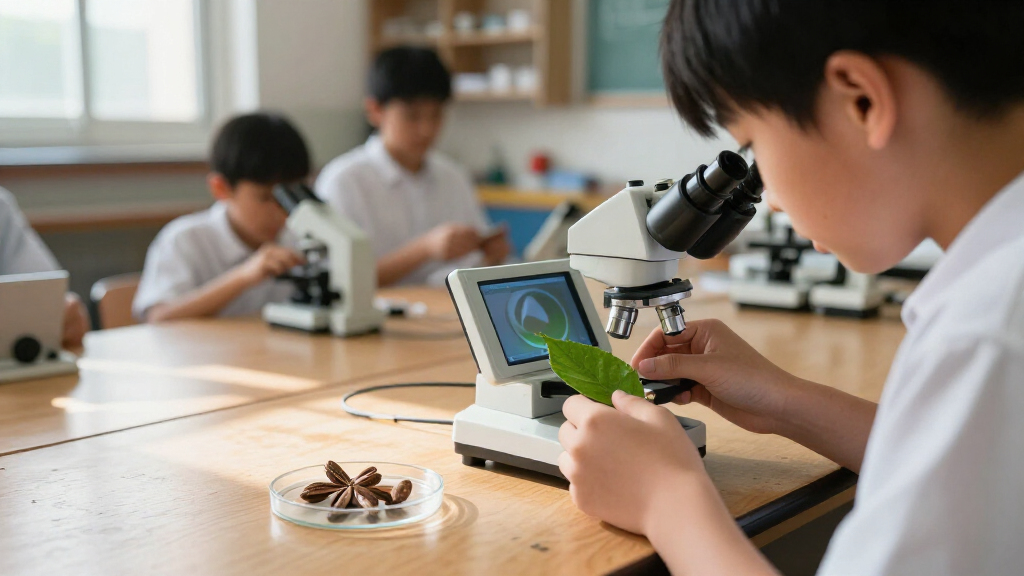
How We Picked
I ranked these digital microscopes for students by how well their design supports learning across common classroom and home activities: viewing prepared samples, inspecting small objects, documenting observations, and sharing a live image. I looked at display size and position, the practicality of the magnification approach, specimen fit, connection options, and whether a specialist feature solves a real student need. I also weighed likely setup demands and how easily a student can use the microscope without adding a computer or other equipment.
The DM301 Pro ranks first for its balanced, general-use role; models aimed at coins or soldering rank lower for broad student use, even when their dedicated features may be useful for a particular class or hobby. The TetraView earns distinction for a more conventional, group-friendly viewing arrangement, while the AD266S stands out for lens variety and HDMI flexibility. I treated product names and claimed magnification ranges as starting points, not proof of classroom performance: a suitable working distance, useful lighting, and a manageable setup matter more than a headline number on its own.
| digital microscopes for student | Connectivity |
|---|---|
| TOMLOV DM4W Digital Microscope | USB; compatible with macOS and Windows |
| Celestron TetraView LCD Digita | — |
| TOMLOV DM4W Max Digital Coin M | USB output; compatible with Windows and Mac |
| TOMLOV DM9 7" Digital Coin Mic | USB; compatible with Windows and Mac |
| TOMLOV TM3K-3D 3D Digital Sold | HDMI and USB |
| TOMLOV DM301 Pro Digital Micro | Wi-Fi app support, USB, and HD output |
| TOMLOV DM301 Max Digital Micro | Wi-Fi app viewing, USB, and HD connections |
| Andonstar AD266S 20X-5000X HDM | HDMI and USB |
Factors to Consider When Choosing Digital Microscopes For Students
Before choosing, I would match the microscope to the way a student will actually work. A tool for prepared slides has different needs from one used to inspect coins, electronics, leaves, or classroom materials. These broader checks can help avoid buying a specialized feature that rarely gets used—or a general-purpose model that cannot accommodate the planned lessons.
Match the Microscope to the Specimen
Start with the objects students will examine, not the largest magnification printed on the box. Prepared slides, flat materials, coins, and three-dimensional objects need different clearance beneath the lens and different ways of holding the specimen. A microscope designed around coin inspection may be convenient for surface details but less suitable for thin slides or samples that need transmitted light. For a mixed classroom, I would favor a flexible stage and enough space to position varied samples. Ask whether the microscope can focus on the actual object size and shape before assuming it will serve every science activity.
Choose Magnification for Useful Detail
Magnification is helpful only when the image remains clear and the student can keep the target in view. High settings narrow the visible area, making it harder for beginners to locate a feature or compare it with the surrounding specimen. Digital zoom can enlarge an image on screen, but enlargement alone does not create additional optical detail. Students often learn more from a stable, well-lit view at a moderate setting than from repeatedly pushing to the highest number. Look for controls that make it easy to move between overview and close inspection.
Decide How Students Will Share What They See
A built-in screen lets a student inspect an object without connecting another device, and it can make small details easier for a group to discuss. A swivel or adjustable display can help classmates gather around without moving the specimen or microscope. HDMI or computer connections are useful when lessons call for a larger shared display, saved images, or instructor demonstrations, but they add equipment and setup steps. Before prioritizing connectivity, check which devices and cables are required and whether the classroom can support them. For individual work, a self-contained screen may be the simpler choice.
Treat Lighting and Working Distance as Core Features
Lighting affects whether a specimen’s details are visible, especially when students inspect opaque objects rather than prepared slides. Reflections can hide surface features, while too little light can leave images dull; adjustable illumination gives students more control over different materials. Working distance—the space between the lens and specimen—also shapes what can be examined comfortably. A short distance may suit flat samples but make taller objects awkward to position. Check how the intended specimen is lit and whether students can adjust focus without bumping or damaging it.
Pay for Flexibility Only When It Will Be Used
Multiple lenses, specialized measuring tools, and dedicated coin or soldering features can be worthwhile when they align with a course or ongoing project. They can also add controls and setup choices that distract from basic observation for a younger learner. For a shared school microscope, broad specimen compatibility and a simple learning curve may be more useful than a narrow specialty feature. For an advanced student with a defined project, lens options or video output may justify a more involved setup. I would decide based on recurring activities, not a single occasional experiment.
Check the Full Classroom Setup
Consider where the microscope will sit, who will use it, and what accessories the student already has. A large screen can help group work but needs bench space; a computer-connected setup may require a nearby outlet and a compatible device. Think about how samples will be stored and whether the microscope can be moved between home and school without losing small parts. For younger students, fewer adjustments and a stable base can matter more than advanced capture options. A clear plan for storage, power, and specimen handling can prevent a capable microscope from becoming an occasional-use gadget.
Frequently Asked Questions
Is a digital microscope suitable as a student’s only microscope?
That depends on the lessons. A digital model is convenient for screen-based viewing, group discussion, and capturing observations, but it may not reproduce the handling and viewing habits taught with a conventional eyepiece microscope. Students working mainly with prepared slides should confirm that the chosen model supports that format and offers appropriate illumination. For a broad science course, a digital microscope can be a practical primary tool if its stage and lighting match the curriculum. If the course requires specific optical techniques, check the teacher’s equipment list before buying.
Should I choose a built-in screen or an HDMI model?
A built-in screen is usually simpler for one student or a small group because it avoids dependence on a separate display. HDMI is more useful when a class needs to show a live image to a larger audience or connect to existing presentation equipment. The connection can also mean extra cables, compatibility checks, and a less portable setup. I would choose HDMI when classroom sharing is a regular requirement, not just a possible future use. If quick setup matters most, a self-contained screen is often the more direct fit.
Will a microscope made for coins work for school science samples?
It may work for some surface inspections, but a coin-focused design is not automatically suited to prepared slides, transparent samples, or taller objects. The key questions are whether the stage can hold the sample, whether the lighting suits it, and whether the lens has enough clearance. The DM4W and DM4W Max add scale-related functions that are more relevant to coins and small objects than to general biology lessons. For varied schoolwork, I would favor a general-purpose format unless coin study is a regular activity. Check the planned sample types against the microscope’s stage and illumination before choosing.
Does a higher advertised magnification mean a better microscope for a student?
No. A high magnification claim does not by itself tell you whether the image will show useful detail or remain easy to focus. At higher settings, students see a smaller area, which can make it harder to find and follow a specimen. Image quality, lighting, working distance, and stable focusing all shape what a learner can observe. The AD266S offers a broad lens-based approach, but that flexibility is most useful when students have projects that call for different views. For routine classroom activities, usability and specimen fit deserve equal attention.
Which features matter most for a beginner working without an adult?
I would prioritize a stable setup, accessible focus controls, clear on-screen viewing, and lighting that can be adjusted without a complicated routine. A built-in display can reduce the number of connections a student has to manage. Specialized weighing, advanced lens changes, and computer capture may be useful later, but they can add steps to basic observation. The best beginner choice is the one that matches the student’s specimens and lets them get a usable image with minimal setup. An adult should still check sample handling and any power or device requirements before independent use.
Conclusion
For the broadest student use, I recommend the TOMLOV DM301 Pro as best overall, with its built-in 7-inch display and general-purpose positioning. The TOMLOV DM4W is my best value-style pick for students whose work includes coins or small objects and who can use its precision-scale feature; it is less compelling for mixed biology lessons. For beginners, I would choose the Celestron TetraView when a conventional microscope layout and swiveling screen suit the way they learn. The Andonstar AD266S is best for advanced projects that can make use of several lenses and HDMI output. For dedicated coin work, compare the DM4W Max and DM9; for electronics work, the TM3K-3D is the specialist choice, while the DM301 Max is worth considering when its specific feature set matches the student’s needs. The right pick is the one that fits the specimens and classroom setup—not the one with the biggest magnification claim.