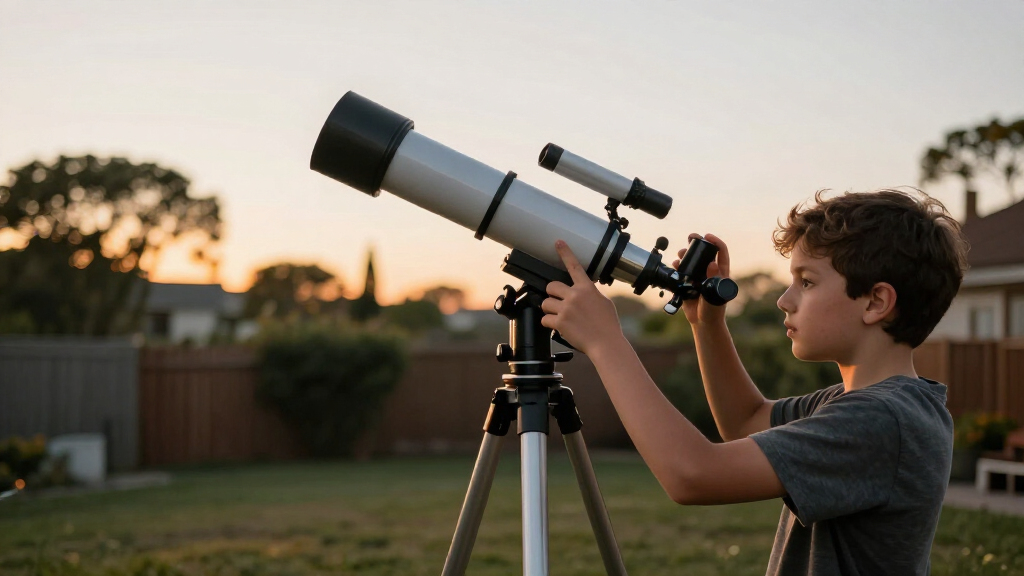
For most first-time stargazers, I’d start with the Celestron StarSense Explorer LT 114AZ: its phone-guided navigation and larger aperture make locating and viewing objects easier than with many entry-level refractors. The Celestron Travel Scope 80 is a strong choice for portable viewing, while the Dianfan 90mm refractor favors greater light gathering and lunar detail. The main tradeoffs are guided finding versus simple setup, and aperture versus portability; a larger telescope can show more, but may be less convenient to carry and store. I compare all 15 options by beginner usability, practical viewing potential, and included equipment. Read on for the full breakdown and a guide to choosing a telescope that suits your observing plans.

Prime made for students and young adults
- Fast, free delivery for dorm and study essentials
- Prime Video and Amazon Music included
- Member-only deals
Key Takeaways
- StarSense Explorer LT 114AZ leads for sky navigation: its smartphone-guided locating system addresses a common beginner hurdle that aperture alone cannot solve.
- The Travel Scope 80 prioritizes portability: its backpack-ready kit is easier to take along than longer, bulkier telescopes, though a compact setup is not automatically the steadiest.
- The Dianfan 90mm is the aperture-focused refractor: its larger objective may gather more light than the 70mm models, but its longer tube and kit are less travel-oriented.
- Most of the lineup consists of 70mm to 80mm refractors: these favor approachable lunar and bright-object viewing, while differences in mount stability and finder usability may matter more than headline magnification.
- Phone adapters are not the same as guided navigation: many included adapters help hold a phone for imaging, but they do not perform the sky-finding role of the StarSense system.


| beginner astronomy telescope | Focal length | Eyepieces | Aperture | Included accessories |
|---|---|---|---|---|
| Celestron StarSense Explorer L | 1000 mm | 10 mm and 25 mm | 114 mm (4.5 in) | Smartphone dock, full-height tripod, red dot finderscope, and two eyepieces |
| Fuoibl 70mm Refractor Telescop | 300 mm | 6 mm and 20 mm | 70 mm | Phone adapter, wireless remote, adjustable tripod, 5×24 finderscope, two eyepieces, and 3× Barlow lens |
| EACONN 80mm Aperture 600mm Ref | 600 mm | K20mm and K9mm | — | Smartphone adapter, adjustable tripod, and carrying backpack |
| National Geographic Sky View 7 | 400 mm | — | — | Smartphone adapter, adjustable tripod, accessory tray, diagonal, and viewfinder |
| Dianfan 80mm Refractor Telesco | 500 mm | Two Kellner eyepieces | — | 3× Barlow lens, smartphone adapter, tripod, backpack, and two reusable sticker sheets |
| Gskyer 70mm Refractor Telescop | 400mm (f/5.7) | 25mm (16×) and 10mm (40×) | 70mm | Carry bag, smartphone adapter, wireless camera remote, 3× Barlow lens |
| Dianfan 90mm Aperture 800mm Re | 800mm | Two Kellner eyepieces | 90mm | Stainless steel tripod, phone adapter, carry bag, 3× Barlow lens, 45° zenith mirror |
| MEEZAA 80mm Refractor Telescop | 500mm | 25mm and 10mm | 80mm | Waterproof backpack, phone adapter, 3× Barlow lens, 45° zenith mirror |
| Celestron Travel Scope 70mm Po | 400mm | 20mm and 10mm | 70mm | Full-height tripod, finderscope, star diagonal, padded backpack, Starry Night software download |
| Celestron Travel Scope 80mm Re | 457mm | 20mm and 10mm | 80mm | Full-height tripod, star diagonal, backpack, smartphone adapter, Starry Night software download |
| Celestron AstroMaster 70AZ 70m | 900 mm | — | 70 mm (2.8 in) | — |
| NASA Lunar Telescope for Kids | — | Low-power and high-power | — | — |
| ToyerBee 70mm Refractor Telesc | 300 mm | 20 mm and 6 mm | 70 mm | — |
| 70mm Aperture Refractor Telesc | 300 mm | 20 mm and 6 mm | 70 mm | — |
| Vvnonix 70/500 Refractor Teles | 500 mm | H20 mm, H12 mm, and H6 mm | — | — |
More Details on Our Top Picks
Celestron StarSense Explorer LT 114AZ Smartphone-Guided Newtonian Telescope
I’d put the StarSense Explorer first for beginners who might otherwise spend more time searching the sky than observing it. Its smartphone-guided navigation helps point the telescope toward chosen targets, while the 114 mm reflector has more light-gathering aperture than the 70 mm refractors here, including the National Geographic Sky View 70mm. That makes it the more capable choice for exploring beyond the Moon and bright planets, provided conditions cooperate.
The tradeoff is that the app guides rather than moves the telescope: the manual altazimuth mount still needs hands-on pointing and tracking. It also depends on a compatible phone. Unlike the EACONN 80mm, this package does not emphasize a backpack for transport, and its Newtonian design may ask a beginner to learn more basic care than a refractor. I’d choose it for guided discovery, not fully automatic observing.
Pros:- Smartphone sky recognition helps beginners locate celestial targets.
- 114 mm aperture offers more light gathering than the 70 mm refractors in this group.
- Two eyepieces, a red dot finder, and a full-height tripod are included.
- Altitude slow-motion adjustment supports more controlled manual tracking.
Cons:- Guided navigation requires a compatible smartphone.
- The manual mount requires users to point and track targets themselves.
- The Newtonian reflector may involve more care and setup learning than a simple refractor.
Best for: New observers who want app-assisted help locating a broad range of celestial targets and are comfortable steering the telescope manually.
Not ideal for: Buyers who want a phone-free setup, automatic tracking, or a compact refractor-and-backpack kit for frequent travel.
- Optical design:Newtonian reflector
- Aperture:114 mm (4.5 in)
- Focal length:1000 mm
- Mount:Manual altazimuth
- Eyepieces:10 mm and 25 mm
- Finderscope:Reflex red dot
- Field of view:2.04 degrees
- Included accessories:Smartphone dock, full-height tripod, red dot finderscope, and two eyepieces
Our verdict“Choose the StarSense Explorer if guided target-finding and larger aperture matter more than phone-free or hands-off operation.”
Fuoibl 70mm Refractor Telescope with Phone Adapter
The Fuoibl is aimed at beginners who want a straightforward refractor for the Moon, bright planets, and daytime scenery, with a phone adapter ready for basic photos. Its 70 mm aperture and 300 mm focal length make it a shorter, more compact optical setup than the National Geographic Sky View 70mm’s 400 mm tube. The supplied 3× Barlow and two eyepieces add viewing combinations, though advertised magnification options are not a guarantee of equally useful detail.
For target-finding and deeper exploration, I’d favor the Celestron StarSense Explorer LT 114AZ: its larger aperture and guided app give it a clear advantage. The Fuoibl instead keeps the package focused on accessible, casual use, including a wireless remote for phone photography. Its manual focus and altazimuth movement still require practice, and the inverted finderscope image may take beginners a little adjustment. This is a simple starter, not a substitute for a more capable observing setup.
Pros:- 70 mm refractor suits the Moon, bright planets, and distant scenery.
- Fully multi-coated optics are included.
- Two eyepieces and a 3× Barlow provide several viewing combinations.
- Phone adapter and wireless remote support smartphone photography.
Cons:- Manual focusing and pointing require hands-on adjustment.
- The finderscope image is inverted, which can make initial aiming less intuitive.
- Its 70 mm aperture is less suited to dim targets than the 114 mm Celestron StarSense Explorer.
Best for: First-time observers who want a compact refractor for bright targets and occasional smartphone snapshots, including daytime views.
Not ideal for: Beginners prioritizing deep-sky observing, guided sky navigation, or a finderscope view that matches ordinary orientation.
- Telescope type:Refractor
- Aperture:70 mm
- Focal length:300 mm
- Magnification range:15×–150×
- Eyepieces:6 mm and 20 mm
- Barlow lens:3×
- Mount and focus:Altazimuth; manual focus
- Included accessories:Phone adapter, wireless remote, adjustable tripod, 5×24 finderscope, two eyepieces, and 3× Barlow lens
Our verdict“Pick the Fuoibl for casual bright-target observing and phone photography, but choose a larger-aperture telescope for broader night-sky ambitions.”
EACONN 80mm Aperture 600mm Refractor Telescope with Backpack
The EACONN earns its place for beginners who want a refractor they can carry to a darker observing spot or use for landscapes and wildlife as well as astronomy. Its 80 mm aperture exceeds the 70 mm openings on the Fuoibl and National Geographic Sky View, while the 600 mm focal length gives it a longer optical setup than the Fuoibl’s 300 mm design. A backpack, adjustable tripod, and setup instructions make transport and assembly part of the package rather than an afterthought.
The compromise is modest listed magnification: 30×–66×. The Dianfan 80mm, for example, lists a broader magnification range, but that figure alone does not establish the quality of high-power views. EACONN’s refractor remains a more sensible fit for beginners focused on the Moon, planets, and mixed daytime use than on pushing magnification. Manual focus and a basic altazimuth mount also mean observers must make their own adjustments.
Pros:- 80 mm aperture is larger than the 70 mm Fuoibl and National Geographic refractors.
- Fully multi-coated optics and two eyepieces are included.
- Backpack and adjustable tripod support portable setup.
- Smartphone adapter and setup instructions are supplied.
Cons:- Listed magnification tops out at 66×, lower than the ranges advertised for the Fuoibl and Dianfan 80mm.
- Manual focus and the altazimuth mount require hands-on positioning.
- No smartphone-guided sky-navigation system is listed.
Best for: Beginners who want an 80 mm refractor for the Moon, bright planets, and daytime viewing, with a backpack for carrying it between locations.
Not ideal for: Buyers seeking app-guided target locating, high listed magnification, or a mount that tracks objects automatically.
- Optical type:Refractor
- Objective lens diameter:80 mm
- Focal length:600 mm
- Listed magnification:30×–66×
- Eyepieces:K20mm and K9mm
- Mount and focus:Altazimuth; manual focus
- Finderscope:5×24 with crosshair
- Included accessories:Smartphone adapter, adjustable tripod, and carrying backpack
Our verdict“Choose the EACONN if portability and an 80 mm refractor matter more than high listed magnification or guided target-finding.”
National Geographic Sky View 70mm Refractor Telescope with Panhandle Mount
The Sky View’s defining beginner-friendly feature is not its aperture but its panhandle mount, which gives users a direct way to steer the telescope without learning a more elaborate control system. Its 70 mm refractor is suited to the Moon, planets, and a limited selection of bright deep-sky objects. Compared with the Fuoibl 70mm, its 400 mm focal length is longer than that model’s 300 mm, and it includes a diagonal, accessory tray, and smartphone adapter for a more complete observing setup.
The 3× Barlow and two eyepieces yield several listed magnification options, but beginners should not assume the highest setting will always provide the clearest view. Its 70 mm aperture is also smaller than the EACONN and Dianfan 80 mm refractors, limiting its appeal for dimmer targets. Manual focus remains part of the learning curve, and deep-sky viewing is explicitly limited to brighter objects. I’d choose it for accessible manual control, not expansion into faint targets.
Pros:- Panhandle control offers a direct way to aim the telescope.
- 70 mm refractor is suited to lunar and bright-planet viewing.
- Two eyepieces and a 3× Barlow provide multiple listed magnifications.
- Smartphone adapter, adjustable tripod, and accessory tray are included.
Cons:- 70 mm aperture is smaller than the 80 mm EACONN and Dianfan refractors.
- Deep-sky use is limited to some bright objects.
- Manual focusing and tracking require user adjustments.
Best for: Beginners who want an uncomplicated panhandle control for the Moon, bright planets, and occasional bright deep-sky objects.
Not ideal for: Observers seeking larger aperture for dimmer objects, app-based target guidance, or a telescope designed for extensive deep-sky viewing.
- Telescope type:Refractor
- Objective lens diameter:70 mm
- Focal length:400 mm
- Mount:Altazimuth with panhandle control
- Magnification options:16×, 40×, 48×, and 120×
- Eyepieces and Barlow:Two interchangeable eyepieces and a 3× Barlow lens
- Finderscope:Straight-through
- Included accessories:Smartphone adapter, adjustable tripod, accessory tray, diagonal, and viewfinder
Our verdict“Choose the Sky View for approachable manual aiming and bright targets, not for dim deep-sky objects or larger-aperture performance.”
Dianfan 80mm Refractor Telescope, 500mm Focal Length, Purple
The Dianfan suits beginners who want a portable refractor with a few extras for home observing and trips. Its 80 mm aperture is larger than the 70 mm Fuoibl and National Geographic models, and its 500 mm focal length sits between the EACONN 80mm’s 600 mm and the Fuoibl’s 300 mm. Two eyepieces, a Barlow lens, smartphone adapter, tripod, and water-resistant backpack give families several ways to use and carry the kit.
The listed 20×–150× range looks flexible on paper, but magnification alone does not promise crisp detail at the top end. The EACONN takes a more conservative approach, listing 30×–66× and emphasizing portability; this Dianfan’s appeal is its accessory bundle and higher stated range. Setup is described as taking about 15 minutes, though manual focus and a straight-through finder still require practice. I’d pick it for a portable all-round starter, not guaranteed high-power planetary views.
Pros:- 80 mm aperture is larger than the 70 mm Fuoibl and National Geographic options.
- Includes two eyepieces, a 3× Barlow lens, and smartphone adapter.
- Water-resistant backpack supports carrying the kit between observing spots.
- About 15-minute assembly is stated for the beginner-oriented setup.
Cons:- Manual focus and straight-through finder require practice to aim and adjust.
- The 20×–150× range does not establish that the highest magnifications will give useful views.
- No smartphone-guided navigation or automatic tracking is listed.
Best for: Families and first-time observers who want an 80 mm refractor with a backpack, phone adapter, and accessories for both astronomy and nature viewing.
Not ideal for: Buyers who need app-guided target locating, hands-free tracking, or a telescope with demonstrated high-power performance rather than a broad listed range.
- Telescope type:Refractor
- Objective lens diameter:80 mm
- Focal length:500 mm
- Listed magnification:20×–150×
- Eyepieces:Two Kellner eyepieces
- Mount and focus:Altazimuth; manual focus
- Field of view:2.5 degrees
- Included accessories:3× Barlow lens, smartphone adapter, tripod, backpack, and two reusable sticker sheets
Our verdict“Pick the Dianfan for an accessory-rich portable 80 mm starter kit, while treating its maximum listed magnification as a specification rather than a promise of detail.”
Gskyer 70mm Refractor Telescope, 400mm Focal Length, with Carry Bag and Smartphone Adapter
The Gskyer suits beginners who want a light, short-tube telescope for casual lunar viewing and daytime scenery. Its 70mm aperture and 400mm focal length pair with a carry bag, phone adapter, and wireless remote, making this kit more travel-oriented than the larger Dianfan 90mm. The included 25mm and 10mm eyepieces cover wide and closer views, while the 3× Barlow extends the stated magnification range. That extra magnification is not a guarantee of sharper detail, though, and the short focal length is better suited to broad targets than close planetary views. The manual focus and adjustable aluminum tripod also call for patient setup and steady handling. Choose it for portability and bundled phone photography; skip it if gathering more light matters more than keeping the kit compact.
Pros:- Carry bag makes the short refractor easier to store and take on outings.
- Two eyepieces and a 3× Barlow provide several magnification options.
- Phone adapter and wireless remote support basic image capture.
- Erecting BAK4 prism supports upright views of terrestrial targets.
Cons:- The 70mm aperture gathers less light than the 80mm and 90mm options here.
- Manual focusing and a lightweight adjustable tripod require careful handling.
- The 3× Barlow’s highest magnification can be difficult to use for clear views.
Best for: First-time observers who want a compact telescope for Moon viewing, daytime scenery, and occasional phone photos on trips.
Not ideal for: Buyers prioritizing brighter views or more planetary detail; its 70mm aperture is smaller than the Dianfan 90mm.
- Optical type:Refractor
- Aperture:70mm
- Focal length:400mm (f/5.7)
- Mount:Altazimuth
- Eyepieces:25mm (16×) and 10mm (40×)
- Maximum magnification:120×
- Finderscope:5×24 with cross-hair lines
- Included accessories:Carry bag, smartphone adapter, wireless camera remote, 3× Barlow lens
Our verdict“Pick the Gskyer if portability and phone-photo accessories matter more to you than the larger aperture of the Dianfan 90mm.”
Dianfan 90mm Aperture 800mm Refractor Telescope with Tripod, Phone Adapter, and Carry Bag
Among these refractors, the Dianfan puts the most emphasis on aperture and focal length: its 90mm objective and 800mm focal length offer a stronger starting point for lunar detail than the compact Gskyer 70mm. The longer tube also makes it a less grab-and-go choice, and its listed 4.7kg weight is substantial for longer walks. Two eyepieces and a 3× Barlow are advertised across a broad 32×–240× range, but the upper end may be hard to use steadily and should not be mistaken for consistently useful magnification. A 45° zenith mirror makes daytime targets easier to view upright, while the phone adapter and bag add versatility. Manual focusing is part of the learning curve; buyers wanting a lighter travel kit may prefer the Celestron Travel Scope 70.
Pros:- 90mm aperture gathers more light than the 70mm Gskyer and Celestron Travel Scope 70.
- 800mm focal length is suited to closer views of the Moon.
- 45° zenith mirror supports upright views of terrestrial objects.
- Includes a stainless steel tripod, phone adapter, and carry bag.
Cons:- At 4.7kg with an 80cm tube, it is less convenient for extended carrying.
- Manual focus and an altazimuth mount require hands-on adjustments when tracking targets.
- The advertised 240× maximum may be difficult to use steadily.
Best for: Beginners who plan mostly home-based lunar observing and want more aperture than a compact 70mm travel telescope.
Not ideal for: Young children or observers carrying gear on long walks; the 4.7kg weight and 80cm tube are less portable than the Celestron Travel Scope 70.
- Telescope type:Refractor
- Aperture:90mm
- Focal length:800mm
- Mount:Altazimuth
- Magnification:32×–240×
- Eyepieces:Two Kellner eyepieces
- Weight:4.7kg
- Included accessories:Stainless steel tripod, phone adapter, carry bag, 3× Barlow lens, 45° zenith mirror
Our verdict“Choose the Dianfan if you value a larger aperture for home observing and can accept more weight than the travel-focused Celestron 70mm.”
MEEZAA 80mm Refractor Telescope, 500mm Focal Length
The MEEZAA is a middle-ground option for beginners who want more aperture than a 70mm travel scope without the Dianfan 90mm’s longer 800mm tube. Its 80mm aperture and 500mm focal length suit lunar viewing and broad sky targets, while a 45° mirror also makes daytime use more comfortable. The waterproof backpack, adjustable foldable tripod, and phone adapter give this kit a stronger portability-and-accessories angle than the Celestron Travel Scope 80, which includes a full-height tripod and software instead. Here, the 20×–150× range comes from two eyepieces and a 3× Barlow; the highest setting may be less forgiving than the lower powers, especially on a modest tripod. Manual focus remains hands-on, so this is not a point-and-view instrument.
Pros:- 80mm aperture offers more light-gathering capacity than the 70mm Gskyer.
- Fully multi-coated optics and a 45° mirror support astronomy and upright daytime viewing.
- Foldable adjustable tripod and waterproof backpack suit portable use.
- Phone adapter and two eyepieces provide useful starter accessories.
Cons:- Manual focus requires practice when switching between targets.
- The stated 150× upper magnification may be demanding for steady, clear views.
- The short 500mm focal length favors wider views over the Dianfan 90mm’s longer focal-length approach.
Best for: Beginners who want an 80mm telescope for mixed lunar and daytime viewing, with a backpack and phone adapter included.
Not ideal for: Buyers seeking the simplest possible setup or steady high-magnification views; manual focusing and the lightweight tripod call for care.
- Optical type:Refractor
- Aperture:80mm
- Focal length:500mm
- Magnification:20×–150×
- Eyepieces:25mm and 10mm
- Finderscope:5×24 straight-through
- Tripod:Adjustable aluminum, 16.92–44.48 inches
- Included accessories:Waterproof backpack, phone adapter, 3× Barlow lens, 45° zenith mirror
Our verdict“Choose the MEEZAA for a portable, accessory-rich 80mm kit, but favor the Dianfan 90mm if aperture and a longer focal length take priority.”
Celestron Travel Scope 70mm Portable Refractor Telescope with Backpack
The Celestron Travel Scope 70 focuses on a beginner-friendly setup rather than a long list of add-ons. Its 70mm aperture and 400mm focal length make it a compact choice for the Moon and daytime scenery, and tool-free assembly helps new owners get started without extra setup steps. Compared with the Gskyer 70mm, it skips the listed smartphone adapter, wireless remote, and Barlow lens, but includes a padded backpack, full-height tripod, and a two-year US warranty. That simpler package may suit families who value straightforward portability over phone photography or a broader magnification kit. The tradeoff is the same small-aperture ceiling found in the Gskyer: it is intended for introductory viewing, not demanding deep-sky observation. Manual focus also means targets need hands-on adjustment.
Pros:- Tool-free setup reduces friction for beginners and family outings.
- Padded backpack and full-height tripod support portable use.
- Two eyepieces provide wide and closer viewing options.
- Includes a two-year US warranty and Starry Night software download.
Cons:- 70mm aperture is less suited to faint targets than the Dianfan 90mm.
- No smartphone adapter or Barlow lens is listed, unlike the Gskyer 70mm.
- Manual focusing requires adjustment by the user.
Best for: Families and first-time observers who want a straightforward, tool-free travel telescope for the Moon and daytime scenery.
Not ideal for: Buyers wanting phone-photo accessories or more aperture; the Gskyer adds a phone adapter and Barlow, while the Dianfan 90mm gathers more light.
- Telescope type:Refractor
- Aperture:70mm
- Focal length:400mm
- Mount:Altazimuth
- Eyepieces:20mm and 10mm
- Field of view:1.43°
- Setup:Tool-free
- Included accessories:Full-height tripod, finderscope, star diagonal, padded backpack, Starry Night software download
Our verdict“Pick this Celestron for a simple, packable first telescope; choose the Gskyer 70mm if phone imaging accessories matter more.”
Celestron Travel Scope 80mm Refractor Telescope Kit with Backpack and Smartphone Adapter
This Travel Scope 80 is the strongest fit here for families who want a larger-aperture travel refractor without stepping up to the heavier Dianfan 90mm. Its 80mm aperture and 457mm focal length pair with tool-free setup, a full-height tripod, and a backpack, making it easier to take from storage to an observing spot. The 1.7° field of view supports broad sweeps of the sky, while the 20mm and 10mm eyepieces offer two viewing scales. A smartphone adapter is included, unlike the Celestron Travel Scope 70, but the kit does not list a Barlow lens. The manual focus and altazimuth mount still require hands-on aiming, and its portability-minded design is not a substitute for a larger, more specialized telescope when high-power observing is the goal.
Pros:- 80mm aperture gathers more light than the 70mm Celestron Travel Scope.
- Tool-free setup and included backpack make it convenient for outings.
- Smartphone adapter supports basic telescope-through-phone photography.
- 1.7° field of view suits broad sky views.
Cons:- Manual focus and altazimuth aiming need ongoing adjustment.
- No Barlow lens is listed, unlike the Gskyer and MEEZAA kits.
- Its portable 457mm focal length is less focused on close views than the Dianfan 90mm’s 800mm focal length.
Best for: Families and new observers who want an 80mm scope for casual astronomy and daytime viewing, with a backpack and phone adapter.
Not ideal for: Observers prioritizing a heavier, longer-focal-length setup for close views; the Dianfan 90mm offers a larger aperture and 800mm focal length.
- Telescope type:Refractor
- Aperture:80mm
- Focal length:457mm
- Mount:Altazimuth
- Eyepieces:20mm and 10mm
- Finderscope:5×24
- Field of view:1.7°
- Included accessories:Full-height tripod, star diagonal, backpack, smartphone adapter, Starry Night software download
Our verdict“Choose the Travel Scope 80 for a portable family starter with a phone adapter, or the Dianfan 90mm if a larger aperture and longer focal length matter more.”
Celestron AstroMaster 70AZ 70mm Refractor Telescope
The AstroMaster 70AZ is a sensible first telescope for beginners who want to learn the basics of locating and tracking the Moon, planets, and bright star clusters. Its 900 mm focal length gives it a different emphasis from the short-tube ToyerBee HT001: the AstroMaster’s included eyepieces provide 45× and 90× magnification, while the ToyerBee adds phone photography accessories and a broader advertised magnification range. Here, the useful advantage is a straightforward, manual alt-azimuth mount and an erect-image diagonal that also supports daytime viewing. Tool-free assembly keeps setup approachable, but users still have to move the telescope by hand as an object crosses the sky. Its 70 mm aperture is best suited to bright targets, not faint deep-sky observing, and the tripod needs careful positioning for steadier views.
Pros:- 900 mm focal length and included 20 mm and 10 mm eyepieces provide useful beginner magnifications of 45× and 90×.
- Manual alt-azimuth mount with panhandle makes pointing intuitive to learn.
- Erect-image diagonal supports terrestrial viewing as well as astronomy.
- Tool-free assembly and adjustable tripod simplify initial setup.
Cons:- Manual pointing means users must keep adjusting the mount to follow moving targets.
- The 70 mm aperture limits useful observing mainly to brighter celestial objects.
- The 10.8 lb assembled weight is less convenient to carry than the 3.5 lb ToyerBee HT001.
Best for: First-time observers who want a conventional, longer-focal-length refractor for the Moon, bright planets, and occasional daytime viewing.
Not ideal for: Beginners whose main goal is faint galaxies or nebulae, or who want a mount that tracks targets without manual adjustments.
- Optical design:Achromatic refractor
- Aperture:70 mm (2.8 in)
- Focal length:900 mm
- Mount:Manual alt-azimuth
- Included eyepieces:20 mm and 10 mm
- Magnification:45× and 90×
- Finderscope:StarPointer red dot
- Assembled weight:10.8 lb (4.9 kg)
Our verdict“Choose the AstroMaster 70AZ if you want a simple, longer-focal-length starter scope for bright targets and daytime use, rather than a lighter travel or phone-photography kit.”
NASA Lunar Telescope for Kids with Tripod and Finder Scope
This NASA-branded lunar telescope is the most narrowly focused choice in this group: it is designed for children ages 8 and up who want a guided first look at the Moon, rather than a flexible family instrument for many kinds of observing. Two eyepieces and a straight-through finder scope introduce the basic steps of locating and focusing a target, while the educational learning guide gives the activity a learning component missing from the ToyerBee HT001’s accessory list. The tabletop tripod can be easier to manage than a full-height setup, but it also ties observing to a solid table or other stable surface. Its listed maximum magnification is up to 90×, though magnification alone does not promise sharp views. Compared with the AstroMaster 70AZ, this is more child-oriented but less suited to observers seeking a conventional adjustable tripod.
Pros:- Designed for children ages 8 and up with beginner use in mind.
- Includes two eyepieces and a finder scope for learning basic target location and viewing.
- Educational learning guide adds context to Moon-observing sessions.
- Tabletop tripod supports a compact setup when used on a stable surface.
Cons:- Tabletop tripod limits where the telescope can be used and requires a firm support.
- Manual focusing takes practice, particularly for younger users.
- The Moon-focused design offers less stated versatility than the AstroMaster 70AZ, which also includes an erect-image diagonal for terrestrial viewing.
Best for: Children ages 8 and up who want a compact, guided introduction to Moon viewing with an included learning guide.
Not ideal for: Families who need a full-height tripod, broad observing flexibility, or a telescope that can be set up away from a stable tabletop.
- Brand:Blue Marble
- Recommended age:8 years and up
- Magnification:Up to 90×
- Eyepieces:Low-power and high-power
- Finder scope:Straight-through
- Field of view:0.85 degrees
- Mount type:Equatorial
- Included tripod:Tabletop
Our verdict“Pick this for a child’s first Moon-focused observing sessions if a stable tabletop is available and the educational guide matters more than a full-size tripod.”
ToyerBee 70mm Refractor Telescope with Phone Adapter and Tripod
The ToyerBee HT001 puts portability and phone-assisted sharing ahead of the longer focal length offered by the Celestron AstroMaster 70AZ. At just 3.5 lb, it is easier to carry for casual family sessions, and its phone adapter and wireless remote give beginners a way to attempt eyepiece photos without holding a phone by hand. The package also includes two eyepieces, a 3× Barlow lens, a finderscope, and a star chart. Its 300 mm focal length creates a short-tube design suited to broad, casual views, but the advertised 15×–150× range should not be read as a guarantee of clear images at every setting. Manual focus still needs adjustment, and the supplied information does not clarify the warranty duration. Compared with the Vvnonix 70/500, the ToyerBee is lighter and more explicit about phone accessories, while the Vvnonix offers a longer focal length and a moon filter.
Pros:- Lightweight 3.5 lb design is convenient for travel and short observing sessions.
- Phone adapter and wireless remote support beginner attempts at eyepiece photography.
- Includes two eyepieces, a 3× Barlow lens, a finderscope, and a star chart.
- Fully multi-coated optics and 70 mm aperture are specified for celestial and daytime viewing.
Cons:- Manual focus requires adjustment for each target and viewing setup.
- The 300 mm focal length is shorter than the AstroMaster 70AZ’s 900 mm focal length, giving the two scopes different observing emphasis.
- Warranty description is listed as “3” without a clear duration.
Best for: Families and beginners who value a lightweight kit, want to try phone-through-eyepiece photos, and expect to carry the telescope between observing spots.
Not ideal for: Observers prioritizing a longer focal length, clearly documented warranty terms, or dependable sharpness at the highest advertised magnifications.
- Optical type:Refractor telescope
- Aperture:70 mm
- Focal length:300 mm
- Magnification range:15×–150×
- Optics:Fully multi-coated optical glass
- Eyepieces:20 mm and 6 mm
- Barlow lens:3×
- Item weight:3.5 lb
Our verdict“Choose the ToyerBee if a light carry and phone-photo accessories matter more than a longer focal length or clearly stated warranty coverage.”
70mm Aperture Refractor Telescope with FMC Optics, 300mm Focal Length, 15-150x Zoom, Phone Adapter and Tripod – Beginner Friendly for Kids and Adults
This 70 mm refractor kit is aimed at families who want one setup for basic observing and phone-photo attempts. Its 300 mm focal length and included 20 mm and 6 mm eyepieces, 1.5× erecting eyepiece, and 3× Barlow give beginners several ways to change the view, while the phone adapter and wireless remote add a simple sharing activity. The listed 15×–150× range is broad on paper, but the upper end should not be treated as a promise of detailed planetary views from a 70 mm telescope. Compared with the ToyerBee HT001, the accessory package is similar, but the product data gives no brand or weight to help buyers judge portability and support. Its listed dimensions also do not establish how sturdy the tripod will feel during use, so realistic expectations matter.
Pros:- 70 mm aperture and fully multi-coated optics are specified for observing bright targets.
- Includes 20 mm and 6 mm eyepieces, a 1.5× erecting eyepiece, and a 3× Barlow lens.
- Phone adapter and wireless remote support casual image capture.
- Tool-free tripod assembly is described as beginner-friendly.
Cons:- The 15×–150× advertised range may suggest more useful high-power viewing than the 70 mm aperture can deliver.
- Product data does not identify a brand or provide a weight, making support and portability harder to judge.
- Its short 300 mm focal length differs from the Celestron AstroMaster 70AZ’s longer 900 mm design and is less tailored to higher-power viewing.
Best for: Families with children and adults who want a shared beginner kit with interchangeable optics and a phone adapter for casual observing.
Not ideal for: Buyers who need a well-documented brand, clearly specified weight, or a telescope primarily for high-magnification planetary detail.
- Aperture:70 mm
- Focal length:300 mm
- Magnification range:15×–150×
- Eyepieces:20 mm and 6 mm
- Erecting eyepiece:1.5×
- Barlow lens:3×
- Finder scope:5×24
- Phone adapter:Included
Our verdict“Consider this kit for shared family observing and phone-photo experiments, but choose a better-documented model if support details and higher-power expectations matter.”
Vvnonix 70/500 Refractor Telescope with Smartphone Adapter and Tripod
The Vvnonix 70/500 stands out for the number of observing accessories bundled with a moderate focal length: three eyepieces, two Barlow lenses, a 5×24 finderscope, a moon filter, and a smartphone adapter. That gives a beginner more combinations to explore than the Celestron AstroMaster 70AZ, which keeps its included eyepiece set and setup more straightforward. The 500 mm focal length sits between the AstroMaster’s 900 mm and the ToyerBee HT001’s 300 mm, offering a middle-ground format rather than either model’s longer- or shorter-tube emphasis. The tradeoff is that more accessories can mean more trial and error, and the supplied Huygens eyepieces are basic. Manual focus and a manual alt-azimuth mount also leave target finding and tracking to the user; the included backpack helps with transport but does not remove those learning steps.
Pros:- Three eyepieces and two Barlow lenses provide several combinations for experimenting with magnification.
- Includes a moon filter for reducing lunar brightness during observation.
- Smartphone adapter supports basic photos and videos through the eyepiece.
- Backpack supports storage and transport of the telescope kit.
Cons:- Included Huygens eyepieces may provide a basic viewing experience.
- Manual focus and alt-azimuth operation require users to adjust focus, point, and track targets themselves.
- The larger accessory set can take more time to learn than the simpler AstroMaster 70AZ package.
Best for: Beginners who want several eyepiece and Barlow combinations, a moon filter, and a backpack for carrying a starter refractor.
Not ideal for: Buyers who prefer a simple, low-accessory setup or want higher-quality eyepieces and a mount that tracks targets automatically.
- Telescope type:Refractor
- Objective lens diameter:70 mm
- Focal length:500 mm
- Optics:Multi-coated glass
- Mount:Altazimuth
- Eyepieces:H20 mm, H12 mm, and H6 mm
- Barlow lenses:3× and 1.5×
- Warranty:1-year manufacturer’s warranty
Our verdict“Choose the Vvnonix if you want an accessory-heavy 70 mm starter kit and do not mind learning which eyepiece combinations work best.”
How We Picked
I ranked these beginner astronomy telescopes by how well their design supports a first observing session: straightforward assembly, practical object finding, usable controls, and a kit that makes sense for the stated use. I weighed aperture and focal length as part of the viewing picture, but did not treat maximum advertised magnification as proof of useful performance; steadiness, optics, and sky conditions also shape what a beginner can see.
The order reflects the balance of viewing potential, ease of use, and portability, rather than one specification. Guided locating gives the StarSense Explorer LT 114AZ an advantage for newcomers who may struggle to find targets, while compact travel kits rank well for convenience. I also considered included accessories, mount type, and the practical tradeoffs of longer or larger instruments. Models with similar apertures are separated by their intended role and ease-of-use features, not by claims that cannot be established from listed specifications alone.
| beginner astronomy telescope | Mount |
|---|---|
| Celestron StarSense Explorer L | Manual altazimuth |
| Fuoibl 70mm Refractor Telescop | — |
| EACONN 80mm Aperture 600mm Ref | — |
| National Geographic Sky View 7 | Altazimuth with panhandle control |
| Dianfan 80mm Refractor Telesco | — |
| Gskyer 70mm Refractor Telescop | Altazimuth |
| Dianfan 90mm Aperture 800mm Re | Altazimuth |
| MEEZAA 80mm Refractor Telescop | — |
| Celestron Travel Scope 70mm Po | Altazimuth |
| Celestron Travel Scope 80mm Re | Altazimuth |
| Celestron AstroMaster 70AZ 70m | Manual alt-azimuth |
| NASA Lunar Telescope for Kids | — |
| ToyerBee 70mm Refractor Telesc | — |
| 70mm Aperture Refractor Telesc | — |
| Vvnonix 70/500 Refractor Teles | Altazimuth |
Factors to Consider When Choosing Beginner Astronomy Telescopes
Before choosing, decide what you want your first nights at the eyepiece to feel like. The best fit depends on where you’ll observe, what you hope to see, and whether finding objects or carrying the equipment will be the bigger challenge.
Choose a Telescope You Can Aim Comfortably
For beginners, finding a target can be harder than looking at it, especially under a sky with few familiar landmarks. A guided system can point you toward objects, while a basic finder requires you to learn the sky and align the telescope yourself. Neither approach removes the need to aim carefully, but guided locating can reduce early frustration. A phone adapter is different: it holds a phone for viewing or imaging and does not necessarily guide the telescope. If learning constellations is part of the goal, a simple finder and a sky chart can be a rewarding pairing. If you want help locating targets from the start, favor a dedicated guidance system.
Match Aperture to the Objects You Want to See
Aperture affects how much light a telescope collects, but it does not guarantee sharp or detailed views by itself. The Moon is a forgiving first target, while faint deep-sky objects depend on aperture, sky darkness, and realistic expectations. A 70mm or 80mm refractor can suit bright targets and casual observing without demanding a large storage space. Moving to a larger objective can improve light gathering, but it may also mean a longer or heavier tube. High magnification claims can distract from the image quality a telescope can maintain. Choose around the targets and conditions you expect, rather than the largest number printed on the box.
Treat the Mount as Part of the Optical System
A telescope that shakes whenever you touch the focuser can make even a bright target frustrating to observe. Lightweight tripods are convenient, but portability often comes with less resistance to vibration. Before buying, look for a mount that lets you make small, controlled adjustments and holds position while you focus. A panhandle-style control can feel intuitive for sweeping across the sky, while other mounts may take more practice to move smoothly. Keep expectations grounded: a compact beginner kit is not a heavy observatory mount. If stable viewing matters more than packing small, accept some added bulk instead of choosing solely by the included carry bag.
Decide Whether Portability Will Get the Telescope Used
A telescope that fits in a car or can be carried to a darker observing spot may get more use than a larger instrument kept at home. Travel kits with backpacks make storage and transport simpler, but a carrying case does not tell you how quickly the telescope will be ready or how steady its tripod will feel. Think through the full routine: carrying the scope, setting up the tripod, aligning the finder, and packing away accessories. If you observe mainly from a yard or balcony, portability may matter less than a comfortable mount and focal length suited to your targets. If you plan to travel, check that the scope and accessories fit together without making setup cumbersome.
Separate Useful Accessories from Marketing Claims
Phone holders, eyepieces, finders, and bags can make a starter kit more convenient, but included accessories vary in how much they help at the eyepiece. A phone mount may support basic lunar photos, yet phone imaging through a small telescope can be fiddly and is not a substitute for visual observing. Extra eyepieces are only useful if they provide practical magnification and remain comfortable to use. Be cautious about very high zoom ranges, since atmospheric turbulence and a shaky mount can erase the benefit. Check what is included and whether the accessory solves a problem you actually expect to face. For a first telescope, dependable controls and a usable finder usually matter more than a long accessory list.
Plan for Setup, Storage, and Care
Ease of ownership matters after the first night, too. Refractors generally avoid the mirror alignment routine associated with some reflector designs, which can appeal to buyers who want a simpler maintenance path. Any telescope still benefits from careful handling, capped optics, and dry storage; exposed lenses should not be touched or cleaned casually. Before choosing a larger model, make sure you have room to store its tube and tripod without risking knocks or dust. A small, easy-to-carry telescope can be a sensible first step if you are unsure how often you’ll observe. If you already expect regular sessions, prioritize a setup you can assemble and aim without making the process feel like a chore.
Frequently Asked Questions
Is the Celestron StarSense Explorer LT 114AZ a better first telescope than a 70mm refractor?
It can be a better fit if finding objects is your main concern, because its smartphone-guided system helps direct you around the sky. Its 114mm aperture also gives it a different light-gathering profile from the 70mm refractors in this roundup. A smaller refractor may appeal more if you want a compact, straightforward kit and expect to focus on bright targets such as the Moon. The choice is not simply larger versus smaller: reflectors and refractors have different designs and ownership needs. Pick the StarSense if guided locating is a priority; choose a compact refractor if portability and a familiar setup matter more.
Can I take worthwhile pictures with a beginner telescope phone adapter?
A phone adapter can hold a camera over the eyepiece, making it possible to try simple images of bright, steady targets such as the Moon. It does not turn a visual telescope into a dedicated astrophotography setup, and lining up the phone can take patience. Small vibrations, focus, exposure settings, and the phone’s camera all affect the result. For planets and faint objects, expectations should stay modest with entry-level visual kits. If photography is your main goal, choose based on the imaging system and mount rather than treating a bundled phone holder as a complete solution.
Should I choose a 70mm, 80mm, or 90mm telescope for my first scope?
The aperture gives a useful comparison of light-gathering potential, but it cannot predict the whole observing experience. A 70mm scope can be easier to carry and may suit lunar and bright-object viewing; an 80mm model offers a middle ground, while a 90mm objective can gather more light but may come in a longer or less portable setup. Mount steadiness, optical quality, and the darkness of your observing site affect what you actually see. A larger telescope is not automatically the right choice if it is difficult to transport or aim. Choose the largest setup that still fits your storage, carrying, and setup habits.
Are these beginner telescopes suitable for viewing planets?
Many of these telescopes can show bright planets as small, identifiable disks, with the amount of visible detail shaped by aperture, focus, atmospheric steadiness, and the telescope’s mount. The Moon is usually a more rewarding starting target because its features are bright and comparatively easy to locate. Magnification alone does not promise a detailed planetary view; excessive magnification can make an image dim and hard to hold steady. A stable setup and careful focusing often help more than pushing the eyepiece to its highest claimed power. If planetary detail is your main interest, prioritize aperture and mount quality over bundled extras.
Is a travel telescope a sensible choice if I mostly observe from home?
Yes, if compact storage and quick transport matter in your home, a travel model can still be convenient for backyard or balcony sessions. Its light build may also make it easier to carry outside for a short look at the Moon. The tradeoff is that travel-oriented tripods and mounts can feel less steady than heavier setups, which is noticeable while focusing at higher magnification. If the telescope will rarely leave one observing spot, a travel bag may offer little value compared with comfortable controls and a steady mount. Think about your actual setup location and carrying routine, not just the word “travel” in a product name.
Conclusion
For the broadest beginner appeal, my best overall pick is the Celestron StarSense Explorer LT 114AZ, because guided locating tackles a common early obstacle while its aperture stands apart from most of the 70mm refractors here. I’d call the Celestron Travel Scope 70 the best value for portability-minded buyers who want a compact kit, and the Dianfan 90mm the best premium-style choice in this lineup for shoppers prioritizing a larger refractor aperture and longer focal length. The National Geographic Sky View 70mm is my beginner-friendly choice for someone drawn to a straightforward refractor with a panhandle mount. For travel, compare the Celestron Travel Scope 80 and EACONN 80mm; for a simple first look at the Moon with a child, the NASA Lunar Telescope is the most specifically child-oriented option. Choose based on whether your main need is finding targets, carrying the scope, or gathering more light—not on the longest magnification claim.