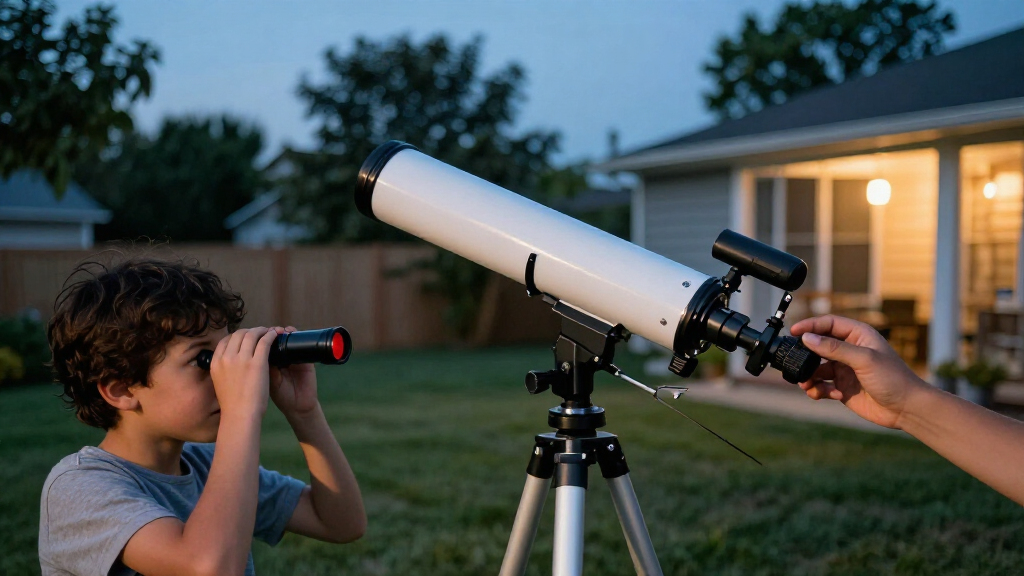
For most new stargazers, I’d start with the Celestron StarSense Explorer LT 114AZ: its smartphone-guided locating system addresses one of the hardest beginner tasks, finding objects in the sky. The Celestron AstroMaster 70AZ offers a familiar, straightforward alternative, while the Hawkko 90mm models appeal to buyers who want a larger refractor aperture. The main tradeoffs are light-gathering ability versus portability, and useful guidance versus a simpler setup. A telescope’s mount and ease of aiming can matter more to a beginner than a high advertised magnification figure. Read on for the full comparison and a pick for different observing needs.

Prime made for students and young adults
- Fast, free delivery for dorm and study essentials
- Prime Video and Amazon Music included
- Member-only deals
Key Takeaways
- Smartphone guidance separates the StarSense Explorer LT 114AZ: its locating aid targets the beginner challenge of finding objects, while the refractor options rely on manual aiming.
- Aperture varies from 70mm to 90mm among the refractors: larger openings can gather more light, but do not by themselves promise sharper views or an easier experience.
- Portability is a recurring priority: the Travel Scope 70, Hawkko 80mm, and EACONN 80mm with backpack emphasize carrying and storage, unlike longer 800mm-focal-length models.
- Several models bundle phone adapters or accessories: these can support casual phone viewing or image capture, but they do not replace a steady mount or make every object easy to photograph.
- The lineup favors refractors, with one guided Newtonian: the StarSense 114AZ provides a different optical and guidance approach, while most alternatives offer a more familiar refractor format.
| Gskyer 70mm Refractor Telescope with 400mm Focal Length |  | Best Compact Starter Kit | Optical design: Refractor | Aperture: 70mm | Focal length: 400mm (f/5.7) | VIEW LATEST PRICE | See Our Full Breakdown |
| Hawkko 80mm Portable Refractor Telescope for Beginners |  | Best for a Larger Aperture in a Portable Kit | Model: 80500 | Telescope type: Refractor | Objective lens diameter: 80mm | VIEW LATEST PRICE | See Our Full Breakdown |
| Celestron Travel Scope 70 Portable Beginner Telescope |  | Best for Tool-Free Setup and Travel | Telescope type: Refractor | Aperture: 70mm | Focal length: 400mm | VIEW LATEST PRICE | See Our Full Breakdown |
| NASA Lunar Telescope for Kids with Tripod and Finder Scope |  | Best for Young Moon Observers | Recommended age: 8 years and up | Magnification: 90× | Eyepieces: Low-power and high-power | VIEW LATEST PRICE | See Our Full Breakdown |
| Celestron AstroMaster 70AZ Refractor Telescope |  | Best for More Focused Lunar and Planetary Views | Optical design: Achromatic refractor | Aperture: 70mm (2.8in) | Focal length: 900mm | VIEW LATEST PRICE | See Our Full Breakdown |
| MEEZAA 80mm Aperture, 500mm Refractor Telescope |  | Best Beginner Family Kit | Aperture: 80mm | Focal length: 500mm | Magnification: 20×–150× | VIEW LATEST PRICE | See Our Full Breakdown |
| WOSPORTS 90mm Refractor Telescope with Adjustable Tripod and Phone Adapter |  | Best for Brighter Lunar Views | Telescope type: Refractor | Objective lens diameter: 90mm | Focal length: 600mm | VIEW LATEST PRICE | See Our Full Breakdown |
| EACONN 80mm Aperture, 600mm Refractor Telescope with Backpack |  | Best for Simple, Lower-Power Viewing | Optical design: Refractor | Objective lens diameter: 80mm | Focal length: 600mm | VIEW LATEST PRICE | See Our Full Breakdown |
| Dianfan 80mm 500mm Portable Refractor Telescope, Purple |  | Best Compact Colorful Starter | Aperture: 80mm | Focal length: 500mm | Magnification: 20×–150× | VIEW LATEST PRICE | See Our Full Breakdown |
| HUGERSTAR 90mm Aperture Refractor Telescope with 800mm Focal Length |  | Best for Closer Lunar and Planetary Views | Telescope type: Refractor | Aperture: 90mm | Focal length: 800mm | VIEW LATEST PRICE | See Our Full Breakdown |
| Hawkko 90mm Aperture Refractor Telescope with AZ Mount and Smartphone Adapter |  | Best for Bright Lunar and Planetary Views | Telescope type: Refractor | Objective lens diameter: 90 mm | Focal length: 900 mm | VIEW LATEST PRICE | See Our Full Breakdown |
| Fuoibl BY-001 70mm Refracting Telescope with Phone Adapter |  | Best for Quick, Simple Setup | Model: BY-001 | Telescope type: Refractor | Objective lens diameter: 70 mm | VIEW LATEST PRICE | See Our Full Breakdown |
| Celestron StarSense Explorer LT 114AZ Smartphone-Guided Newtonian Telescope |  | Best for Finding Targets | Optical design: 114 mm Newtonian reflector | Focal length: 1000 mm | Mount: Manual altazimuth | VIEW LATEST PRICE | See Our Full Breakdown |
| ToyerBee 70mm Refractor Telescope for Beginners, 15x–150x Magnification |  | Best Lightweight Phone-Photography Kit | Model: HT001 | Optical design: Refractor | Objective lens diameter: 70 mm | VIEW LATEST PRICE | See Our Full Breakdown |
| MEEZAA 90mm Aperture Refractor Telescope, 800mm Focal Length | 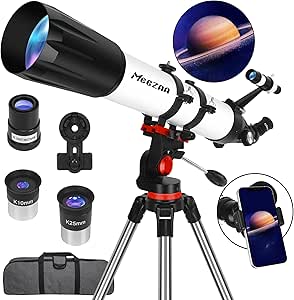 | Best 90mm Refractor Kit | Optical design: Refractor | Aperture: 90 mm | Focal length: 800 mm | VIEW LATEST PRICE | See Our Full Breakdown |
| astronomy telescopes for beginner | Focal length | Mount | Eyepieces | Included accessories |
|---|---|---|---|---|
| Gskyer 70mm Refractor Telescop | 400mm (f/5.7) | Altazimuth | 25mm (16×) and 10mm (40×) | Carry bag, smartphone adapter, wireless camera remote |
| Hawkko 80mm Portable Refractor | — | Altazimuth | 25mm and 10mm | — |
| Celestron Travel Scope 70 Port | 400mm | Altazimuth | 20mm and 10mm | Tripod, finderscope, star diagonal, backpack, Starry Night software |
| NASA Lunar Telescope for Kids | — | Equatorial | Low-power and high-power | — |
| Celestron AstroMaster 70AZ Ref | 900mm | Manual alt-azimuth | 20mm and 10mm | — |
| MEEZAA 80mm Aperture | 500mm | Altazimuth | 25mm and 10mm | Phone adapter and waterproof backpack |
| WOSPORTS 90mm Refractor Telesc | 600mm | Altazimuth | 10mm and 25mm | 3× Barlow lens, 45° diagonal mirror, phone adapter, carrying case |
| EACONN 80mm Aperture | 600mm | Altazimuth | K20mm and K9mm | Smartphone adapter, adjustable tripod, carrying backpack |
| Dianfan 80mm 500mm Portable Re | 500mm | Altazimuth | — | Two eyepieces, 3× Barlow lens, tripod, smartphone adapter, backpack, reusable stickers |
| HUGERSTAR 90mm Aperture Refrac | 800mm | Altazimuth | 10mm and 25mm | 3× Barlow lens, moon filter, smartphone adapter, carrying bag |
| Hawkko 90mm Aperture Refractor | 900 mm | Manual altazimuth | — | Smartphone adapter, finder scope, 10 mm and 25 mm eyepieces, 3x Barlow lens, tripod, and carry bag |
| Fuoibl BY-001 70mm Refracting | 300 mm | — | 6 mm and 20 mm | 3x Barlow lens, adjustable tripod, smartphone adapter, and wireless remote |
| Celestron StarSense Explorer L | 1000 mm | Manual altazimuth | 10 mm and 25 mm | — |
| ToyerBee 70mm Refractor Telesc | 300 mm | — | 20 mm and 6 mm | 3x Barlow lens, 5×24 finderscope, tripod, smartphone adapter, wireless camera remote, and star chart |
| MEEZAA 90mm Aperture Refractor | 800 mm | — | — | 10 mm and 25 mm eyepieces, 3x Barlow lens, tripod, phone adapter, carry bag, accessory tray, zenith mirror, and finder scope |
More Details on Our Top Picks
Gskyer 70mm Refractor Telescope with 400mm Focal Length
The Gskyer earns this spot for beginners who want a portable, ready-to-pack setup for casual Moon viewing and daytime use. Its 70mm aperture and 400mm focal length give it a wide-field approach, while the carry bag, smartphone adapter, and wireless remote make it easier to transport and try basic telescope photography. Compared with the Celestron AstroMaster 70AZ, it is the more travel-oriented choice; the AstroMaster’s longer 900mm focal length is better suited to tighter views of lunar and planetary targets. The Gskyer includes a 3× Barlow, but its listed 120× maximum magnification is a ceiling rather than a promise of sharp views. Manual focusing and the compact tripod setup call for patient adjustment, so this is better for relaxed exploring than detailed observing.
Pros:- Carry bag makes the telescope and accessories easier to transport
- Smartphone adapter and wireless remote support simple phone photography
- Two eyepieces and a 3× Barlow provide several magnification options
- Fully coated optics support both celestial and terrestrial viewing
Cons:- Manual focusing requires patience to sharpen the image
- The 120× listed maximum magnification may not deliver useful detail in typical viewing conditions
- Its 400mm focal length favors wider views over the tighter framing available from the AstroMaster 70AZ
Best for: Beginners who want a portable telescope for casual Moon viewing, daytime scenery, and smartphone snapshots.
Not ideal for: Buyers seeking steadier high-magnification views of planets or a longer focal-length instrument for close-up observing.
- Optical design:Refractor
- Aperture:70mm
- Focal length:400mm (f/5.7)
- Mount:Altazimuth
- Eyepieces:25mm (16×) and 10mm (40×)
- Barlow lens:3×
- Finderscope:5×24 with crosshair lines
- Tripod:Height-adjustable aluminum, 65cm
- Included accessories:Carry bag, smartphone adapter, wireless camera remote
Our verdict“Choose the Gskyer if portability and phone-friendly extras matter more than tight, high-magnification views.”
Hawkko 80mm Portable Refractor Telescope for Beginners
The Hawkko’s main beginner-friendly advantage is its 80mm objective lens, which gathers more light than the 70mm apertures on the Gskyer and Celestron Travel Scope 70. That gives a first-time observer a stronger starting point for the Moon and bright targets, while its backpack and smartphone adapter keep the package oriented toward portable use. The stated 20×–150× range and included 3× Barlow offer flexibility, but magnification figures alone do not guarantee crisp views; steady setup and careful manual focus still matter. Compared with the Celestron Travel Scope 70, this model has the larger aperture and a four-stage adjustable tripod, while the Celestron includes a star diagonal and astronomy software. The Hawkko makes more sense for buyers prioritizing aperture and storage, but its straight-through finder may be less comfortable for some users to aim.
Pros:- 80mm fully multi-coated objective offers a larger aperture than the 70mm models in this group
- Backpack and smartphone adapter support portable observing and phone-based images
- Two eyepieces and a 3× Barlow offer a range of viewing options
- Adjustable four-stage aluminum tripod accommodates different setups
Cons:- Manual focus requires repeated adjustment when changing targets or eyepieces
- Straight-through finderscope can be awkward to use when aiming high in the sky
- Unlike the Celestron Travel Scope 70, it does not list a star diagonal or astronomy software
Best for: New observers who want an 80mm refractor with a backpack and phone adapter for home and travel use.
Not ideal for: Buyers who prefer a supplied star diagonal or astronomy software, or who want to avoid manual focusing and aiming.
- Model:80500
- Telescope type:Refractor
- Objective lens diameter:80mm
- Magnification:20×–150×
- Eyepieces:25mm and 10mm
- Barlow lens:3×
- Mount:Altazimuth
- Tripod:Adjustable four-stage aluminum
- Warranty:2 years
Our verdict“Pick the Hawkko if you want a portable beginner refractor with more aperture than the 70mm kits and can manage manual aiming and focus.”
Celestron Travel Scope 70 Portable Beginner Telescope
The Travel Scope 70 is a straightforward choice for beginners who value quick setup and a portable kit over extra aperture or specialized controls. Its 70mm refractor design handles the Moon, bright planets, and daytime scenery, and the included backpack makes it easier to take along than a conventional tripod-based starter setup. Setup requires no tools, a practical advantage over kits that may involve more assembly before observing. Compared with the Hawkko 80mm, the Celestron gives up 10mm of aperture but includes a star diagonal and Starry Night software, which add useful observing aids. Its 400mm focal length and manual focus keep the design simple, though the included 20mm and 10mm eyepieces offer less listed magnification detail than some competing kits. It is a travel-first starter telescope, not a route to advanced observing.
Pros:- Tool-free setup reduces friction for first-time users
- Backpack supports travel and storage
- Star diagonal and Starry Night software add useful included tools
- Suitable for both night-sky and daytime targets
Cons:- 70mm aperture gathers less light than the Hawkko 80mm
- Manual focusing requires user adjustment
- Designed as an entry-level travel scope rather than an upgrade path for advanced observing
Best for: Beginners who want a tool-free, backpack-friendly telescope for casual astronomy and daytime viewing.
Not ideal for: Observers who prioritize a larger aperture or want a longer focal length for tighter views of lunar and planetary targets.
- Telescope type:Refractor
- Aperture:70mm
- Focal length:400mm
- Field of view:1.43 degrees
- Mount:Altazimuth
- Focus type:Manual
- Eyepieces:20mm and 10mm
- Included accessories:Tripod, finderscope, star diagonal, backpack, Starry Night software
- Warranty:2 years
Our verdict“Choose the Travel Scope 70 if easy setup, travel storage, and a simple all-purpose starter kit outweigh a larger aperture.”
NASA Lunar Telescope for Kids with Tripod and Finder Scope
This Blue Marble telescope has a narrower mission than the other picks: it is aimed at children learning to find and scan the lunar surface. The tabletop tripod and smooth mount keep the setup compact, while the finder scope, two eyepieces, and learning guide give a young observer a basic starting point. Compared with the more general-purpose Celestron Travel Scope 70, it is more focused on moon-centered learning and less suited to families who want one instrument for travel, daytime scenery, and a broader set of night-sky targets. Its 0.85-degree field of view is relatively narrow, which can make locating objects less forgiving for a beginner. The 90× specification and manual focus also mean a child may need adult help to aim and sharpen the view. Batteries are another requirement, so check that before a session.
Pros:- Designed around beginner-friendly Moon viewing
- Finder scope and two eyepieces support basic locating and magnification changes
- Tabletop tripod and smooth mount suit a compact observing spot
- Educational learning guide gives children context for lunar viewing
Cons:- Primarily intended for the Moon rather than broad astronomy use
- Narrow 0.85-degree field of view can make locating targets harder
- Battery-powered operation adds a preparation requirement
Best for: Families introducing children aged 8 and up to lunar observing with a compact tabletop setup and educational guide.
Not ideal for: Adults or families seeking a versatile telescope for varied deep-sky targets, daytime viewing, or frequent travel.
- Recommended age:8 years and up
- Magnification:90×
- Eyepieces:Low-power and high-power
- Mount:Equatorial
- Focus type:Manual
- Field of view:0.85 degrees
- Optical coating:Fully coated
- Included components:Telescope, tabletop tripod, two eyepieces, lens dust cap
- Power source:Battery powered
Our verdict“This is a focused first telescope for children learning the Moon, not the best fit for families wanting a versatile all-purpose scope.”
Celestron AstroMaster 70AZ Refractor Telescope
Among these 70mm refractors, the AstroMaster 70AZ is the better fit for beginners who want a longer focal length for tighter views of the Moon and bright planets. Its 900mm focal length is more than twice that of the Gskyer and Travel Scope 70, whose 400mm designs favor wider views and portability. The 20mm and 10mm eyepieces provide listed magnifications of 45× and 90×, giving new observers a simple choice between lower and higher power. The tradeoff is a manual alt-azimuth mount: you point and track targets yourself, unlike a guided system, and the 10.8-pound setup is less travel-oriented than the Celestron Travel Scope 70 with its backpack. This scope is still limited to bright targets and terrestrial viewing, but its adjustable tripod and familiar controls make it a purposeful step up from compact travel kits.
Pros:- 900mm focal length favors tighter framing than the 400mm Gskyer and Travel Scope 70
- Two eyepieces provide straightforward 45× and 90× viewing options
- Adjustable tripod supports seated or standing use
- Fully coated 70mm optics suit lunar, planetary, and terrestrial targets
Cons:- Manual alt-azimuth mount requires the observer to point and track objects
- At 10.8 pounds, it is less portable than the backpack-equipped Travel Scope 70
- Best suited to bright targets rather than demanding deep-sky observing
Best for: Beginners who mainly want to observe the Moon, bright planets, and daytime targets from a regular viewing spot.
Not ideal for: Travel-focused buyers or observers seeking guided tracking, greater light-gathering capacity, or broad deep-sky performance.
- Optical design:Achromatic refractor
- Aperture:70mm (2.8in)
- Focal length:900mm
- Mount:Manual alt-azimuth
- Eyepieces:20mm and 10mm
- Magnification:45× and 90×
- Finderscope:StarPointer red dot
- Weight:10.8lb (4.9kg)
- Warranty:2 years
Our verdict“Choose the AstroMaster 70AZ if tighter views of the Moon and planets matter more than portability or assisted tracking.”
MEEZAA 80mm Aperture, 500mm Refractor Telescope
The MEEZAA is a flexible starter for families who want one telescope for Moon watching and occasional daytime views. Its 80mm aperture gathers more light than the 70mm Gskyer, while the 500mm focal length keeps the tube relatively portable. Two eyepieces and a 3× Barlow provide a broad advertised magnification range, though the highest settings are not automatically the clearest views. The tool-free assembly, adjustable tripod, phone adapter, and backpack make it easier to share and take outside than a bare-bones setup. Compared with the longer-focal-length EACONN 80mm, this MEEZAA offers a larger stated magnification range but gives up some reach. Manual focusing and the beginner-level mount limit its appeal for users seeking fine control or a long-term advanced instrument.
Pros:- 80mm aperture offers more light gathering than the 70mm Gskyer
- Two eyepieces and a 3× Barlow offer several viewing magnifications
- Tool-free assembly and adjustable tripod suit shared family use
- Phone adapter and waterproof backpack support casual outings
Cons:- Manual focus requires adjustment at the telescope
- Short 500mm focal length offers less reach than the 600mm EACONN
- Beginner-oriented setup is not aimed at advanced observing
Best for: Families and first-time observers who want a portable kit for lunar viewing, simple phone photos, and daytime scenery.
Not ideal for: Experienced observers seeking a sturdier mount, more precise tracking, or advanced deep-sky capability.
- Aperture:80mm
- Focal length:500mm
- Magnification:20×–150×
- Eyepieces:25mm and 10mm
- Barlow lens:3×
- Mount:Altazimuth
- Optical coating:Fully multi-coated
- Tripod height:16.92–44.48 inches
- Included accessories:Phone adapter and waterproof backpack
Our verdict“Choose the MEEZAA for a family-friendly, portable starter kit with a useful accessory bundle, not for advanced control.”
WOSPORTS 90mm Refractor Telescope with Adjustable Tripod and Phone Adapter
The WOSPORTS pairs a 90mm objective with a 600mm focal length, giving beginners a step up in light gathering from the 80mm MEEZAA and EACONN models. That extra aperture can help make the Moon and bright targets easier to see, while its 45° diagonal also suits daytime viewing. The included 25mm and 10mm eyepieces, Barlow, phone adapter, and carrying case make this a practical all-in-one choice for someone who wants to transport the telescope between home and a darker observing spot. Its 29–49-inch tripod has a taller adjustment range than the MEEZAA’s. The tradeoff is a manual altazimuth setup: users must focus and move the tube themselves, and the instructions recommend beginning with the 25mm eyepiece rather than jumping straight to high magnification.
Pros:- 90mm aperture gathers more light than the 80mm MEEZAA and EACONN
- 600mm focal length balances lunar viewing with general beginner use
- Tripod adjusts from 29 to 49 inches
- Phone adapter, diagonal mirror, and carrying case come in the kit
Cons:- Manual focusing and altazimuth movement require hands-on operation
- Getting started calls for beginning with the 25mm eyepiece
- The listed 180× upper magnification depends on the Barlow and viewing conditions
Best for: Beginners prioritizing brighter Moon and planet views who also want a taller adjustable tripod and a carry case.
Not ideal for: Buyers who want automated object finding, tracking, or a telescope that needs little hands-on adjustment.
- Telescope type:Refractor
- Objective lens diameter:90mm
- Focal length:600mm
- Magnification:24×–180× with 3× Barlow lens
- Eyepieces:10mm and 25mm
- Mount:Altazimuth
- Optics coating:Fully multi-coated
- Tripod height:29–49 inches
- Included accessories:3× Barlow lens, 45° diagonal mirror, phone adapter, carrying case
Our verdict“Pick the WOSPORTS if you want a 90mm beginner refractor with a taller tripod and portable accessories.”
EACONN 80mm Aperture, 600mm Refractor Telescope with Backpack
The EACONN takes a more restrained approach than the MEEZAA 80mm: its 600mm focal length is longer, but its stated 30×–66× magnification range is narrower. That makes it a straightforward pick for beginners focused on the Moon, landscapes, and wildlife rather than maximizing magnification. The 80mm aperture and fully multi-coated optics provide a sound entry-level foundation, while the backpack, adjustable tripod, and phone adapter support outings without requiring a separate accessory purchase. Its 5×24 finder includes a crosshair, which can help with aiming. Compared with the WOSPORTS 90mm, however, the EACONN has a smaller aperture and a much lower stated magnification ceiling. That modest range may suit relaxed observing, but buyers wanting more flexibility for lunar detail should look at the MEEZAA or WOSPORTS instead.
Pros:- 600mm focal length provides a longer-reach setup than the 500mm MEEZAA
- 80mm aperture and fully multi-coated optics suit beginner viewing
- Crosshair finder helps with aiming
- Backpack, adjustable tripod, and smartphone adapter are included
Cons:- Stated magnification range tops out at 66×
- Smaller 80mm aperture gathers less light than the 90mm WOSPORTS
- Manual focusing requires user adjustment
Best for: New observers who want uncomplicated low-to-moderate-power views of the Moon, scenery, and wildlife from a portable kit.
Not ideal for: Buyers who want high magnification options or a larger aperture for brighter views of celestial targets.
- Optical design:Refractor
- Objective lens diameter:80mm
- Focal length:600mm
- Magnification:30×–66×
- Eyepieces:K20mm and K9mm
- Finderscope:5×24 with crosshair
- Mount:Altazimuth
- Optics coating:Fully multi-coated
- Included accessories:Smartphone adapter, adjustable tripod, carrying backpack
Our verdict“Choose the EACONN for portable, modest-magnification viewing rather than a wide range of lunar magnification options.”
Dianfan 80mm 500mm Portable Refractor Telescope, Purple
The Dianfan is the portable, personality-forward option in this group: its 50cm optical tube, backpack, and water-resistant carry setup make it easy to take on family outings. Optically, it sits close to the MEEZAA 80mm, with the same 80mm aperture, 500mm focal length, and stated 20×–150× range using a 3× Barlow. Both are aimed at beginner lunar and landscape viewing, but the Dianfan adds a 2.5-degree field of view and a purple finish with reusable astronomy and alphabet stickers. Those touches may make it more inviting for younger users; they do not replace the need to learn manual focusing and aiming. Its straight-through finder may also feel less comfortable to use than the MEEZAA’s specified 5×24 finder. Treat the high magnification figure as a range claim, not a guarantee of sharp views.
Pros:- Compact 50cm tube and backpack suit travel and storage
- 80mm aperture and 20×–150× stated range match the MEEZAA’s beginner-friendly scope
- 2.5-degree field of view is specified
- Phone adapter and reusable stickers add family-friendly extras
Cons:- Manual focus requires hands-on adjustment
- Straight-through finder may be less comfortable to use
- The 150× upper figure depends on the Barlow and practical viewing conditions
Best for: Families with children who want a portable beginner telescope with a distinctive color, reusable stickers, and phone-photo accessories.
Not ideal for: Observers who prefer a more conventional finish, a more comfortable finder arrangement, or a telescope for advanced use.
- Aperture:80mm
- Focal length:500mm
- Magnification:20×–150×
- Optics coating:Fully coated
- Eyepiece lens:Kellner
- Mount:Altazimuth
- Field of view:2.5 degrees
- Optical tube length:50cm
- Included accessories:Two eyepieces, 3× Barlow lens, tripod, smartphone adapter, backpack, reusable stickers
Our verdict“Pick the Dianfan for a portable, child-friendly presentation, while expecting optics and operation similar to the MEEZAA 80mm.”
HUGERSTAR 90mm Aperture Refractor Telescope with 800mm Focal Length
Among these five, the HUGERSTAR combines a 90mm aperture with the longest focal length, 800mm, making it the more reach-oriented choice for beginners interested in the Moon and bright planets. Its longer focal length gives more magnification with a given eyepiece than the 500mm MEEZAA and Dianfan, while the 3× Barlow and included moon filter add useful options for lunar sessions. The tradeoff is a longer 80cm tube, so it is less compact to carry than those short-tube models. The stated 32×–240× range also depends on changing eyepieces and using the Barlow; the maximum is not a promise of consistently clear detail. A manual altazimuth mount keeps operation simple but calls for active focusing and repositioning. The carrying bag helps with transport, though this is not the easiest kit in the group to store.
Pros:- 90mm aperture matches the light-gathering size of the WOSPORTS
- 800mm focal length offers more reach than the 600mm WOSPORTS
- Includes a moon filter, 3× Barlow, and smartphone adapter
- Adjustable tripod and carrying bag support transport and setup
Cons:- 80cm optical tube is less compact than the MEEZAA and Dianfan
- Manual focusing and altazimuth movement require hands-on operation
- The listed 240× maximum depends on eyepiece and Barlow combinations
Best for: Beginners who mainly want lunar and bright-planet viewing and can accommodate a longer tube for added focal reach.
Not ideal for: Families prioritizing the smallest, easiest-to-pack telescope or users seeking automatic tracking and focusing.
- Telescope type:Refractor
- Aperture:90mm
- Focal length:800mm
- Focal ratio:f/8.89
- Magnification:32×–240×
- Eyepieces:10mm and 25mm
- Mount:Altazimuth
- Tripod height:28.7–46.4 inches
- Included accessories:3× Barlow lens, moon filter, smartphone adapter, carrying bag
Our verdict“Choose the HUGERSTAR if lunar and bright-planet viewing matter more than a compact tube or effortless setup.”
Hawkko 90mm Aperture Refractor Telescope with AZ Mount and Smartphone Adapter
The 90mm aperture gives this Hawkko more light-gathering capacity than the 70mm Fuoibl BY-001, a practical advantage when observing the Moon and bright planets. Its 900mm focal length also favors more magnified views than the shorter Fuoibl, though the longer tube is less compact to handle and store. The altazimuth mount keeps movement straightforward for a first-time observer, but it is manual, so you must guide the telescope as objects cross the sky. The included smartphone adapter, carry bag, and eyepieces make the package versatile, while the adjustable tripod accommodates different viewing positions. Treat 270x as a listed upper range, not a dependable everyday setting: atmospheric conditions and mount steadiness can limit useful magnification.
Pros:- 90mm aperture gathers more light than the 70mm Fuoibl BY-001
- 900mm focal length suits closer views of the Moon and bright planets
- Includes smartphone adapter, carry bag, finder scope, and two eyepieces
- Adjustable tripod and manual altazimuth mount offer a simple way to aim
Cons:- Manual mount requires frequent hand tracking as objects move across the sky
- Longer optical tube is less convenient to carry and store than compact 70mm scopes
- The 270x listed maximum may not provide steady, useful views in typical conditions
Best for: Beginners prioritizing brighter lunar and planetary views who have room for a longer telescope and are comfortable tracking targets by hand.
Not ideal for: Travelers seeking a compact grab-and-go scope, or beginners who want app-guided target finding or automatic tracking.
- Telescope type:Refractor
- Objective lens diameter:90 mm
- Focal length:900 mm
- Listed magnification:36x–270x
- Mount:Manual altazimuth
- Field of view:1.39 degrees
- Tripod height:28–46 in
- Weight:5 kg
- Included accessories:Smartphone adapter, finder scope, 10 mm and 25 mm eyepieces, 3x Barlow lens, tripod, and carry bag
Our verdict“Choose the Hawkko if a larger aperture and longer focal length matter more to you than compactness or guided navigation.”
Fuoibl BY-001 70mm Refracting Telescope with Phone Adapter
The Fuoibl BY-001 is the straightforward choice for beginners who want a short 300mm focal length and a setup described as tool-free. Its 70mm aperture is smaller than the Hawkko 90mm, so the Hawkko is better suited to gathering light and pursuing more detailed views of bright celestial targets. The Fuoibl instead puts emphasis on approachable use across the Moon, landscapes, and other bright objects. It includes a phone adapter with wireless remote, two eyepieces, and a 3x Barlow, giving newcomers several ways to frame and record what they see. The altazimuth mount and manual focus keep operation hands-on rather than automated. Its 5×24 finderscope shows an inverted image, which may make initial aiming less intuitive, and the short focal length is not a substitute for a larger-aperture scope when viewing faint objects.
Pros:- Tool-free setup suits newcomers who want to start observing without extra assembly tools
- Phone adapter and wireless remote support simple smartphone photography
- Two eyepieces and a 3x Barlow provide several viewing combinations
- 70mm aperture and multi-coated optics are suited to bright targets and daytime viewing
Cons:- Smaller 70mm aperture gathers less light than the Hawkko 90mm
- Manual mount and focus require hands-on aiming and adjustment
- The 5×24 finderscope presents an inverted image that can complicate target alignment
Best for: First-time observers who value tool-free setup, daytime versatility, and phone-assisted snapshots of bright targets.
Not ideal for: Beginners mainly seeking faint deep-sky objects, or anyone who would be frustrated by an inverted finderscope image and manual tracking.
- Model:BY-001
- Telescope type:Refractor
- Objective lens diameter:70 mm
- Focal length:300 mm
- Listed magnification:15x–150x
- Eyepieces:6 mm and 20 mm
- Mount and focus:Altazimuth mount; manual focus
- Finderscope:5×24, inverted image
- Included accessories:3x Barlow lens, adjustable tripod, smartphone adapter, and wireless remote
Our verdict“Pick the Fuoibl for uncomplicated setup and bright-object viewing, but choose a larger-aperture telescope if faint targets are your priority.”
Celestron StarSense Explorer LT 114AZ Smartphone-Guided Newtonian Telescope
For a beginner unsure where to point a telescope, the StarSense Explorer LT 114AZ offers the clearest difference in this group: app-guided sky navigation uses a smartphone and sky recognition to direct you toward selected targets. That can make finding stars, planets, and deep-sky objects less of a guessing game than with the manually aimed Hawkko 90mm or MEEZAA 90mm refractors. Its 114mm Newtonian reflector also has a larger aperture than those refractors, supporting views of a broader range of celestial objects. The tradeoff is that the guidance depends on a compatible phone, while the altazimuth mount still needs you to move and track the scope by hand. This is not an automatic telescope; it is a manual scope with a useful digital pointing aid.
Pros:- Sky-recognition app guides users toward selected observing targets
- 114mm Newtonian aperture is larger than the 90mm Hawkko and MEEZAA refractors
- Target guidance can ease the early learning curve of locating objects
- Includes two eyepieces, a red dot finderscope, tripod, and smartphone dock
Cons:- Guided navigation requires a smartphone that meets the listed compatibility requirements
- Manual altazimuth mount still requires hand movement and tracking
- The phone dock and app add a dependency absent from simpler, fully manual scopes
Best for: Beginners with a compatible smartphone who want help locating a varied list of sky targets, including deep-sky objects.
Not ideal for: Buyers without a compatible phone, or anyone expecting automatic movement and tracking after selecting a target.
- Optical design:114 mm Newtonian reflector
- Focal length:1000 mm
- Mount:Manual altazimuth
- Eyepieces:10 mm and 25 mm
- Field of view:2.04 degrees
- Finderscope:Reflex red dot
- Smartphone compatibility:Android 12 or later; iOS 18 or later, including iPhone XR and newer
- Glass coating:Aluminum and SiO₂
- Warranty:2-year US warranty
Our verdict“Choose the StarSense Explorer if finding targets is your main beginner hurdle and you have a compatible smartphone.”
ToyerBee 70mm Refractor Telescope for Beginners, 15x–150x Magnification
The ToyerBee’s strongest case is its lightweight, 3.5 lb build paired with a generous set of beginner accessories. It is easier to pack for outdoor trips than the 5 kg Hawkko 90mm, though the Hawkko’s larger aperture is the stronger choice when light gathering takes priority. ToyerBee’s 70mm refractor is aimed at the Moon, bright planets, and daytime viewing; it is not the pick here for pursuing faint objects. A smartphone adapter, wireless camera remote, and star chart make it appealing to someone learning the sky while trying phone photography. Like the Fuoibl BY-001, it uses a 300mm focal length, manual focus, and 15x–150x listed magnification. That short focal length keeps the package travel-friendly, but the high end of the range may be difficult to use steadily.
Pros:- At 3.5 lb, it is easier to carry than the 5 kg Hawkko 90mm
- Includes a smartphone adapter and wireless camera remote for phone photography
- Star chart gives beginners a basic aid for learning the sky
- Suitable for bright celestial targets and daytime use
Cons:- 70mm aperture gathers less light than the Hawkko and MEEZAA 90mm refractors
- Manual focus and mount require direct adjustment and tracking
- The listed 150x maximum may be difficult to hold steady in practical viewing
Best for: Beginners who want a light telescope for trips, bright-object viewing, and experimenting with smartphone photos.
Not ideal for: Observers seeking a larger aperture for faint targets, or buyers who want a stable, automated mount and hands-free tracking.
- Model:HT001
- Optical design:Refractor
- Objective lens diameter:70 mm
- Focal length:300 mm
- Listed magnification:15x–150x
- Eyepieces:20 mm and 6 mm
- Weight:3.5 lb
- Dimensions:5.5 × 13.6 × 20.9 in
- Included accessories:3x Barlow lens, 5×24 finderscope, tripod, smartphone adapter, wireless camera remote, and star chart
Our verdict“The ToyerBee suits mobile beginners who value low carry weight and phone-photo accessories over aperture and steadier high magnification.”
MEEZAA 90mm Aperture Refractor Telescope, 800mm Focal Length
The MEEZAA is a strong fit for beginners who want a 90mm refractor and an 800mm focal length without adding app-based target guidance. Compared with the Hawkko 90mm, it has a 100mm shorter focal length and a lower listed maximum magnification, while retaining the same aperture class and a similar beginner-oriented accessory package. That makes the two refractors close alternatives: the Hawkko offers the longer focal length, while the MEEZAA’s stated range is 32x–240x and its fully multi-coated optics support bright-object viewing. Both rely on a manual altazimuth mount, so neither removes the need to aim and track by hand. The MEEZAA includes a phone adapter and carry bag, but assembly is required, and its 80cm optical tube is less compact than a short focal-length travel refractor.
Pros:- 90mm aperture offers more light-gathering capacity than the ToyerBee and Fuoibl 70mm refractors
- 800mm focal length pairs a substantial aperture with a shorter tube than the Hawkko 900mm
- Includes two eyepieces, a 3x Barlow lens, phone adapter, and carry bag
- Fully multi-coated optical glass lenses are specified for night-sky viewing
Cons:- Manual focus and altazimuth mount require hands-on adjustments and target tracking
- Assembly is required before use
- The 80cm optical tube is less portable than the shorter 300mm focal-length Fuoibl and ToyerBee
Best for: Beginners who want a 90mm refractor, a practical accessory kit, and a carry bag for storing or transporting the telescope.
Not ideal for: Buyers seeking guided target finding, automatic tracking, or a compact short-tube scope for frequent travel.
- Optical design:Refractor
- Aperture:90 mm
- Focal length:800 mm
- Focal ratio:f/8.88
- Listed magnification:32x–240x
- Mount and focus:Altazimuth mount; manual focus
- Tripod height:28–46 in
- Optical tube length:80 cm
- Included accessories:10 mm and 25 mm eyepieces, 3x Barlow lens, tripod, phone adapter, carry bag, accessory tray, zenith mirror, and finder scope
Our verdict“Choose the MEEZAA if you want a 90mm refractor kit with a carry bag and do not need the Hawkko’s longer 900mm focal length.”
How We Picked
I compared these 15 beginner-oriented telescopes through the practical demands of a first setup: how approachable the design appears, how much aperture it offers, how manageable it is to carry and store, and what its mount and included aids may contribute to observing. I also looked at focal length and optical format as clues to each model’s likely role, while treating advertised magnification ranges cautiously: magnification depends on conditions, optics, and a stable mount.
The ranking gives extra weight to finding objects and getting started, since a capable telescope can frustrate a beginner if aiming is difficult. That puts the smartphone-guided Celestron StarSense Explorer LT 114AZ ahead for general usability, while the AstroMaster 70AZ stands out as a more conventional entry point. Portable models rank well for travel and storage, and 90mm refractors earn attention for aperture, but neither portability nor aperture alone outweighs setup and handling. Product names and listed features guide this comparison; I do not treat unverified claims as proof of optical performance.
| astronomy telescopes for beginner | Mount |
|---|---|
| Gskyer 70mm Refractor Telescop | Altazimuth |
| Hawkko 80mm Portable Refractor | Altazimuth |
| Celestron Travel Scope 70 Port | Altazimuth |
| NASA Lunar Telescope for Kids | Equatorial |
| Celestron AstroMaster 70AZ Ref | Manual alt-azimuth |
| MEEZAA 80mm Aperture | Altazimuth |
| WOSPORTS 90mm Refractor Telesc | Altazimuth |
| EACONN 80mm Aperture | Altazimuth |
| Dianfan 80mm 500mm Portable Re | Altazimuth |
| HUGERSTAR 90mm Aperture Refrac | Altazimuth |
| Hawkko 90mm Aperture Refractor | Manual altazimuth |
| Fuoibl BY-001 70mm Refracting | — |
| Celestron StarSense Explorer L | Manual altazimuth |
| ToyerBee 70mm Refractor Telesc | — |
| MEEZAA 90mm Aperture Refractor | — |
Factors to Consider When Choosing Astronomy Telescopes For Beginners
Before choosing among these scopes, I’d match the telescope to where and how you plan to observe. A beginner’s best first instrument is often the one that can be set up, aimed, and carried without turning every clear evening into a project.
Choose Around Your Observing Location
Start with the distance between your storage spot and your observing spot. A scope used from a balcony or carried to a nearby field has different needs from one that stays assembled in a yard. Compact 70mm and 80mm refractors are easier to handle, but portability can come with less aperture than a larger instrument. If you must carry gear on foot, count the tripod and accessories as part of the load, not just the optical tube. A backpack can help organize a kit, though it does not automatically make setup faster. I’d favor a manageable scope you will take outside over a larger one that regularly stays indoors.
Treat Aperture as One Part of the Decision
Aperture is the diameter of the telescope’s main lens or mirror, and it affects how much light the instrument can gather. That matters when observing dimmer objects, but aperture is not a shortcut to good views in every setting. City light pollution, atmospheric steadiness, optical quality, and the mount all shape what you can see. A 90mm refractor may offer more light-gathering capacity than a 70mm model, yet its larger size may be less convenient for a quick session. Beginners focused on the Moon and bright planets may value simple handling more than a modest aperture difference. Compare the complete setup rather than picking by the largest number alone.
Look for a Mount That Makes Aiming Manageable
The mount determines how the telescope points and how steadily it holds a target. Many entry-level refractors use an alt-azimuth arrangement, which moves up, down, left, and right in a familiar way. A lightweight tripod may be easier to carry, but wobble can make focusing and tracking an object frustrating. Phone adapters can help with casual viewing or basic imaging, but a phone’s weight may add strain and phone photography through an eyepiece takes practice. When comparing listings, check whether the tripod height and adjustment controls suit the person who will use the telescope. A stable, intuitive mount can be more rewarding than extra magnification.
Ignore Magnification Claims Without Context
High magnification figures are easy to advertise, but they are not a reliable measure of a telescope’s overall ability. Useful magnification depends on the optics, the eyepiece, the atmosphere, and whether the mount stays steady. Pushing magnification too far often makes an image dimmer and harder to keep centered. For a first telescope, prioritize clear optics, a usable finder, and a mount that moves smoothly. Check which eyepieces are included and whether additional accessories are standard or optional. If the product page emphasizes a very large magnification range but offers little detail on the mount or optics, treat that claim cautiously.
Decide Whether Guided Finding Is Worth the Extra Complexity
Locating an object is a separate skill from viewing it, and this is where smartphone guidance can make a real difference. A guided system can help a newcomer identify where to point, while a manual telescope asks the user to learn the sky and use a finder. Neither approach removes the need to align the telescope or keep the target centered. Guided tools may depend on a compatible phone, app access, power, and a clear view of the sky, so check what the system requires before buying. Manual models can be simpler and less dependent on electronics, but learning to find targets takes patience. Choose guidance if finding objects is likely to be your main early frustration.
Match the Optical Design to Your Long-Term Interests
Most scopes in this lineup are refractors, which use lenses and often suit buyers who want a straightforward, enclosed tube. The StarSense Explorer LT 114AZ is a Newtonian reflector, using a mirror-based design and offering a different route to collecting light. Reflectors may need occasional alignment, while refractors generally avoid that particular task, though all telescopes benefit from careful handling and clean storage. Think about whether you want a low-maintenance first instrument or are willing to learn basic upkeep for a different optical format. Also consider whether your interests may expand from bright lunar and planetary targets to fainter objects. The best choice balances what you want to see with the care and setup you are ready to take on.
Frequently Asked Questions
Should I choose the StarSense Explorer LT 114AZ or a simpler refractor?
I’d choose the StarSense Explorer LT 114AZ if locating targets is the part of astronomy most likely to put you off, since its smartphone-guided approach is a key difference from the manual refractors here. A simpler model such as the AstroMaster 70AZ may suit someone who prefers a more conventional setup and wants to learn to aim without relying on an app. The StarSense is a Newtonian reflector, so its care and setup differ from the refractor majority in this roundup. Check phone compatibility and the app’s operating requirements before deciding. The right pick depends less on which design sounds advanced and more on which one you will use consistently.
Is a 90mm beginner telescope always a better choice than a 70mm model?
No. A 90mm aperture can gather more light than a 70mm aperture, but a telescope’s full performance also depends on its optics, mount, observing conditions, and handling. The larger model may take more space or be less convenient to carry, which matters if you observe away from home. For bright targets such as the Moon, ease of aiming and a stable view can matter more than the aperture difference. I’d compare the tripod and total setup as carefully as the lens diameter. Choose 90mm when the added aperture fits your space and portability needs, not simply because the number is larger.
Will a phone adapter let me take clear pictures of planets?
A phone adapter can hold a phone near an eyepiece, but it does not guarantee clear planetary photos. Aligning the phone camera with the eyepiece can take adjustment, and a shaky tripod makes framing harder. Phone cameras may also struggle with small, bright targets, even when the telescope provides a useful visual view. Treat adapters on models such as the WOSPORTS and Hawkko 90mm as an accessory for experimentation rather than a substitute for a dedicated imaging setup. If viewing is your priority, assess the mount and optics first; choose based on phone features only if you are comfortable with trial and error.
Are portable 70mm and 80mm telescopes suitable as a first telescope?
They can be a sensible first choice when easy carrying and storage are high priorities. Models such as the Celestron Travel Scope 70 and the EACONN 80mm with backpack are presented around portability, which may make them easier to take out for short sessions. Their smaller apertures gather less light than larger options in this list, so they are not the strongest fit if your main goal is seeking faint objects. A portable scope still needs a stable place to stand and a usable finder. I’d choose one when convenience is likely to lead to more observing, rather than expecting compact size to deliver every capability of a larger telescope.
What should I check before buying a beginner telescope for a child?
Check whether the child can reach the controls, carry or help set up the telescope, and keep the tripod steady. A product labeled for kids, such as the NASA Lunar Telescope, may be packaged with a younger user in mind, but the label alone does not tell you how smooth the mount or clear the instructions will be. Supervision can help with alignment, focusing, and handling small accessories. Avoid choosing by a large magnification claim; a simple view that is easy to find and focus is more rewarding. If an adult will share the telescope, compare its usability with general beginner models rather than limiting the choice to children’s branding.
Conclusion
For the strongest all-around beginner fit, I’d choose the Celestron StarSense Explorer LT 114AZ, especially for someone who wants help finding targets and is comfortable with a smartphone-guided Newtonian. My best for a straightforward first setup is the Celestron AstroMaster 70AZ, while the Celestron Travel Scope 70 is a better match when portability leads the decision. For aperture-focused buyers, the Hawkko 90mm refractor models are worth comparing, with the tradeoff that a larger scope may be less convenient to carry. The lineup does not provide enough verified information to name a price-based best value or premium pick; I’d make those choices only after checking current kit contents, mount stability, and support. Match your choice to where you will observe and how you prefer to find objects, then favor the scope you can comfortably set up and use often.
Halloween Picks

MGparty 14.5 ft Halloween Inflatable Walk-In Pumpkin House with LED Lights

12.5-Foot Lighted Halloween Inflatable Archway

JOYIN 5-Foot Halloween Animatronic Drinking Skeleton
As an affiliate, we earn on qualifying purchases.