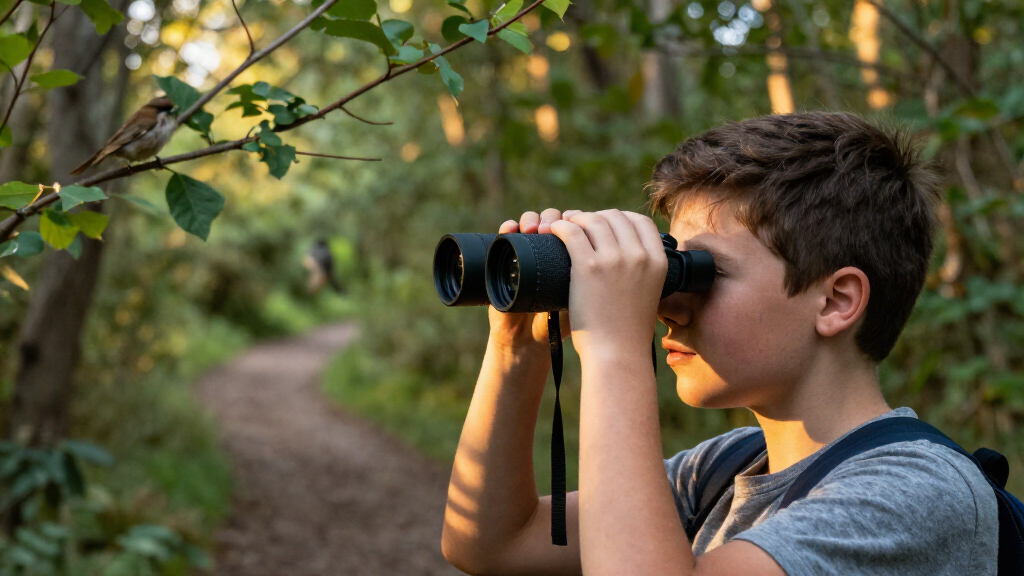

For most newcomers, I’d start with the Celestron Outland X 8×42: its 8x magnification and 42 mm objectives make it a balanced choice for finding and following birds. The Gosky 8×42 adds a phone adapter and tripod, while the Pentax Papilio II 6.5×21 suits close-up nature viewing and compact carry. The main tradeoff is between a steadier, brighter full-size view and the lighter, more portable feel of compact binoculars; higher magnification can make moving birds harder to track. Read on for how all 12 options compare and which one fits your birdwatching habits.

Prime made for students and young adults
- Fast, free delivery for dorm and study essentials
- Prime Video and Amazon Music included
- Member-only deals
Key Takeaways
- 8×42 models lead as versatile first binoculars: the Celestron Outland X and Gosky combine moderate magnification with larger objectives, a useful balance for locating and following birds.
- The phone-adapter bundles are not automatically better birding tools: Gosky, Adorrgon, and the other 12×42 options add recording accessories, but their higher magnification can make quick tracking less comfortable for beginners.
- Compact 10×25 and 12×25 designs favor portability over viewing ease: Aurosports, Hontry, and Occer are easier to carry, but their smaller objectives and stronger magnification can be less forgiving in dim light or while locating a bird.
- Not every useful beginner pick is a conventional birding binocular: Pentax Papilio II’s 6.5x magnification and close-focus design favor nearby details, not distant birds across a field.
- Feature claims alone do not settle the choice: several listings use broad labels such as HD, high powered, or waterproof, so prioritize the stated magnification, objective size, focus usability, and the conditions you expect to encounter.


| beginner birdwatching binocular | Magnification | Objective lens diameter | Field of view | Prism type |
|---|---|---|---|---|
| Aurosports 10×25 Compact Binoc | 10x | 25 mm | 362 feet | Porro prism |
| Gosky 8×42 Binoculars for Adul | 8x | 42 mm | 110 meters | Roof prism |
| Celestron Outland X 8×42 Binoc | 8x | 42 mm | 7 degrees | BaK-4 |
| 10×42 Binoculars for Adults | 10x | 42 mm | 5.5 degrees | Roof prism |
| Pentax Papilio II 6.5×21 Binoc | 6.5x | 21 mm | 393 feet | Porro prism |
| Occer 12×25 Compact Binoculars | 12x | 25mm | 7.5 degrees | BAK-4 |
| Vortex Triumph HD 10×42 Binocu | 10x | 42mm | 0.67 degrees | Roof prism |
| Hontry 10×25 Compact Binocular | 10x | 25mm | 362 feet | Porro prism |
| Aurosports 10×25 Binoculars fo | 10x | 25mm | 965 feet | — |
| Mini Compact Binoculars for Ad | 8x | 21mm | 1010 yards | Roof prism |
| Adorrgon 12×42 High Powered Bi | 12x | 42 mm | 367 ft at 1,000 yd | Roof prism |
| 12×42 Binoculars for Adults wi | 12x | 42 mm | 367 yards | Roof prism |
More Details on Our Top Picks
Aurosports 10×25 Compact Binoculars for Bird Watching, Travel, and Outdoor Activities
The Aurosports 10×25 is the easiest fit here for beginners who want binoculars they can keep in a small bag or jacket pocket. At 8.8 ounces, it is much easier to carry all day than full-size options such as the Celestron Outland X 8×42. Its 10x magnification can bring distant birds closer, but the narrower 25 mm lenses and 2.5 mm exit pupil mean a dimmer view at dawn, dusk, or under dense tree cover. The 362-foot field of view gives beginners useful room to find moving birds, though holding a 10x image steady can take practice. Water resistance and rubber armor add outdoor practicality, but this is not a waterproof choice for sustained wet weather. It suits casual daytime birding better than low-light watching.
Pros:- Light 8.8-ounce build is convenient for long walks and travel.
- 10x magnification helps bring distant birds closer.
- 362-foot field of view gives beginners room to locate moving subjects.
- Fully multi-coated optics and rubber armor support clear viewing and everyday handling.
Cons:- Small 25 mm objectives and 2.5 mm exit pupil limit brightness in low light.
- 10x magnification can make it harder for beginners to hold the view steady.
- Water resistant, but not fully waterproof.
Best for: Beginners who prioritize a pocketable, lightweight pair for daytime walks, travel, and occasional bird spotting.
Not ideal for: Birders who often watch at dawn or dusk, need a steadier wide view, or expect protection from heavy rain or immersion.
- Magnification:10x
- Objective lens diameter:25 mm
- Field of view:362 feet
- Weight:8.8 ounces
- Prism type:Porro prism
- Coating:Fully multi-coated
- Water resistance:Water resistant
- Eye relief:14.8 mm
Our verdict“Choose the Aurosports if easy carrying matters more than bright low-light views or all-weather protection.”
Gosky 8×42 Binoculars for Adults with Phone Adapter and Tripod
The Gosky 8×42 is the package-oriented choice for a beginner who wants to observe birds and try recording them with a phone. Its 8x magnification is easier to hold steady than the 10x Aurosports 10×25, while the 42 mm objectives and 5.25 mm exit pupil give a brighter-viewing setup for changing outdoor light. The included phone adapter and tripod add ways to capture or stabilize a view, though they also make this less of a grab-and-go option than a compact pair. Its IPX7 waterproofing and fogproof construction suit wet-weather outings better than the Celestron Outland X’s listed general waterproof rating. One specification lists the weight as 2.4 pounds, so buyers should not assume it is especially light despite the product description. The adapter and tripod are useful extras, not a substitute for learning basic bird-finding and focusing.
Pros:- 8x magnification is generally easier to steady than 10x for a new user.
- 42 mm objectives and a 5.25 mm exit pupil support brighter views than compact 25 mm models.
- IPX7 waterproof rating and fogproof construction suit wet outdoor use.
- Phone adapter and tripod are included for image capture and stable viewing.
Cons:- Listed weight of 2.4 pounds is substantial for extended carrying.
- 8x magnification offers less reach than the 10x Aurosports 10×25 and 10×42 models.
- The phone adapter and tripod add setup complexity for beginners who just want to watch.
Best for: New birders who want 8x viewing, weather protection, and included equipment for phone photos or steadier observation.
Not ideal for: Hikers seeking a genuinely lightweight setup, or birders who want extra reach for distant birds and prefer a simple binocular-only kit.
- Magnification:8x
- Objective lens diameter:42 mm
- Field of view:110 meters
- Exit-pupil diameter:5.25 mm
- Eye relief:15 mm
- Prism type:Roof prism
- Water resistance:IPX7 waterproof
- Weight:2.4 pounds
Our verdict“Pick the Gosky if phone capture and wet-weather protection matter more than keeping your birding kit light and simple.”
Celestron Outland X 8×42 Binoculars for Birding & Nature Viewing
The Celestron Outland X 8×42 is the most balanced starting point in this group: familiar 8x magnification, full-size objectives, and a wide view help beginners find and follow birds without pushing reach at the expense of steadiness. Its 7-degree field of view is especially useful when a bird moves through branches, and BaK-4 prisms with multi-coated optics support bright, detailed viewing. Unlike the compact Aurosports 10×25, this model is better equipped for dimmer conditions, though it takes up more room and is not as pocketable. Waterproof and fogproof construction suit unpredictable outings. A tripod mount is present, but the adapter is not included, and the supplied accessories are limited. For a first dedicated birding pair, I would favor this straightforward balance over the Gosky’s more elaborate phone-and-tripod bundle.
Pros:- 8x magnification supports a steadier view and easier tracking for beginners.
- 7-degree field of view helps locate and follow moving birds.
- 42 mm objectives and BaK-4 prisms support bright, detailed viewing.
- Waterproof, fogproof, rubber-armored housing is suited to outdoor use.
Cons:- Full-size design is less convenient to carry than the Aurosports 10×25.
- Tripod mount is included, but the tripod adapter is not.
- Limited included accessories may disappoint buyers seeking a complete kit.
Best for: First-time birders who want a steady, wide-view 8×42 binocular for parks, woodland walks, and general nature watching.
Not ideal for: Travelers who need pocket-sized optics, or buyers who want a phone adapter and tripod included in the package.
- Magnification:8x
- Objective lens diameter:42 mm
- Field of view:7 degrees
- Prism type:BaK-4
- Waterproof:Yes
- Fogproof:Yes
- Housing material:Rubber-armored polycarbonate
- Tripod mount:Yes
Our verdict“Choose the Celestron Outland X for a dependable, wide-view first pair when portability matters less than easy bird tracking.”
10×42 Binoculars for Adults – HD Roof BAK4 Prism Lens for Bird Watching, Hunting, Travel, Sports, Cruise with Carrying Bag
This 10×42 roof-prism model suits beginners who prioritize seeing distant birds more closely than quickly tracking them. Its 10x magnification provides more reach than the Celestron Outland X 8×42, while the same 42 mm objective size retains a full-size format. That extra magnification comes with a tradeoff: the listed 5.5-degree field of view is narrower than the Celestron’s 7-degree view, so finding a bird in the eyepieces can take more effort. At 1.1 pounds, it is lighter than the Gosky’s listed 2.4 pounds, but its 10 mm eye relief may feel restrictive for some glasses wearers despite the product description’s glasses-friendly claim. Water resistance helps with light exposure, not heavy rain or immersion. This is a reach-first option, not the easiest all-round pair for a new birder.
Pros:- 10x magnification brings distant subjects closer than the 8×42 alternatives.
- 42 mm objectives provide a full-size viewing format.
- Center-focus control supports straightforward adjustment.
- At 1.1 pounds, it is lighter than the Gosky package’s listed weight.
Cons:- 5.5-degree field of view is narrower than the Celestron Outland X’s 7-degree view.
- 10 mm eye relief may not give glasses wearers a comfortable full field.
- Water resistance does not cover heavy rain or water immersion.
Best for: Beginners who regularly watch more distant birds in open spaces and are comfortable trading a wider view for 10x reach.
Not ideal for: New birders focused on fast-moving woodland birds, glasses wearers needing generous eye relief, or anyone needing waterproof protection.
- Magnification:10x
- Objective lens diameter:42 mm
- Field of view:5.5 degrees
- Weight:1.1 pounds
- Prism type:Roof prism
- Focus type:Center focus
- Eye relief:10 mm
- Water resistance:Water resistant
Our verdict“Choose this model when added reach is your priority and you can accept a narrower view and limited water protection.”
Pentax Papilio II 6.5×21 Binoculars (Gray)
The Pentax Papilio II 6.5×21 takes a different route from standard birding pairs: its close-focus design makes nearby nature observation a central strength, while 6.5x magnification gives a calm, easy-to-hold view. That can appeal to beginners watching insects, flowers, and birds at close range, but it offers less reach than the 10×42 model and less light-gathering capacity than the Celestron Outland X 8×42. Its 393-foot field of view helps with locating subjects, and 15 mm eye relief is more accommodating than the 10×42 model’s listed 10 mm. The compact 21 mm objectives keep it portable but can make the image dimmer in low light. Although the supplied description calls it waterproof, buyers should confirm the protection level they need before relying on it in wet conditions. This is a specialist nature companion, not the most conventional birding choice.
Pros:- Close-focus design supports nearby nature viewing beyond typical distant birding.
- 6.5x magnification is comparatively easy to hold steady.
- 393-foot field of view helps locate subjects.
- 15 mm eye relief is more generous than the 10×42 model’s listed 10 mm.
Cons:- 6.5x magnification gives less reach for distant birds than the 10x models.
- 21 mm objectives and a 3 mm exit pupil limit brightness in low light.
- No tripod adapter is included.
Best for: Beginners who enjoy close-up nature observation and want a compact, steady pair for nearby subjects as well as casual birding.
Not ideal for: Birders who mainly watch distant birds, need brighter dawn or dusk views, or want an included tripod adapter.
- Magnification:6.5x
- Objective lens diameter:21 mm
- Field of view:393 feet
- Eye relief:15 mm
- Prism type:Porro prism
- Exit-pupil diameter:3 mm
- Focus type:Close focus
- Diopter adjustment:+/-5 diopters
Our verdict“Pick the Papilio II if close-up nature viewing and a steady, compact view matter more than distant reach or low-light performance.”
Occer 12×25 Compact Binoculars for Adults and Kids
The Occer stands out for putting 12x magnification in a compact body, which can help beginners pick out distant birds without carrying standard-size binoculars. Compared with the Mini Compact 8×21, it brings more reach, but the higher magnification can make moving birds harder to keep centered and hand shake more visible. Its 2.5mm exit pupil also gives it less light-gathering capacity than the larger Vortex Triumph HD 10×42, so it is better suited to bright daytime walks than dawn or shaded woodland. Adjustable eye cups and a stated 20mm eye relief are useful for glasses wearers. The tradeoff is a small objective lens and manual center focus, which may demand patience when tracking quick movement.
Pros:- 12x magnification offers more reach than the 8×21 Mini Compact.
- Compact size and stated waterproof construction suit travel and outdoor walks.
- Adjustable eye cups and 20mm eye relief accommodate many glasses wearers.
- BAK-4 prisms and fully multi-coated optics are specified.
Cons:- The 25mm lenses and 2.5mm exit pupil limit performance in dim conditions.
- 12x magnification can make handheld viewing less steady than 8x or 10x options.
- Manual center focus requires adjustment when switching between nearby and distant birds.
Best for: Daytime beginners who want a pocketable pair for distant birds and occasional travel, especially glasses wearers.
Not ideal for: Birders who often watch at dawn, in deep shade, or want an easy-to-steady view of birds in flight.
- Magnification:12x
- Objective lens diameter:25mm
- Field of view:7.5 degrees
- Exit pupil:2.5mm
- Prism type:BAK-4
- Eye relief:20mm
- Focus:Center focus
- Water resistance:Waterproof
Our verdict“Choose the Occer if compact size and extra reach matter more to you than a bright, forgiving view in low light.”
Vortex Triumph HD 10×42 Binoculars
For a beginner ready to carry full-size binoculars, the Vortex Triumph HD offers a more versatile starting point than the compact 25mm models here. Its 10×42 configuration combines useful reach with a larger 4.2mm exit pupil, which can make woodland and overcast viewing more comfortable than with the Occer 12×25 or Hontry 10×25. Waterproof and fog-proof construction also suits changing outdoor conditions, while the diopter adjustment lets each eye be tuned. The included GlassPak harness gives it a more supported carry setup than the pocket-sized Aurosports kit. The tradeoffs are its larger body and 0.45kg weight, plus a listed field of view of 0.67 degrees that may feel restrictive when scanning for fast-moving birds. Its 10x power is not the highest in this group, but it is easier to manage than 12x magnification.
Pros:- 42mm objective lenses and a 4.2mm exit pupil suit more varied daylight conditions than 25mm compacts.
- Waterproof, fog-proof, and shockproof construction is specified.
- Diopter adjustment and adjustable eyecups allow a more tailored view.
- GlassPak harness and neck strap support carrying the larger binoculars.
Cons:- At 0.45kg, it is heavier and bulkier than the compact models in this batch.
- The listed 0.67-degree field of view may make fast scanning less convenient.
- 10x magnification offers less reach than the Occer 12×25.
Best for: Beginners who plan regular birding walks and want larger objectives, weather protection, and a harness-supported carry.
Not ideal for: Travelers who prioritize pocketability or birders who want a broad, forgiving view for locating birds quickly.
- Magnification:10x
- Objective lens diameter:42mm
- Exit pupil:4.2mm
- Field of view:0.67 degrees
- Prism type:Roof prism
- Eye relief:17mm
- Diopter adjustment:±5.0
- Water resistance:Waterproof
Our verdict“Pick the Vortex if you want a weather-ready, full-size birding option and can accept more bulk than a compact pair.”
Hontry 10×25 Compact Binoculars for Adults and Kids
The Hontry is the straightforward compact choice for a beginner who wants 10x magnification without the extra reach—and extra hand shake—of the Occer 12×25. Its 25mm objectives keep the body portable, while center focus and adjustable diopter settings provide familiar controls for sharing between users. The listed field of view is 362 feet, giving new birders a practical basis for scanning, though it is not as light-friendly as the Vortex Triumph HD 10×42 with its larger objectives. Hontry specifies fully multi-coated optics and BAK-4 prisms, but the stated 10mm eye relief is short compared with the Occer’s 20mm, so glasses wearers may find the view less comfortable. Waterproofing is listed, yet accessory details are sparse. This is a simple carry-anywhere option, not the strongest pick for low-light birding.
Pros:- 10x magnification is less demanding to hold steady than the Occer’s 12x.
- Compact 25mm format is easy to pack for walks and travel.
- BAK-4 prisms and fully multi-coated optics are specified.
- Adjustable diopter and a stated wide interpupillary range support shared use.
Cons:- The stated 10mm eye relief may be uncomfortable for many glasses wearers.
- 25mm objectives are less suited to dim conditions than the Vortex 10×42.
- The product data does not specify included carrying accessories.
Best for: Beginners and families seeking a compact, shared pair for bright daytime outings, travel, and casual bird spotting.
Not ideal for: Glasses wearers needing generous eye relief, or birders who regularly watch in low light and want larger lenses.
- Magnification:10x
- Objective lens diameter:25mm
- Field of view:362 feet
- Prism type:Porro prism
- Eye relief:10mm
- Focus:Center focus
- Coating:Fully multi-coated
- Weight:0.6 pounds
Our verdict“Choose the Hontry for casual daytime birding when compact size and easy sharing matter more than eye relief or low-light viewing.”
Aurosports 10×25 Binoculars for Bird Watching with Bird Guide Book
The Aurosports kit is the most explicitly beginner-oriented package here: alongside 10×25 binoculars, it includes a bird guide book, case, strap, and lens cloth. That gives a newcomer more to work with than the Hontry, whose listed data does not specify accessories, and makes it easier to start identifying birds rather than just viewing them. The compact form and BAK-4 prisms with FMC coating suit casual daylight outings. Its listed field of view is 965 feet, but the unusually short stated 3.75mm eye relief is a real comfort concern, particularly for glasses wearers. It is only water resistant, unlike the waterproof Vortex Triumph HD, so it is less reassuring in wet weather. The kit’s appeal is convenience and learning support, not maximum weather protection or long-session comfort.
Pros:- Bird guide book gives beginners a reference for identifying what they spot.
- Includes a carrying case, neck strap, and lens cloth.
- Compact 10×25 format is easy to bring on walks.
- BAK-4 prisms and FMC coating are specified.
Cons:- The stated 3.75mm eye relief is very short and may make viewing uncomfortable.
- Water resistance is specified, not full waterproofing like the Vortex Triumph HD.
- 25mm objectives are less suited to dim light than full-size 42mm binoculars.
Best for: First-time birders who want binoculars and basic bird-identification gear in one compact kit.
Not ideal for: Glasses wearers or anyone who expects to bird in steady rain and wants fully waterproof protection.
- Magnification:10x
- Objective lens diameter:25mm
- Field of view:965 feet
- Exit pupil:3.41mm
- Eye relief:3.75mm
- Coating:FMC
- Water resistance:Water resistant
- Included items:Binocular, bird guide book, carrying case, neck strap, lens cloth
Our verdict“Choose this kit if you want a compact first pair with a guide book and accessories, and do not need long eye relief or full waterproofing.”
Mini Compact Binoculars for Adults and Kids – Waterproof, High Powered, Easy Focus, 8x Magnification
At 8x magnification, this mini pair favors finding and following birds over enlarging distant detail. That makes it a more forgiving first binocular than the Occer 12×25, whose higher power can be harder to hold steady, and a sensible fit for children or adults who are still learning to aim binoculars. The listed 1010-yard field of view supports broad scanning, while its 0.19kg weight is the lightest specified in this batch. The compromise is a 21mm objective lens and 2.6mm exit pupil, which limit light reaching the eye compared with the Vortex Triumph HD 10×42. Its water rating is only water resistant, despite the title’s waterproof wording, so I would not treat it as suitable for sustained rain. This is a portability-and-ease pick, not a long-distance or low-light specialist.
Pros:- 8x magnification is easier to keep steady than the Occer’s 12x.
- Very light at 0.19kg and suited to compact carrying.
- Wide listed field of view helps beginners locate birds.
- Center focus and diopter adjustment are specified.
Cons:- 21mm objectives and a 2.6mm exit pupil limit performance in dim light.
- 8x magnification provides less reach than the 10x and 12x options.
- Water resistance is listed, not full waterproofing.
Best for: Children, casual beginners, and travelers who want a very light pair that is easier to aim and scan with.
Not ideal for: Birders seeking strong detail at long distances, dawn viewing, or binoculars rated for full waterproof protection.
- Magnification:8x
- Objective lens diameter:21mm
- Field of view:1010 yards
- Exit pupil:2.6mm
- Prism type:Roof prism
- Focus:Center focus
- Diopter adjustment:±5 diopters
- Weight:0.19kg
Our verdict“Pick this mini pair for easy handheld scanning and low carry weight, but choose a larger model for dim conditions or distant birds.”
Adorrgon 12×42 High Powered Binoculars for Adults with Phone Adapter and Tripod
The Adorrgon suits beginners who want to inspect distant birds and are comfortable trading some ease of aiming for 12x magnification. Its 42 mm objectives and fully multi-coated lenses are intended to support bright views, while the 367 ft field of view at 1,000 yards gives more room to follow movement than the magnification alone might suggest. Compared with the Gosky 8×42, this model offers greater magnification for distant detail, but lower-power binoculars are generally easier to hold steady and track birds with. The included phone adapter and tripod can help with stable viewing or phone photos, though they add setup rather than making quick handheld observations simpler. At 1.1 lb, it is relatively portable for a 12×42 pair; the 10 mm eye relief may be less accommodating for some eyeglass wearers, and close focusing still takes manual adjustment.
Pros:- 12x magnification can reveal more detail on distant subjects than the 8×42 Gosky
- 42 mm objective lenses and fully multi-coated optics support brighter views
- Wide stated field of view helps keep moving subjects in sight
- Phone adapter and tripod are included for steadier viewing and phone photography
Cons:- Higher magnification is harder to hold steady while tracking birds by hand
- 10 mm eye relief may make the full view harder to see for eyeglass wearers
- Manual focus requires adjustment as viewing distance changes
Best for: Beginners watching distant waterbirds or wildlife from a fixed viewpoint who want a phone adapter and tripod included.
Not ideal for: New birders who mainly follow small, fast-moving birds handheld, or eyeglass wearers who need generous eye relief.
- Magnification:12x
- Objective lens diameter:42 mm
- Field of view:367 ft at 1,000 yd
- Eye relief:10 mm
- Prism type:Roof prism
- Coatings:Fully multi-coated
- Weight:1.1 lb
- Water resistance:Waterproof
- Included accessories:Phone adapter and tripod
Our verdict“Choose the Adorrgon if distant detail and included phone-photography accessories matter more than easy handheld tracking.”
12×42 Binoculars for Adults with Phone Adapter & Tripod
This 12×42 pair has a more accommodating fit on paper than the Adorrgon: its 13.6–19.6 mm eye relief gives eyeglass wearers more scope to see the full image. The center-focus control also makes distance adjustments straightforward as birds move between perches, while the 42 mm objectives and fully multi-coated lenses are aimed at bright views. That extra reach is useful for distant subjects, but beginners should know that 12x magnification can make handheld tracking less steady than with the 8×42 Celestron Outland X. The included tripod can help with stationary viewing, and IPX7 waterproofing plus fog-proof construction suit changing weather. At 1.2 lb, it is still manageable to carry, though the higher power and included accessories do not make it the simplest option for quick, roaming birdwatching.
Pros:- Long, adjustable eye relief is more accommodating for eyeglass wearers than the Adorrgon’s stated 10 mm
- Center focus allows distance adjustments from a central control
- IPX7 waterproofing and fog-proof construction suit wet or changeable conditions
- Phone adapter and tripod are included for stable viewing and phone photos
Cons:- 12x magnification can make it harder to acquire and follow moving birds handheld
- At 1.2 lb, it weighs slightly more than the Adorrgon
- The supplied tripod adds setup and is less convenient for casual walks
Best for: Eyeglass-wearing beginners who want 12x reach for distant birds and plan to use a tripod for steadier observation.
Not ideal for: Birders who prioritize quick handheld tracking of nearby or fast-moving birds; an 8×42 model such as the Celestron Outland X is a more beginner-friendly direction.
- Magnification:12x
- Objective lens diameter:42 mm
- Field of view:367 yards
- Eye relief:13.6–19.6 mm
- Prism type:Roof prism
- Water resistance:IPX7 waterproof; fog-proof
- Focus:Center focus
- Weight:1.2 lb
- Accessories:Phone adapter and tripod
Our verdict“Pick this model if you wear glasses and want high magnification with tripod support, but choose an 8×42 pair for easier handheld bird tracking.”

How We Picked
I ranked these options for a first-time birder, not for maximum magnification or the longest accessory list. My main criteria were how manageable the stated magnification is for finding and tracking birds, how the objective size suits common daylight and lower-light viewing, and whether the format seems practical to carry and focus. I also weighed stated weather protection, included accessories, and the kind of birdwatching each design appears to support.
The Celestron Outland X 8×42 ranks first because its specifications fit the broadest range of beginner outings without leaning on add-ons. The Gosky 8×42 follows for buyers who want a similar basic format plus a phone adapter and tripod; the Pentax Papilio II earns a distinct place for close-range nature observation. Compact models and 12x options rank lower for general birding because portability or extra reach can come with a less steady, less forgiving view. Product descriptions do not provide comparable test data for every model, so I avoid treating marketing labels as proof of optical performance.
| beginner birdwatching binocular | Prism type | Water resistance |
|---|---|---|
| Aurosports 10×25 Compact Binoc | Porro prism | Water resistant |
| Gosky 8×42 Binoculars for Adul | Roof prism | IPX7 waterproof |
| Celestron Outland X 8×42 Binoc | BaK-4 | — |
| 10×42 Binoculars for Adults | Roof prism | Water resistant |
| Pentax Papilio II 6.5×21 Binoc | Porro prism | — |
| Occer 12×25 Compact Binoculars | BAK-4 | Waterproof |
| Vortex Triumph HD 10×42 Binocu | Roof prism | Waterproof |
| Hontry 10×25 Compact Binocular | Porro prism | — |
| Aurosports 10×25 Binoculars fo | — | Water resistant |
| Mini Compact Binoculars for Ad | Roof prism | — |
| Adorrgon 12×42 High Powered Bi | Roof prism | Waterproof |
| 12×42 Binoculars for Adults wi | Roof prism | IPX7 waterproof; fog-proof |
Factors to Consider When Choosing Beginner Birdwatching Binoculars
Choosing beginner birdwatching binoculars is less about chasing the biggest number and more about matching the optics to how you watch. I’d think about viewing steadiness, light, carrying comfort, and where birds tend to appear before deciding whether compactness or extra reach is worth a tradeoff.
Choose Magnification You Can Hold Steady
Magnification tells you how much closer a subject appears, but it also magnifies hand movement. For a beginner trying to pick a bird out of branches, a broad view and steady image are often more useful than extra reach. Higher-power binoculars can make a distant perched bird look larger, yet the narrower, shakier view may make it harder to find a moving one. Try raising binoculars to your eyes and tracking a moving object before settling on a high-power format. A tripod can help during stationary viewing, but it adds setup and is rarely convenient for casual walks. If you mainly watch birds in parks or wooded paths, favor easy target-finding over maximum magnification.
Match Objective Size to Your Viewing Light
The objective number refers to the diameter of the front lenses in millimeters; a larger opening can gather more light, while also adding bulk. This matters most around dawn, dusk, or under a shaded canopy, when small-lens compacts may feel less comfortable to use. Daytime backyard watching may not justify carrying a larger instrument if you value a light bag. A common mistake is to compare magnification alone and overlook the second number in a format such as 8×42 or 10×25. Think about when you actually go outside, then decide whether low-light usability or easy carry matters more. No specification guarantees a bright view by itself, since coatings and optical design also affect what you see.
Check Comfort and Fit Before Chasing Features
Binoculars need to fit your eyes and hands well enough that you can use them without fuss. Eye relief, eyecup design, interpupillary adjustment, focus-wheel access, and weight all affect comfort, especially for people who wear glasses or share binoculars with family. If possible, check whether the eyecups can adjust and whether the focus wheel is easy to reach while holding the instrument. A stiff or awkward focus control can make fleeting sightings frustrating even when the advertised magnification looks appealing. For children, a lighter model may be easier to carry, but the fit between the eyepieces must still match their eyes. Do not assume a product labeled for adults and kids will fit every face equally well.
Treat Weather Protection as a Use-Case Decision
Birdwatching often means dealing with damp grass, mist, or an unexpected shower, so weather protection can matter beyond planned rain. Check the product’s stated protection details rather than relying on a broad word such as waterproof in a listing title. Sealed, nitrogen-purged construction can help prevent moisture entering the body and fogging internal surfaces, but not every product description states those details. A protective case and lens caps help during storage, yet they do not replace weather sealing. If you mostly watch from a dry porch, you may prefer lower weight or easier handling over rugged construction. For regular outdoor use in changing conditions, clearer protection specifications are worth prioritizing.
Pay for Useful Optics Before Accessories
Phone adapters and tripods can be appealing, especially if you hope to document sightings, but they do not make binoculars easier to aim at a bird. Smartphone alignment takes patience, and a tripod is most useful for stationary subjects or extended viewing. For a first pair, comfortable focusing and a view you can locate quickly matter more than a bundle of extras. Accessories make more sense if you already know you enjoy digiscoping or plan to observe from one fixed spot. Compare what is included with the optical format, not as a substitute for it. A simpler pair that suits your hands and viewing conditions may see more use than a feature-heavy kit.
Frequently Asked Questions
Are 8×42 binoculars a better first choice than 10×42 for birdwatching?
For many beginners, yes: 8x magnification generally gives a steadier view and makes it easier to find birds moving through foliage. A 10×42 model brings distant subjects closer, which can help in open habitats, but hand movement is more visible and target acquisition can take longer. The larger 42 mm objectives on both formats are useful for general outdoor viewing, though they do not make the two magnifications equally easy to handle. If you are new to binoculars or often watch in woods, start by favoring control over extra reach. Choose 10×42 if distant viewing is a regular need and you can hold the binoculars steadily.
Will compact 10×25 binoculars work for a full birdwatching walk?
They can, especially if low weight and pocketable size determine whether you bring binoculars at all. The tradeoff is that a small objective gathers less light than a 42 mm model, and 10x magnification can make the view harder to steady while tracking birds. That combination may feel less comfortable in shade or near dawn and dusk. For short daytime trips and casual sightings, a compact pair can be a practical compromise. For long outings or frequent woodland watching, a steadier, larger format is usually easier to use.
Should I choose 12x binoculars if I want to see distant birds?
Only if distant viewing is more important to you than quick, steady handling. At 12x, small hand movements are amplified, which can make a moving bird difficult to keep in view without support. A tripod helps with stationary subjects but is less convenient when walking or scanning a tree line. Beginners often find it easier to locate birds with lower magnification and a broader, steadier view. If you regularly watch across open water or fields, compare a 12x model against an 8x or 10x option in person before choosing.
Do I need a phone adapter and tripod for beginner birdwatching?
No; they are optional tools rather than requirements for seeing birds well. A phone adapter may help record a view, but lining up a phone camera with the eyepiece can take practice and may slow down a fleeting sighting. A tripod is more useful for long sessions with stationary subjects than for walking routes. If your main goal is learning to identify birds, prioritize comfortable focusing and a view you can acquire quickly. Choose a bundle when you have a clear plan to photograph or observe from a fixed position.
What should I prioritize if I wear glasses?
Look for comfortable eye relief and eyecups that adjust or fold down so your eyes can sit at the right distance from the eyepieces. Without enough eye relief, glasses can keep you from seeing the full field of view, even if the binoculars otherwise suit your needs. Try the binoculars with your glasses on if you can, and check that both eyes can see the full image without pressing hard against the eyecups. Focus and interpupillary adjustment still matter, since a comfortable fit helps during extended observation. Product listings may omit detailed fit information, so check the manufacturer’s specifications before making a final choice.
Conclusion
Best overall: I’d choose the Celestron Outland X 8×42 for a balanced first birding pair. Best value-oriented choice: the Gosky 8×42 suits buyers who want a familiar 8×42 format with a phone adapter and tripod included, while accepting that accessories are not a replacement for easy handling. Best premium pick: the Vortex Triumph HD 10×42 is the lineup’s higher-end option for birders who prefer 10x reach and want to prioritize an established optics-focused design; its stronger magnification may be less forgiving than an 8x model. Best for beginners: the Celestron is again the simplest all-around starting point. For a specific need, choose the Pentax Papilio II for close-up nature viewing or a compact Aurosports, Hontry, or Occer model when portability comes first. If you expect to watch distant birds, consider the 12x options only if you are comfortable managing a shakier view.