TL;DR

Prime made for students and young adults
- Fast, free delivery for dorm and study essentials
- Prime Video and Amazon Music included
- Member-only deals
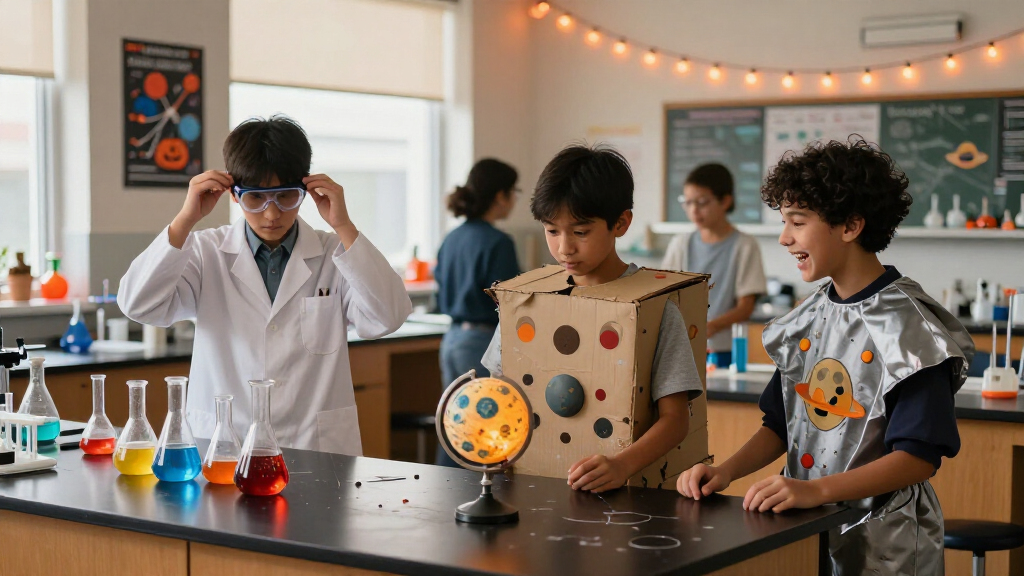
Science-themed Halloween costumes turn scientists, cells, space, and scientific phenomena into playful outfits that can spark real conversations. Choose one clear idea, build it with comfortable and reusable materials, add a short fact or simple interactive feature, and check visibility, movement, and fire safety before heading out.
A black sweatshirt, two ribbons, and a handful of paper rungs can turn you into a walking DNA molecule before the trick-or-treat bowl empties. That is the charm of science-themed Halloween costumes: they make a big idea visible, wearable, and easy to ask about.
You can dress as a famous scientist, a neuron, a planet, or a bubbling beaker without buying a full costume kit. The most successful designs balance one clear visual idea, comfort, and a bit of scientific accuracy. A homemade atom that stays intact for the school parade beats a spectacular outfit that blocks your view.
This guide covers ideas for kids and adults, simple ways to build a costume from household or thrifted materials, and safety checks that matter after dark. You will also find tips for making your outfit educational without turning Halloween into a pop quiz.
Choose one recognizable idea, such as a DNA ladder, planet ring, neuron, or lab coat.
Use clothing you already own and lightweight materials such as felt, ribbon, and clean packaging.
Add one short, accurate fact so the costume can start a conversation without becoming a lecture.
Test walking, sitting, reaching, and visibility before wearing the outfit outside.
Treat representation and scientific accuracy as part of the design, not just decoration.
Choose a science costume people can recognize at a glance
Science-themed Halloween costumes work best when you can identify the idea in a few seconds from across a room. A lab coat and safety goggles signal a scientist, while colored strands twisted into a ladder suggest DNA; one strong visual cue gives people an opening to ask questions.
Start with a subject you already enjoy, then pick a shape, color, or prop that makes it legible. For example, a child who loves astronomy could wear a dark shirt with a bright cardboard Saturn ring, while a biology student could pin paper cell parts onto a plain jacket. The outfit does not need a dozen details; it needs the right detail. That choice matters because viewers have only a moment to recognize the idea, especially in a crowded party or dimly lit street. Extra decoration can add personality, but too many competing symbols make the central concept harder to read.
Popular options include famous scientists such as Marie Curie and Albert Einstein, plus atoms, neurons, rockets, planets, chemical beakers, and black holes. A costume inspired by a scientist can also open a useful conversation about their work, rather than relying only on a wild hairstyle or a prop. Choose a person whose contributions you can describe respectfully and accurately. A little research helps avoid reducing a real person to a familiar look; it also gives the wearer a more meaningful detail to share, such as a discovery, field, or historical context.
These costumes often blend entertainment with learning, but the explanation can stay delightfully short. Try a card that says, “A neuron sends messages through the nervous system,” or “Saturn’s rings are made mostly of ice and rock.” At a party, that little caption can turn a glowing outfit into a friendly conversation instead of a guessing game. Keep the fact simple enough to remember and accurate enough to hold up to a follow-up question; the goal is to invite curiosity, not to cover the whole subject.
As an affiliate, we earn on qualifying purchases.
Compare five ideas by effort, comfort, and visual impact
The easiest way to choose among science-themed Halloween costumes is to compare how much work each takes, how comfortably you can wear it, and whether the idea reads clearly in dim light. A simple outfit can look striking if you give it one bright color or an oversized shape.
| Costume idea | Effort | Comfort tip | Standout detail |
|---|---|---|---|
| Lab scientist | Low | Wear a regular shirt under the coat | Goggles and a labeled notebook |
| DNA molecule | Medium | Attach lightweight ribbons to a shirt | A twisted ladder of colored rungs |
| Planet or Saturn | Low to medium | Keep the ring narrow and flexible | A bright ring against a dark top |
| Neuron | Medium | Use soft cord or felt, not stiff wire | Branching “dendrites” around the shoulders |
| Rocket | Medium | Leave arms and legs free | Foam fins and a paper flame panel |
Effort is only one part of the decision: a costume can be quick to assemble yet awkward to wear, or take longer while staying comfortable for hours. For instance, a busy parent making a school costume the night before might choose the lab scientist: a borrowed button-up, cardboard name badge, and a notebook can do the job. A maker with a free weekend could build a neuron with felt branches and reflective tape. The extra work pays off only if the wearer can still sit, climb stairs, and use the bathroom easily. If the outfit needs frequent adjustment, its visual impact may not be worth the inconvenience.
Use the table as a starting point, not a ranking. A child who dislikes headwear may enjoy a Saturn shirt more than a planet helmet, and an adult commuting to a party may want something that packs flat. Consider where and how long the costume will be worn: a bulky feature may work for a short indoor event but become tiring on a walk around the neighborhood. Comfort and recognition are practical design features, not afterthoughts. Choosing the right tradeoff means preserving the detail that communicates the idea while simplifying anything that interferes with movement, visibility, or the wearer’s enjoyment.
kids science themed Halloween costume
As an affiliate, we earn on qualifying purchases.
As an affiliate, we earn on qualifying purchases.
Make a DIY costume with household materials in five steps
To make an easy science costume, choose one idea, gather a comfortable base layer, add lightweight shapes, label the concept, and test the outfit before Halloween. This five-step process keeps a creative project manageable and helps you avoid a last-minute costume that looks good on a hanger but falls apart outside.
- Pick one concept. Choose a DNA strand, planet, scientist, or rocket that you can explain in one sentence.
- Check your closet. Start with a dark shirt, old white button-up, or plain dress instead of buying a new outfit.
- Build the main shape. Use paper, felt, ribbon, or clean packaging; favor soft materials that bend with you.
- Add one fact. Attach a small card or label with a short, accurate explanation.
- Do a movement test. Walk, sit, reach, and turn your head while wearing the finished costume.
Imagine making a DNA costume with a black shirt and two lengths of colored ribbon. Pin the ribbons in a gentle twist, then add paper rectangles as rungs; no sewing machine or lab equipment required. Keep the decorations light so they do not swing into someone’s face when you turn. The point is to suggest DNA’s ladder-like structure, not reproduce its molecular scale, so a clean, simplified pattern is both easier to wear and easier to recognize.
A DIY costume is a little like a science model: it simplifies reality to show the feature that matters. Your paper DNA ladder will not include molecular detail, and it does not need to. Clear, comfortable, and recognizable beats elaborate but fragile. Each added piece brings a small tradeoff: more detail may improve the resemblance, but it can also add weight, snagging points, or time spent repairing the costume. If you add battery-powered lights, secure the battery pack, keep wires away from feet, and follow the maker’s instructions rather than improvising electrical connections. Test lights before the event so a failed feature does not leave you scrambling or tempt you to make an unsafe repair.
adult science Halloween costume ideas
As an affiliate, we earn on qualifying purchases.
As an affiliate, we earn on qualifying purchases.
Add a fact that sparks curiosity without slowing the party
A science costume becomes more educational when you pair its visual design with one accurate fact the wearer can share in a sentence. A label, small sign, or simple prop gives people a natural reason to ask what the costume represents, without making the wearer deliver a lecture.
For a neuron outfit, add a tag that says, “Neurons carry messages around your body.” For a black-hole costume, a dark circle and a caption about gravity give the idea a starting point; avoid claiming that a black hole is simply a space vacuum cleaner. Short explanations should be memorable, but they should not trade accuracy for a dramatic punchline. A good fact is specific enough to teach something and simple enough to say while greeting guests or walking between houses.
This is where themed Halloween costumes can blend entertainment with learning. A child dressed as a planet might carry a card with its name and one fact, while an adult dressed as Marie Curie could include a book title or a note about her scientific work. Specific details help make representation meaningful instead of reducing a scientist to a costume stereotype. They also give the wearer a choice: share the fact when someone asks, or let the costume stand on its own when conversation feels tiring.
Try an interactive touch only if it is easy to manage. A paper “quiz” with one question, such as “Which planet has the most prominent rings?” can invite conversation; a small LED light can make a star costume glow. Keep the interaction optional, especially for young children who may be shy or tired after a long evening. Interactivity can make an idea memorable, but it also adds demands: props can be dropped, questions can interrupt play, and lights need safe batteries and secure wiring. If the feature complicates movement or comfort, a simple label may do the educational work better.
As an affiliate, we earn on qualifying purchases.
Reuse materials without sacrificing comfort or safety
You can make a science costume more sustainable by starting with clothing you own, borrowing props, and turning clean household packaging into decorations. Reuse does not mean using every scrap you find: the best materials are lightweight, secure, and comfortable against skin. Reusing something already on hand can reduce new purchases, but only if the material suits the design and can be attached safely; a sturdy-looking box, for example, may be too rigid or cumbersome for a child to wear.
A family could build a rocket from a cereal box panel, foil from a clean wrapper, and felt fins left over from a craft project. Attach decorations to a sweatshirt rather than building a rigid shell around the child. That choice cuts down on single-use supplies and leaves room for climbing steps or holding a treat bag. It also makes the costume easier to remove if the wearer gets hot or tired—a practical advantage that can matter more over an evening than a more elaborate silhouette.
Before wearing the outfit, check that it does not drag, catch on door handles, or block a clear view. Choose non-toxic paints and adhesives suitable for the material, and keep small pieces away from children who may put them in their mouths. Avoid open flames and follow product directions for any battery-powered lights or accessories. Materials that seem harmless on a craft table can behave differently when worn: loose cords may snag, heavy decorations can pull fabric out of place, and paint may irritate skin if it is not intended for that use.
Safety test: If the wearer cannot see clearly, move freely, or take the costume off without help, simplify the design before going out.
For trick-or-treating after sunset, add reflective tape or a bright accessory that does not hide the costume’s main feature. A dark “black hole” outfit can still be visible with reflective stars on the sleeves and a flashlight carried by an adult. Visibility matters more than perfect realism when you are walking near driveways and street crossings. Reflective details may be less dramatic in a photo, but they help drivers notice the wearer; this is a worthwhile tradeoff when the costume will be outdoors after dark.
Find inspiration while keeping your costume original
You can find science costume inspiration in museum activities, maker blogs, educational websites, and craft communities, then adapt one idea to the materials and time you actually have. Online examples are useful for seeing how a shape works, but your own closet may offer a simpler, sturdier solution. Treat an inspiration image as a starting point rather than a specification: recreating every detail can add cost and complexity without making the central idea any clearer.
For example, a museum activity might show a colorful solar system display. You could turn that into a wearable costume with a dark shirt, felt planets, and a paper Saturn ring rather than copying a bulky hanging model. A maker tutorial may show LEDs; if you do not have time to test lights safely, use reflective paper or bright fabric instead. This is a useful design tradeoff: the glowing effect may be eye-catching, but a non-electrical version is easier to assemble, repair, and wear without managing batteries or wires.
Popular culture can inspire science fiction looks, while real discoveries such as gene editing or quantum physics may spark curiosity about scientific phenomena. If you borrow a film or television reference, make clear whether your costume represents real science or fiction. That small distinction keeps a fun idea from accidentally teaching a misleading fact. A fictional design can still prompt a real conversation, as long as the wearer does not present a dramatic effect as established science.
Representation also shapes which ideas feel welcoming. A scientist costume can celebrate a range of people and fields, including women and scientists from different backgrounds, without treating any one person as a prop. Pick a figure whose story interests you, learn one concrete contribution, and share it when someone asks. Curiosity is the best accessory: it fits every size, costs nothing, and travels well from a classroom party to a neighborhood doorstep. The extra context takes only a little preparation, but it can shift the costume from an imitation of someone’s appearance to a celebration of what they did and why it mattered.
Frequently Asked Questions
What is an easy DIY science-themed Halloween costume?
A lab scientist is one of the easiest: wear a white shirt or borrowed lab coat, add a cardboard name badge, and carry a notebook. A DNA costume is another simple option using a dark shirt, colored ribbon, and paper rungs. Choose materials that stay secure when you move.
What science costumes work well for kids?
Planets, rockets, cells, neurons, and friendly scientist outfits can all work for children. Keep the design lightweight and easy to move in; a Saturn ring attached to a shirt is often easier than a large headpiece. Add one short fact the child can share if they want.
How can I make a science costume educational?
Pair one recognizable shape with a short, accurate explanation. A neuron costume could carry a card saying it helps send messages through the nervous system, while a planet outfit could name the planet and share one fact. One useful sentence is usually more memorable than a paragraph of text.
How can I make a science costume more sustainable?
Start with clothes you own or can borrow, then use clean packaging, leftover craft supplies, or thrifted fabric for decorations. Reusing materials works best when the finished outfit remains comfortable and secure. Skip anything sharp, heavy, or likely to snag.
What safety checks should I do before trick-or-treating?
Check that the costume does not block vision, drag on the ground, or restrict movement. Use non-toxic paints and adhesives, keep small parts away from young children, and add reflective details for nighttime visibility. If the outfit includes lights, secure the battery pack and follow the product instructions.
Conclusion
Choose a science idea you enjoy, make its main feature easy to recognize, and build the costume around comfort, visibility, and one good fact. You do not need a glowing helmet or a lab full of supplies; a thrifted shirt, a bright paper planet, and a curious question can be enough.
When the porch light catches your costume, let it do more than look clever. Give someone a reason to ask, “What are you?”—then send them home with a small spark of science.
Halloween Picks
halloween
As an affiliate, we earn on qualifying purchases.