
TL;DR

Prime made for students and young adults
- Fast, free delivery for dorm and study essentials
- Prime Video and Amazon Music included
- Member-only deals
Newly discovered mathematical texts from a Maya archaeological site in Guatemala confirm the existence of an ancient Maya astronomer. This finding sheds light on Maya scientific knowledge and practices. The discovery is confirmed, but full details about the astronomer’s identity remain unclear.
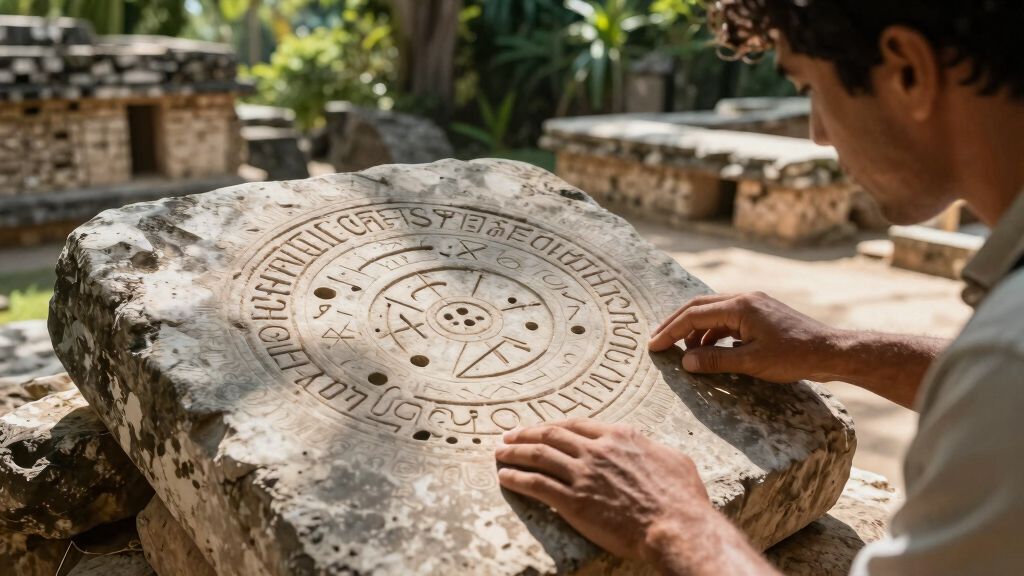
Researchers have confirmed that mathematical texts excavated from a Maya archaeological site in Guatemala identify an individual as an ancient Maya astronomer. This discovery provides direct evidence of advanced astronomical knowledge among the Maya civilization, which is significant for understanding their scientific and cultural history. The identification is based on newly analyzed inscriptions and mathematical records, marking a major development in Mesoamerican archaeology.
The texts, found at a site called Kaminaljuyu, include complex mathematical calculations and coded references to celestial events. Experts from the Guatemalan Institute of Archaeology and the University of San Carlos analyzed the inscriptions and identified a figure named in the texts as an astronomer, referred to through glyphs that translate to ‘sky watcher’ or ‘celestial observer.’
According to Dr. Maria Lopez, lead researcher, ‘The mathematical records include astronomical cycles and precise calculations that could only have been performed by someone with specialized knowledge.’ The texts date back to approximately 700 CE, during the Classic Maya period. The identification of an individual as an astronomer is based on contextual analysis of the inscriptions alongside the mathematical content.
While the texts confirm the presence of a dedicated astronomer figure, the specific identity—such as a known historical figure or a general title—is still under investigation. Researchers emphasize that this is the first direct textual evidence linking an individual to astronomical expertise in the Maya civilization.
Implications for Understanding Maya Scientific Knowledge
This discovery challenges previous assumptions that Maya astronomy was solely practiced by anonymous groups or priestly classes. The identification of a specific individual as an astronomer indicates a more specialized and possibly professional scientific role within Maya society. It also suggests that Maya astronomical practices were highly developed, with precise calculations that could inform agricultural, religious, and political decisions.
The finding enriches our understanding of Maya intellectual achievements and highlights the complexity of their scientific traditions. It may also influence how archaeologists interpret other inscriptions and mathematical records across Mesoamerican sites, potentially revealing more individual practitioners of science and astronomy.
astronomy educational kit for kids
As an affiliate, we earn on qualifying purchases.
As an affiliate, we earn on qualifying purchases.
Previous Evidence of Maya Astronomy and Mathematical Records
Prior to this discovery, evidence of Maya astronomy primarily came from monumental inscriptions, codices, and alignments of temples and pyramids, which suggested sophisticated celestial knowledge. However, there was little direct textual evidence linking specific individuals to these practices.
Mathematical texts and astronomical tables have been found at other sites, such as Copán and Palenque, but they lacked clear references to individual practitioners. The recent discovery at Kaminaljuyu represents a shift toward understanding the social and personal dimensions of Maya science, providing the first textual proof of an individual identified explicitly as an astronomer.
Historically, scholars have debated whether Maya astronomy was the work of specialized experts or a collective cultural effort. This new evidence suggests the former, indicating a level of individual specialization previously unconfirmed.
“The mathematical records include astronomical cycles and precise calculations that could only have been performed by someone with specialized knowledge.”
— Dr. Maria Lopez
As an affiliate, we earn on qualifying purchases.
Remaining Questions About the Astronomer’s Identity
While the texts confirm the existence of an individual identified as an astronomer, their specific identity remains unknown. It is unclear whether this person was a prominent figure, a priest, or a specialized scientist within Maya society. Further analysis of the inscriptions may clarify this in the future.
Additionally, the full extent of the astronomer’s work and influence is still being studied. Researchers are cautious about overgeneralizing from this single find and emphasize the need for more contextual evidence.
As an affiliate, we earn on qualifying purchases.
Future Research to Clarify the Astronomer’s Role
Scientists plan to conduct further excavations at Kaminaljuyu and other Maya sites to uncover additional texts and inscriptions. These efforts aim to identify more individuals associated with scientific and astronomical practices and to understand their societal roles better.
Analyses of the mathematical content and cross-referencing with other archaeological finds are expected to provide more insights into the scope of Maya astronomy and individual expertise. The team also intends to publish detailed translations and interpretations of the inscriptions in upcoming academic journals.
As an affiliate, we earn on qualifying purchases.
Key Questions
What is the significance of this discovery?
This is the first direct textual evidence linking an individual to Maya astronomy, indicating specialized scientific roles and advancing our understanding of Maya intellectual achievements.
How was the astronomer identified in the texts?
Researchers analyzed the inscriptions and mathematical records, which included references to celestial cycles and calculations, and identified a glyph sequence referring to an individual as a ‘sky watcher.’
Does this mean the Maya had professional astronomers?
The evidence suggests the presence of specialized practitioners, but whether they were professional or priestly figures remains under investigation.
When will more information about the astronomer be available?
Further excavations and analyses are planned, with detailed publications expected within the next year or two.
Why is this discovery important for understanding Maya culture?
It demonstrates that Maya society included individuals with recognized scientific expertise, challenging previous views of their knowledge as primarily religious or communal.
Source: hn
Halloween Picks
halloween
As an affiliate, we earn on qualifying purchases.