This checklist is for teachers, science departments, and homeschool educators planning hands-on classroom demonstrations. It covers models and kits for molecular structures, human anatomy, geology, mechanics, and microscopy, plus guidance for choosing an astronomy globe. Match each pick to your lessons and the students who will use it.

Prime made for students and young adults
- Fast, free delivery for dorm and study essentials
- Prime Video and Amazon Music included
- Member-only deals
The sections follow the requested classroom topics. Each product pick includes practical considerations for choosing, fitting, and using the item; the astronomy section offers selection advice because no product was specified. Check the product details for included parts, dimensions, and compatibility before purchasing.
Use the look-for lists to compare options, then consider storage, setup time, handling, and how students will share each demonstration. A checklist is a starting point: confirm classroom needs against the curriculum and the available space and equipment.
Molecular Model Kit
A molecular model kit can help students handle and inspect representations of atoms and bonds during lessons. The Happy Atoms Magnetic Molecular Modeling Educator Bundle, 250 Atoms, is the listed pick for this slot. Before choosing it, think through the structures students will build and whether the pieces support the activities you have planned. Check the included components and any guidance about the models they can assemble.
A common buying mistake is assuming that a large atom count automatically suits every classroom. Consider how many students will work at once, how kits will be shared, and whether the pieces can be sorted and stored between lessons. Confirm the kit’s physical dimensions and the recommended age or classroom use in the product information. Plan for storage and handling, especially if students will repeatedly assemble and take apart models.
For a class set or shared demonstration, verify whether one bundle meets your group-size needs and whether additional pieces or kits are needed. Check compatibility with any existing model pieces rather than assuming components from different systems connect. Review the component details before combining kits.
What to look for:
- Atom and bond piece count and types
- Structures supported by the included pieces
- Product dimensions and storage needs
- Age and classroom-use guidance
- Compatibility with existing model components
Happy Atoms Magnetic Molecular Modeling Educator Bundle, 250 Atoms

This chemistry modeling set includes 250 magnetic atoms representing 16 elements, along with scanning mats, quick-start manuals, and a storage bin. Use the free iOS and Android app to scan models, identify molecules, and explore their formulas, properties, uses, and hazards through guided activities.
Pros:
- Hands-on magnetic models make molecular structures tangible.
- App scans models and provides information about molecules.
- Includes 250 atoms across 16 elements.
- Bundle includes five scanning mats and five quick-start manuals.
Cons:
- Device requirements for the app are not specified in the product details.
- The app provides in-depth information for only 150 of the molecules it recognizes.
Best for: Lessons where students build and inspect molecular representations
Not ideal for: Classrooms needing confirmed compatibility with another model system
Bottom line: Check the included pieces and classroom handling needs before selecting this 250-atom bundle.
Human Anatomy Model
A torso model gives a class a physical reference for discussing anatomy and the placement of removable parts. The listed pick is the SFXYJ Human Torso Anatomy Model 33.4″ Dual-Sex, 32 Part Removable Life. Before choosing it, consider what students need to observe, how the model will be presented, and whether its removable components suit the lesson. Confirm which parts are included and how they are identified in the product details.
One common mistake is overlooking the model’s footprint. Check the stated height and base dimensions against your display surface, storage shelf, and classroom pathways. Make sure students can see the model from their seats and that there is room to handle parts without crowding. Measure the intended location before ordering, and confirm whether the model requires assembly or special care.
Removable pieces can be useful for demonstrations, but plan how they will be organized and returned after use. Review the product information for the included parts and any age or handling guidance. If students will work in groups, consider how the model will be shared and whether your lesson needs more than one. Plan for part tracking so components remain together between classes.
What to look for:
- Overall height, base size, and display footprint
- List of included removable parts
- How parts are labeled or identified
- Assembly and care guidance
- Storage and classroom sharing needs
SFXYJ Human Torso Anatomy Model 33.4" Dual-Sex, 32 Part Removable Life-Size with
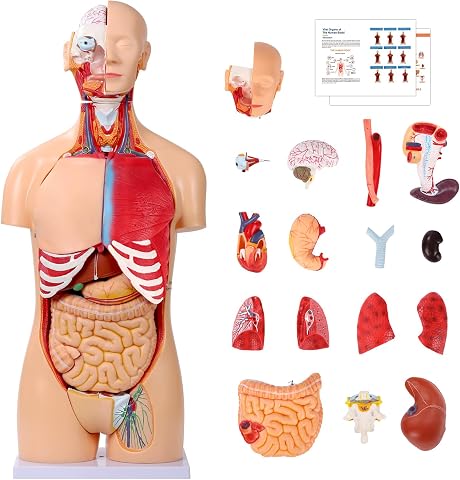
This life-size human torso anatomy model features 32 removable parts, including interchangeable male and female genitalia, ideal for medical students and educational purposes. Made of durable PVC with realistic flexible components, it provides a comprehensive view of human body systems for study and display.
Pros:
- Detailed and comprehensive anatomy model suitable for medical education
- Interchangeable male and female genital parts for versatile study
- Durable construction with realistic flexible components
Cons:
- Assembly of multiple parts may be challenging for beginners
- Relatively heavy at 22 pounds, less portable for some users
- Limited to indoor classroom or display use
Best for: Lessons that benefit from a removable-part torso model
Not ideal for: Spaces without room to display or store a full-size model
Bottom line: Check the dimensions and included parts against your display space and lesson plan.
Geology Rock Set
A geology set can support demonstrations that involve examining rocks and using tools. The listed pick, Geology Rock Pick Hammer Kit – 25PCS Complete Geology Set with Chisels, includes a stated count of 25 pieces, but confirm the exact contents in the product listing. Review the tool inventory and decide which items are appropriate for your students and planned activities.
A common mistake is treating a tool kit as ready for unrestricted student use. Check the product’s age and safety guidance, and establish classroom rules for handling any hammer or chisel. Consider who will supervise the demonstration, where it will take place, and how the pieces will be secured when not in use. Plan supervision and storage before bringing tools into a classroom activity.
Check the dimensions and materials of the tools, and confirm whether the set includes a case or another way to keep components together. For group lessons, decide whether students will observe a teacher demonstration or take turns handling tools. Match the set to the rocks and activities in your curriculum rather than assuming every included item is needed. Choose activities around verified contents and your classroom procedures.
What to look for:
- Exact inventory of the 25 pieces
- Tool dimensions and materials
- Age and handling guidance
- Storage case or organization details
- Suitability for planned supervised activities
Geology Rock Pick Hammer Kit – 25PCS Complete Geology Set with Chisels, Shovel,
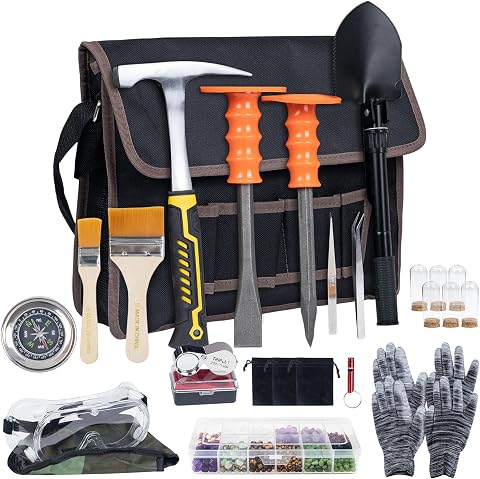
This 25-piece geology kit includes tools such as a durable steel hammer, chisels, folding shovel, magnifier, compass, and safety gear, making it ideal for outdoor rock hounding, gold panning, and fossil hunting. The set is portable with an organized carrying bag, suitable for hobbyists and professionals alike.
Pros:
- Comprehensive 25-piece set for various outdoor geology activities
- Durable steel hammer with ergonomic grip for reliable use
- Includes safety gear and storage bag for convenience and safety
Cons:
- Some users may find the tools heavy for extended use
- Limited customer reviews available for overall durability
- No specific information on tool sizes or material quality
Best for: Supervised geology demonstrations using listed tools
Not ideal for: Activities that cannot accommodate tool-handling procedures
Bottom line: Verify the kit contents and set clear supervision and storage plans before use.
Astronomy Globe
No product was specified for this slot, so choose an astronomy globe based on the concepts your class will study. Identify whether you need a celestial globe, a globe focused on a particular body, or another kind of astronomy teaching aid; product names alone may not make that distinction clear. Start with the lesson objective, then confirm the globe’s subject and labeling in its product description.
Check the globe’s dimensions, stand, and display requirements against your classroom space. Consider whether students need to rotate it or read its labels from nearby, and whether the surface includes the details relevant to your lessons. A frequent buying mistake is choosing a display piece without checking readability or the information shown. Inspect the labels and scale in product images and specifications before deciding.
Also review how the globe is assembled, stored, and cared for, and whether it needs any companion materials for the activities you have in mind. If the globe is intended for group use, plan where it will sit so students can see it without handling it unsafely. Compare features to your curriculum and select a product only after confirming its subject, labeling, and practical fit.
What to look for:
- Type of globe and celestial subject
- Labels and details relevant to lessons
- Dimensions and stand requirements
- Visibility for the intended group size
- Assembly, storage, and care information
Physics Demonstration Kit
A mechanics demonstration kit can give students a way to observe forces and related equipment in a lesson. The listed pick is the Physics Mechanics Kit with Pulley, Balance, Force Gauge, 26 Experiment. Confirm the included apparatus and what the stated experiment count refers to before choosing it. Check the full contents against the demonstrations you expect to teach.
A common buying mistake is assuming that every kit supports the same activities or classroom setup. Review the product information for dimensions, assembly needs, and any additional equipment required. Consider whether the items will be used at a teacher station or shared among student groups, and check that your available surfaces can accommodate the demonstrations. Plan the setup and sharing before selecting a kit for a particular class size.
Inspect guidance for using the pulley, balance, and force gauge, including any age or handling recommendations. Verify whether instructions are included and whether the experiment descriptions match your curriculum. If you already own mechanics equipment, check dimensions and compatibility rather than assuming the pieces work together. Confirm the instructions and apparatus from the product details.
What to look for:
- Exact apparatus included in the kit
- Meaning and contents of the 26 experiments
- Setup instructions and additional equipment needs
- Dimensions and group-use suitability
- Age, handling, and compatibility guidance
Physics Mechanics Kit with Pulley, Balance, Force Gauge, 26 Experiments

This comprehensive physics mechanics lab kit includes tools like a tray balance, pulleys, lever ruler, pressure gauge, spring dynamometer, trolley, and ramp. Designed for hands-on exploration of Newton’s Laws, kinematics, gravity, and simple machines, it is ideal for middle and high school students to enhance understanding of classical mechanics through practical experiments.
Pros:
- Includes a variety of tools for comprehensive mechanics experiments
- Supports hands-on learning of fundamental physics concepts
- Durable and portable design suitable for classroom and family use
- Detailed manual with operation steps and principles
Cons:
- Limited to 26 experiments, may not cover advanced topics
- Requires supervision for younger students due to small parts
- No specific price information available
Best for: Lessons featuring pulleys, balance, and force measurement
Not ideal for: Classrooms needing confirmed compatibility with existing apparatus
Bottom line: Verify the apparatus, instructions, and setup needs against your planned experiments.
Microscope Slide Set
The listed microscope pick is the Microscope for Adults & Kids, 40-2500X Binocular Microscope for School. Its name describes a microscope rather than a slide set, so check the product listing carefully to confirm whether slides are included. Verify the item type and the exact contents before choosing it for a slide-based lesson.
A common buying mistake is relying on a magnification range alone to decide whether a microscope fits classroom work. Review the product specifications for objectives, eyepieces, focusing controls, lighting, stage dimensions, and any slides or accessories. Confirm whether the stated magnification levels are usable with the included optics and whether the instrument suits the age and handling needs of your students. Check the complete optical setup rather than the headline range by itself.
Consider the microscope’s size, power requirements, storage, and how students will take turns using it. If you need prepared slides, confirm their type and quantity separately unless the listing explicitly includes them. Check compatibility with any accessories or slides already in the classroom. Plan for slides and sharing so the equipment supports the lesson as intended.
What to look for:
- Whether prepared slides are included
- Optical components and usable magnification details
- Lighting, focusing controls, and stage dimensions
- Power, storage, and handling requirements
- Compatibility with classroom slides or accessories
Microscope for Adults & Kids, 40-2500X Binocular Microscope for School Lab & Hom

This binocular microscope offers up to 2500X magnification with dual illumination and a rotating filter wheel, making it suitable for educational and professional use. It features adjustable focus, ergonomic design, and accessories like slides and a phone holder for versatile observation.
Pros:
- High magnification range up to 2500X suitable for detailed observation
- Dual illumination system enhances viewing of opaque and translucent specimens
- Ergonomic design with adjustable focus and shared viewing features
- Includes accessories like slides, phone holder, and filters for versatile use
Cons:
- Relatively heavy at 2.27 kg, may be less portable
- Requires USB power, limiting outdoor or battery-only use
- Complex setup may be challenging for beginners
Best for: Classes needing a binocular microscope for slide observations
Not ideal for: Buyers specifically seeking a confirmed slide set
Bottom line: Confirm whether slides are included and review the full optical and classroom setup.
When ordering with a limited classroom budget, prioritize the items that directly support upcoming lessons and can be used safely with your available space and supervision. Check the component lists, dimensions, and any required companion equipment first; then add broader or specialized demonstrations as your curriculum calls for them. Start with the next lessons and build from there.
These picks and checks can help you compare options with a clear classroom purpose in mind. Read the product details closely, plan how students will share and store each item, and choose the equipment that fits your teaching approach. A thoughtful checklist makes planning easier and helps each demonstration feel purposeful.
Evergreen bestsellers Picks

Dyson Cyclone V10 Origin Cordless Vacuum

Bose QuietComfort Headphones (2nd Gen), Wireless Noise-Cancelling Over-Ear Headphones, Black

Vitamix VX1 Professional-Grade Blender, 64 oz, Black
As an affiliate, we earn on qualifying purchases.