
TL;DR

Prime made for students and young adults
- Fast, free delivery for dorm and study essentials
- Prime Video and Amazon Music included
- Member-only deals
NASA’s Astronomy Picture of the Day for Oct. 26, 2026, features a deep image of M42, the Great Nebula in Orion. NASA describes it as a star-forming region about 1,500 light-years away, with young stars, gas, dust, stellar jets and the Trapezium cluster.
NASA’s Astronomy Picture of the Day for Oct. 26, 2026, features a deep image of M42, the Great Nebula in Orion, a nearby region where stars are forming. The image highlights glowing gas and fine structures of dust around young stars, drawing attention to a stellar nursery about 1,500 light-years from Earth.
NASA’s accompanying description says the nebula lies at the edge of a large interstellar molecular cloud. The featured image uses assigned colors, with emission from hydrogen highlighted; NASA notes that this presentation makes wisps and sheets of gas and dust particularly evident. The image is credited to Roberto Palaia.
The Orion Nebula contains the bright open star cluster known as the Trapezium, as well as many stellar nurseries. NASA’s description identifies hydrogen gas, hot young stars, proplyds and stellar jets among the features found there. Proplyds are young planetary systems in formation, while the jets carry material away from young stars at high speeds.
NASA gives the nebula’s span as about 40 light-years and places it in the same spiral arm of the Milky Way as the Sun. It can be seen with the unaided eye near Orion’s easily recognized belt of three stars, though the detailed structures shown in the featured deep image require more than naked-eye viewing.
A Nearby View of Star Formation
M42 offers a relatively close view of star formation in progress. Its young stars, surrounding gas and dust, and stellar jets provide a setting in which astronomers can study how stars emerge from molecular clouds and interact with the material around them. NASA’s daily image brings those structures to a broad audience through a single, processed view.
The nebula’s proximity—about 1,500 light-years away—and visibility from Earth help explain its prominence in astronomy. The image is not a new discovery or a report of a newly observed event; it is a public-facing feature that emphasizes the nebula’s structure and star-forming activity. The assigned colors help distinguish emissions and structures in the image, but should not be read as a direct view of how the nebula would appear to the unaided eye.
Popular right now

KitchenAid Artisan 5-Quart Tilt-Head Stand Mixer, Almond Cream

De’Longhi Classic Matte Black Espresso Machine with Milk Frother

Dyson Ball Animal 3 Extra Upright Vacuum
As an affiliate, we earn on qualifying purchases.
From Orion’s Belt to M42
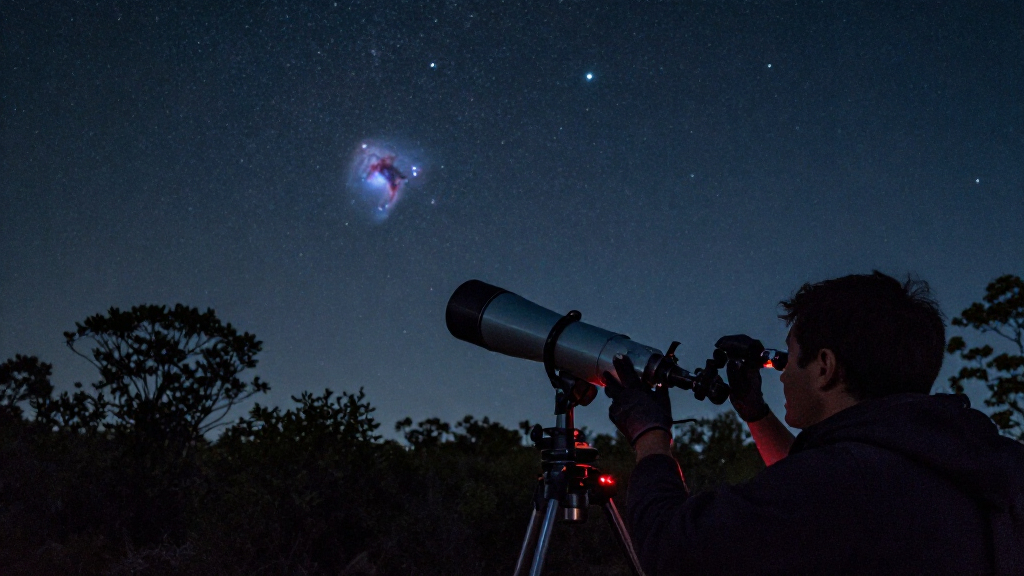
The Orion Nebula is also cataloged as M42 and is located in the constellation Orion, close in the sky to the three stars that form the hunter’s belt. NASA says it is visible without a telescope, while details such as sheets of dust, proplyds and jets are more apparent in deep astronomical images.
The Oct. 26 feature appears in NASA’s Astronomy Picture of the Day (APOD), a service that presents a different space image or photograph each day with an explanation written by a professional astronomer. NASA lists Robert Nemiroff, Jerry Bonnell, Cecilia Chirenti and Keighley Rockcliffe as authors and editors of the entry. The supplied material describes the image and the nebula; it does not report a new observation campaign or a change in scientific understanding.
What the Image Does Not Establish
The NASA entry is an image feature, not a report of newly measured properties. Its supplied text does not identify the telescope or instrument used to capture the featured image, give an observation date, or provide technical details about exposure and processing. It also does not announce new findings about the nebula’s stars or their formation.
The image uses assigned colors, but the description does not provide a full color key or specify what wavelengths or filters correspond to each color. Readers should treat the visual appearance as an astronomical representation designed to highlight structures, not as a literal color photograph of what a person would see from nearby. NASA’s entry also does not detail the individual objects or jets shown in the image.
NASA’s Next Daily Image
NASA’s APOD listing points readers to a new feature for Oct. 27, 2026, with the teaser “open space.” The supplied entry does not provide further details about that image. For M42, the Oct. 26 page serves as the current publication, with the image credit and explanatory description available through NASA Science.
Key Questions
What is M42?
M42 is the Orion Nebula, also called the Great Nebula in Orion. NASA describes it as a nearby star-forming region containing young stars, gas, dust and stellar jets.
How far away is the Orion Nebula?
NASA’s Oct. 26, 2026, description places it about 1,500 light-years from Earth.
Can the Orion Nebula be seen without a telescope?
Yes. NASA says it can be found with the unaided eye near Orion’s belt. The detailed gas and dust structures in the featured deep image are not equivalent to what the naked eye reveals.
What is the Trapezium?
The Trapezium is a bright open cluster of stars within the Orion Nebula, according to NASA’s description.
Does the Oct. 26 feature announce a new discovery?
No new discovery is reported in the supplied NASA entry. It is an Astronomy Picture of the Day feature presenting an image and an explanation of established features of M42.
Source: science.nasa.gov